By Deimantas Steponavicius
Methodology Note
This analysis draws on two distinct evidentiary tiers, and the distinction matters enough to state plainly rather than blend.
Tier 1 — Open-source doctrinal literature. Independently verifiable and available to any researcher. This includes the 2020 revision of 《战略学》 (The Science of Military Strategy), published by the Academy of Military Science, whose treatment of multi-domain integrated joint operations and the cognitive domain has been documented in detail by Western PLA-watchers including Jamestown’s China Brief. It also includes PLA Daily’s own AMS-authored writing on cognitive domain operations (认知域作战) — notably the June 2022 article “混合战争视野下的认知域作战” (Cognitive Domain Operations from the Perspective of Hybrid Warfare) — along with the documented vocabulary of 制脑权 (“mind superiority” / cognitive dominance) and the Three Warfares (三战) framework formalized in 2003. Where this essay’s claims rest on Tier 1 material, they can be checked against the cited public record.
Tier 2 — Privileged source characterization. Certain specific formulations in this essay — including named internal AMS training texts, the precise “不能、不敢、不想” (cannot, dare not, do not want to) operational formula, and terminology such as 信念体系 (“belief architecture”) and 决策退化 (“decision-making degradation”) — were relayed to me by a source with direct professional access to PLA-affiliated research institutions, at whose request I am not naming the individual, the specific materials, or the channel of access. I have not independently verified these formulations against primary documents I can produce, and I want to be explicit about that limitation rather than imply a level of citability the sourcing does not support. Readers should weigh Tier 2 material as informed characterization from a source I judge credible based on a long-standing professional relationship, not as citable primary-source doctrine.
The synthesis. The “distributed mind” thesis — the argument that the PLA’s cognitive domain is not an interior psychological space but an extended system of platforms, protocols, and institutions — is my own interpretive contribution. It uses Tier 1 material as its documented foundation and Tier 2 material as directional confirmation that this reading is consistent with how PLA-affiliated thinking actually characterizes the problem internally. It should not be read as PLA doctrine restated, nor as established Western consensus. It is offered as a corrective lens, built on what can be shown and disclosed about what cannot.
I. The Western Category Error
Western analysis of Chinese cognitive warfare has been consistent in its misunderstanding. For more than two decades, American and European analysts have examined People’s Liberation Army (PLA) doctrine through categories inherited from their own strategic traditions: information operations, psychological operations, influence activity, strategic communication. These categories organize Western defense establishments. They determine budget lines, command structures, career paths. They also impose a conceptual grid that renders invisible what the PLA actually describes.
The result is a systematic misreading. When Western analysts encounter PLA writing on the cognitive domain (认知域), they translate it into familiar vocabulary. Cognitive domain operations become “advanced PSYOP” or “information operations with a human dimension.” The “three warfares”—public opinion warfare, psychological warfare, legal warfare—are treated as a Chinese branding of activities Western militaries already conduct. The assumption persists that Beijing has recognized what Washington recognized earlier: that warfare extends beyond the kinetic into the informational and psychological. It has simply given it a different name.
This assumption is wrong. The PLA does not use Western categories. It does not regard the cognitive domain as an extension of information warfare, a refinement of psychological operations, or a subspecies of strategic communication. It regards the cognitive domain as a distinct battlespace, governed by its own logic, requiring its own operational concepts, and serving as the ultimate objective of military confrontation rather than its supporting activity. Until Western analysis abandons its inherited categories and engages with PLA conceptual architecture on its own terms, it will continue to analyze the wrong object—and prepare for the wrong conflict.
The distinction can be stated simply. Information warfare operates on the network. Cognitive domain operations operate on the human or human-adjacent endpoints of the network. Information warfare seeks to degrade, disrupt, or exploit the infrastructure through which data flows. Cognitive domain operations seek to alter how human consciousness processes, evaluates, and acts upon that data. The former targets the pipe. The latter targets what the pipe delivers to the mind. This is not a difference of degree. It is a difference of kind. The 2024 split structurally validates my argument: the PLA separated the infrastructure support from the cognitive/political warfare functions because they occupy entirely different registers of the distributed mind.
Western doctrine has struggled to grasp this because its own intellectual history does not contain the necessary architecture. American strategic thought descends from a tradition that separated kinetic and non-kinetic effects, then gradually expanded the non-kinetic category to include information, psychology, perception. The PLA descends from a tradition that treats warfare as a unified system in which physical destruction, information dominance, and cognitive control represent progressive stages of a single strategic logic. The Western framework is additive: new domains are appended to old ones. The PLA framework is evolutionary: new domains subsume and redirect the purpose of those beneath them.
The consequences are not merely academic. They shape intelligence collection priorities, defense procurement, operational planning. An analyst who believes the PLA is conducting “information operations” will look for message content, narrative themes, dissemination channels—evidence of persuasion. An analyst who understands that the PLA is conducting cognitive domain operations will look for how beliefs are anchored, how decision architectures are structured, how populations process reality under stress. The first analyst tracks what is said. The second tracks what makes saying possible. These are different jobs, requiring different tools, producing different warnings.
The following sections examine how the PLA conceptualizes the cognitive domain, how that conceptualization translates into operational doctrine, and what Western defense planning would need to change in order to engage with this framework accurately rather than through the distorting lens of inherited categories.
II. The PLA’s Conceptual Architecture
The PLA’s understanding of the cognitive domain cannot be reconstructed from isolated statements or occasional references in official documents. It emerges from a systematic body of doctrinal writing, institutional training materials, and theoretical treatises produced primarily by the Academy of Military Science (AMS) and affiliated research institutions. These texts are prescriptive, designed to instruct PLA cadres in how to think about warfare’s evolving structure and how to plan operations within it.
The foundational text is the 2020 revision of 《战略学》 (The Science of Military Strategy), published by the Academy of Military Science. Unlike the more widely circulated National Defense University editions, the AMS version is structurally rigorous in its treatment of warfare’s developmental stages. It organizes military history into three successive paradigms: mechanized warfare, informatized warfare, and intelligentized warfare. Each represents not merely a technological shift but a transformation in the locus of strategic advantage. Mechanized warfare destroyed physical bodies. Informatized warfare destroyed networks and nodes. Intelligentized warfare destroys the will and cognitive certainty of the adversary.
This evolutionary framing is crucial. It establishes that the cognitive domain is not a subset of information warfare but its destination. Information dominance is valuable not intrinsically but instrumentally: it creates the conditions under which cognitive effects can be achieved. The network is a means. The human endpoint is the end.
The AMS textbooks 《认知域作战导论》 (Introduction to Cognitive Domain Operations) and 《夺取认知域制高点》 (Seizing the Commanding Heights of the Cognitive Domain), both published by AMS Publishing House, develop this logic at the operational level. These are training manuals for military planners, and they treat cognitive domain operations with a granularity that Western analysts rarely encounter in open-source PLA materials.
The operational vocabulary is revealing. Where Western doctrine speaks of “target audiences,” “message resonance,” “narrative alignment,” the AMS materials speak of “cognitive dominance” (认知主导), “belief architecture” (信念体系), and “decision-making degradation” (决策退化). The objective is not persuasion in any conventional sense. It is the systematic reduction of an adversary’s cognitive capacity until the adversary reaches a state the texts describe with a specific formula: “cannot, dare not, do not want to” (不能、不敢、不想). Each term denotes a distinct operational target. “Cannot” refers to the degradation of material and informational capabilities required for decision. “Dare not” refers to the psychological inhibition produced by perceived cost and risk. “Do not want to” refers to the collapse of will itself—the adversary’s internalization of defeat before defeat occurs.
This operational objective places cognitive domain operations at the apex of PLA strategic theory. The “three warfares”—public opinion warfare (舆论战), psychological warfare (心理战), and legal warfare (法律战)—are not coextensive with cognitive domain operations. They are tactical instruments employed within it. Public opinion warfare shapes the information environment. Psychological warfare targets emotional and cognitive states. Legal warfare constrains adversary options through normative pressure. Each operates on a different register of the cognitive domain, and each serves the overarching strategic purpose of degrading the adversary’s decision-making architecture.
The conceptual architecture thus has a clear hierarchy. At the base: physical domain operations, which create the material conditions of conflict. At the intermediate level: information domain operations, which control the networks through which data flows. At the apex: cognitive domain operations, which determine how that data is processed, understood, and acted upon by human consciousness. The three domains are not parallel. They are nested, with each higher level subsuming and redirecting the purpose of those below.
III. The Distributed Mind: Why the Cognitive Domain Is Not Inside the Skull
The hierarchy presented in the previous section—physical, information, cognitive, each subsuming the level beneath—appears at first glance to describe a vertical structure. The cognitive domain sits at the apex, directing the others. But this reading imports a Western assumption that the PLA architecture does not share. The apex is not above. It is distributed throughout.
Western defense planning commits a Cartesian error. It treats the mind as an isolated castle—an interior space protected by walls of critical thinking, where individuals sit and process incoming information. Consequently, Western counter-influence operations resemble medieval siege defense: intercept the incoming missiles before they cross the walls, or fact-check the arrowheads after they land. The defender imagines a boundary between inside and outside, between the self and the information environment, between cognition and data.
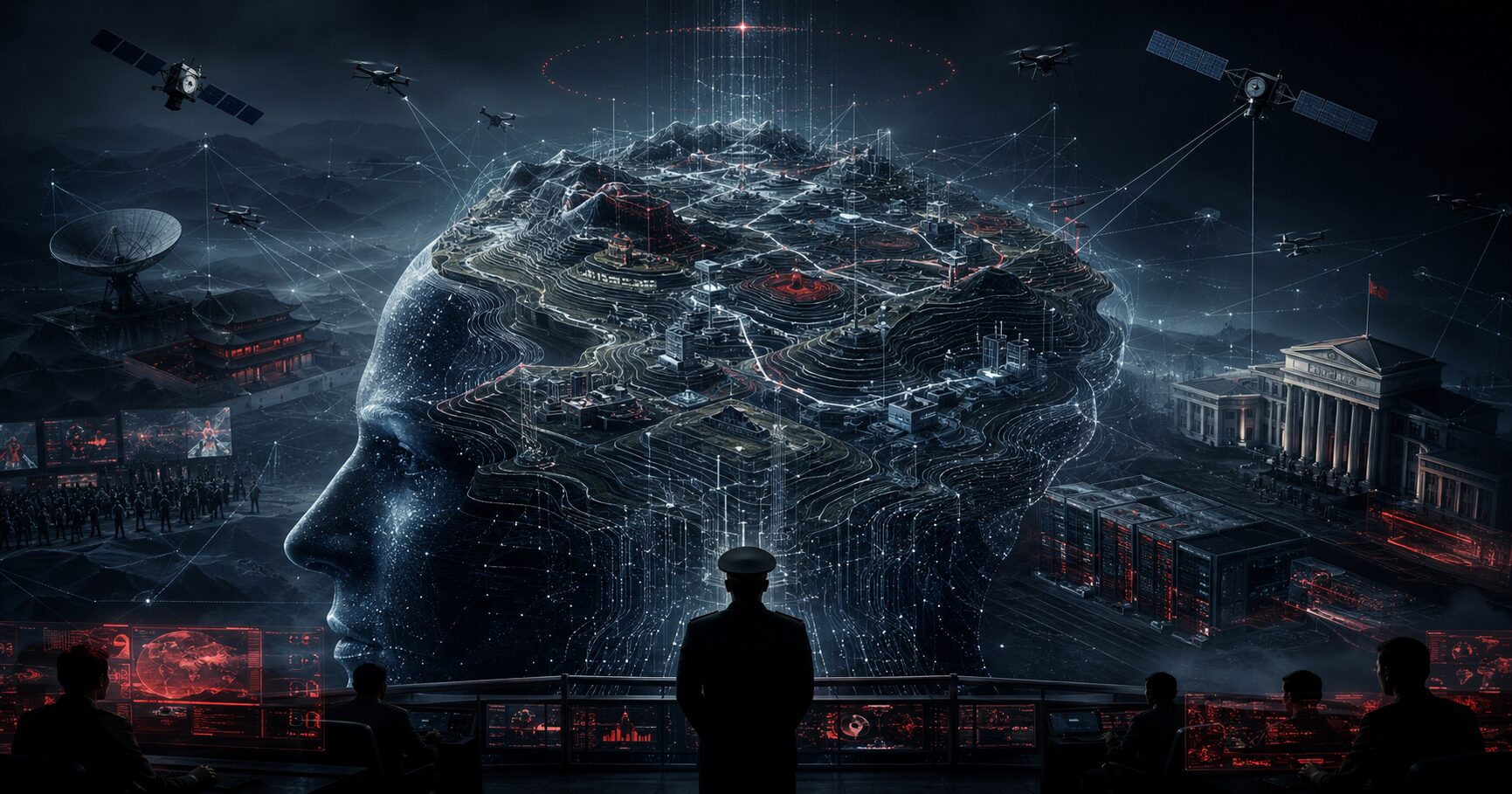
The PLA does not imagine this boundary. In its conceptual architecture, the cognitive domain is not an internal psychological state. It is not inside the skull. It exists in the relationships, tools, linguistic structures, and algorithmic architectures through which human consciousness interacts with reality. The mind extends into the smartphone, the search engine, the professional jargon, the bureaucratic protocol, the institutional feed. These are not channels through which information reaches the mind. They are components of the mind itself. To alter them is to alter cognition—not by persuading the individual, but by restructuring the extended system in which the individual thinks.
This is not philosophical speculation. It is operational doctrine. The AMS materials do not describe cognitive domain operations as attempts to convince adversaries of specific propositions. They describe operations on the scaffolding: the external architecture that populations use to determine what is true, what is possible, what is worth doing. Control the scaffolding, and the mind follows. The target does not change belief because they were persuaded. They change behavior because their external processing tools have become too noisy, too skewed, or too exhausting to navigate otherwise.
The operational implications are precise. If you control algorithmic distribution, you do not need to censor a narrative; you alter the environmental friction required to access it. If you flood the distributed network with specific formats of data, you induce cognitive fatigue at the endpoint; the target’s capacity for independent evaluation degrades not because their will was broken, but because their extended mind was saturated. If you shape the professional jargon and bureaucratic protocols through which institutions process threat, you constrain decision-making before any individual decision-maker has formed an intention.
The “cannot, dare not, do not want to” formula now reveals its full meaning. “Cannot” is achieved not merely by degrading physical and information capabilities, but by disrupting the nodes of the distributed mind—the data streams, the analytical tools, the communication protocols through which organizations think collectively. “Dare not” is achieved not merely by psychological intimidation, but by manipulating the risk-calculation algorithms embedded in institutional software, budget processes, and career incentives. “Do not want to” is achieved not merely by breaking will, but by altering the information ecosystem so thoroughly that the adversary’s mind, operating naturally within that ecosystem, arrives at the conclusion of defeat entirely on its own.
This is why the cognitive domain is not a subset of information warfare. Information warfare operates on the network—the pipes, the nodes, the data flows. Cognitive domain operations operate on the human-adjacent endpoints of the network, which include not merely the biological brain but the entire extended system of cognition: devices, platforms, languages, institutions, algorithms. The network is a means. The distributed mind is the end.
The three domains are therefore not a hierarchy of levels but a hierarchy of extension. Physical domain operations create the material substrate. Information domain operations create the data substrate. Cognitive domain operations create the conditions under which the distributed mind processes that data. Each higher domain does not sit above the others. It permeates them, redirecting their purpose toward cognitive effect. The castle was never the right image. The battlespace is the entire landscape in which the mind is extended—and that landscape can be mapped, occupied, and fortified.
This realization leads directly to the operational question. If the cognitive domain is distributed, how is it operationalized? The answer lies not in abstract theory but in institutional transformation: the organizational shifts that translate distributed cognition into military capability.
IV. From Theory to Doctrine: The Institutional Architecture of Distributed Cognition
If the cognitive domain is distributed—extending through algorithms, platforms, protocols, and institutions—then cognitive domain operations cannot be conducted by a single unit or contained within a single command. They require an institutional architecture capable of coordinating effects across the entire extended system. The PLA’s organizational evolution reflects this understanding. It is not merely bureaucratic restructuring. It is the material embodiment of the distributed mind thesis.
The 2015 military reforms and subsequent organizational adjustments moved the PLA away from service-centric structures toward joint, domain-centric commands. The Strategic Support Force (SSF), established in 2015, initially consolidated space, cyber, electronic, and psychological warfare capabilities. Western analysts frequently described this as an “information warfare” consolidation—a reasonable reading if one assumes the cognitive domain is a subset of information operations. But the subsequent restructuring tells a different story.
The 2024 reorganization that moved beyond traditional SSF structures into specialized, direct-reporting components—including the Information Support Force and relevant political warfare units—represents a more granular institutional response to the distributed cognition framework. The separation of information support from political warfare functions suggests a doctrinal distinction between network operations (the pipes) and cognitive operations (the scaffolding around the endpoints). The former ensures data flows. The latter ensures the data flows in ways that shape the distributed mind.
This institutional architecture reflects the nested relationship described in Section II, but reinterpreted through Section III’s lens. Physical domain operations remain the responsibility of traditional services—Army, Navy, Air Force, Rocket Force. Information domain operations are increasingly centralized under specialized commands that manage network infrastructure, electromagnetic spectrum, and data architecture. Cognitive domain operations, however, cannot be centralized in the same way. They must be distributed across the institutions that shape how populations and decision-makers process reality: media systems, educational platforms, legal frameworks, economic protocols, social media algorithms, and the bureaucratic processes through which organizations evaluate risk and allocate attention.
The “three warfares”—public opinion warfare, psychological warfare, legal warfare—thus find their institutional homes not in a single command but across multiple organizational structures, each operating on a different register of the distributed mind. Public opinion warfare targets the algorithmic and editorial architectures that determine what information populations encounter.
Psychological warfare targets the emotional and cognitive scaffolding through which individuals and groups evaluate threat and opportunity. Legal warfare targets the normative frameworks that constrain adversary options and legitimate friendly actions. Each operates on a different component of the extended cognitive system, and each requires different institutional capabilities.
The AMS training materials emphasize coordination across these registers. Cognitive domain operations are not conducted as isolated campaigns but as integrated components of joint operations, with effects calibrated across physical, information, and cognitive domains simultaneously. A kinetic strike degrades material capability; a simultaneous information operation degrades the adversary’s capacity to assess the strike’s significance; a cognitive operation ensures the adversary’s distributed mind processes the strike as evidence of futility rather than provocation. The institutional architecture must be capable of orchestrating these effects in time and across domains.
This requires capabilities that Western defense establishments rarely possess. The PLA’s political warfare apparatus includes institutional relationships with media organizations, academic institutions, technology companies, and international organizations that operate outside formal military command structures. These relationships are not “covert influence” in the Western sense. They are structural components of the distributed cognitive battlespace—nodes in the extended mind that can be activated, calibrated, or saturated as operational requirements demand. The civilian-military fusion framework institutionalizes this integration, ensuring that cognitive domain operations draw on capabilities distributed across society rather than concentrated within the armed forces.
Western analysts frequently misread this as “whole-of-society” mobilization—a concept familiar from Western strategic discourse.
But the PLA framework is not mobilization. It is operational architecture. The distinction matters. Mobilization assumes a boundary between military and civilian that can be temporarily dissolved in crisis. Operational architecture assumes no such boundary exists. The distributed mind is always already military terrain because the extended cognitive system is always already operational space.
The institutional implication is profound. If cognitive domain operations require distributed institutional capabilities, then the organizational chart of the PLA is only partially visible to outside analysts. The formal commands—SSF, Information Support Force, political warfare units—represent the kinetic tip of a much larger institutional iceberg. The submerged mass includes party committees in technology companies, editorial boards in state media, academic research programs, international organization placements, and the algorithmic governance structures that shape information flow across Chinese platforms and, increasingly, globally.
This is not conspiracy. It is doctrine. The AMS materials describe cognitive dominance as requiring “comprehensive national power” (综合国力) directed toward cognitive effect. The institutional architecture is designed to ensure that economic, technological, cultural, and diplomatic capabilities can be coordinated toward cognitive domain objectives when required, without requiring formal military command in peacetime.
The operational question for Western defense planning is therefore not “what is the PLA’s cognitive warfare unit?” but “what is the full institutional architecture through which the PLA shapes the distributed mind, and how much of it is visible to intelligence collection?” The answer appears to be: less than Western analysts assume, and in forms that Western categories do not recognize.
V. Discourse Power as Terraforming
If cognitive domain operations target the distributed mind—the extended system of tools, platforms, protocols, and institutions through which human consciousness processes reality—then their most consequential effects may occur long before any conflict begins. The PLA does not treat discourse power (话语权) as a communications objective, a public diplomacy goal, or a narrative competition to be won in the court of global opinion. It treats discourse power as the structural capacity to define the terms of reality itself: the vocabulary through which events are named, the frameworks through which they are interpreted, the institutional protocols through which they are processed. This is not persuasion. This is terraforming.
Western analysis frequently describes Chinese discourse power initiatives as “information campaigns” or “narrative competition”—efforts to shape how global audiences think about specific issues. This reading assumes a stable cognitive environment in which competing narratives vie for attention and belief. The PLA framework assumes no such stability. It assumes that the cognitive environment itself can be modified, that the scaffolding of distributed cognition can be restructured so thoroughly that certain thoughts become not merely difficult but structurally impossible. When a massive swath of Western institutional thought, bureaucratic risk-assessment, or algorithmic distribution is concentrated within just two or three massive tech platforms or defense-procurement software systems, the PLA doesn’t need to infiltrate millions of minds. They only need to gently warp the normative parameters or algorithmic friction of those centralized nodes. Market consolidation in the West accidentally creates the exact “single-point capture” vulnerability the PLA’s doctrine is designed to exploit.
The Taiwan case illustrates this logic with unusual clarity. Western observers typically frame Chinese Taiwan messaging as a narrative competition: Beijing promotes reunification as restoration, Washington promotes self-determination as principle, and global audiences evaluate the competing claims. This is the wrong frame. The PLA does not primarily seek to persuade global audiences of reunification’s legitimacy. It seeks to establish the cognitive scaffolding through which any future Taiwan crisis will be processed—by adversaries, by allies, by neutral parties, and by the populations of the relevant states.
Consider what this scaffolding looks like in practice. Decades of official statements, white papers, diplomatic exchanges, and educational initiatives have established “reunification” not as a policy option but as a historical category. The concept of “One China” operates not as a claim to be evaluated but as a background assumption against which claims are evaluated. The economic integration of Taiwan with mainland markets, the cultural and educational exchanges, the institutional relationships between party structures on both sides of the strait—these are not merely “soft power” instruments. They are components of the distributed mind through which Taiwanese and global populations process the possibility of conflict. By the time a crisis emerges, the cognitive terrain has been modified so thoroughly that certain responses—certain thoughts—require operating outside the established scaffolding entirely.
This is terraforming in the literal sense. The PLA does not expect to win a narrative battle over Taiwan in the event of conflict. It expects the conflict to emerge within a cognitive environment so thoroughly shaped by its own discourse power that adversary decision-makers will find themselves operating on a grid where every option for escalation appears structurally impossible, legally prohibited, or psychologically prohibitive. The maze has been built around their minds before they recognize they are in it.
The mechanism is not secrecy. It is normalization. The most effective discourse power initiatives are those that become invisible precisely because they succeed. When a concept becomes the default vocabulary, when a framework becomes the assumed structure, when a protocol becomes the unexamined procedure—then discourse power has achieved its objective. The target population does not believe the Chinese narrative because they were persuaded. They process reality through Chinese-defined scaffolding because that scaffolding has become the available architecture of thought.
Western intelligence collection is poorly configured to detect this form of operations. It looks for messaging campaigns, narrative themes, disinformation spikes—evidence of active persuasion. It does not look for the gradual normalization of conceptual frameworks, the institutionalization of protocols, the sedimentation of vocabulary into unexamined background. These are not intelligence targets in the Western framework because they are not events. They are structures. They do not produce signals. They produce the conditions under which signals are interpreted.
The distributed mind thesis makes this detectable in principle. If cognition extends through platforms, protocols, and institutions, then modifications to those platforms, protocols, and institutions are cognitive operations even when no message is transmitted. A change in search engine optimization algorithms that alters what information populations encounter is a cognitive operation. A shift in academic funding priorities that redirects research agendas is a cognitive operation. A modification in international organization procedures that redefines legitimate state behavior is a cognitive operation. None of these require secrecy. All of them require time, institutional patience, and the willingness to operate on horizons that exceed electoral or budgetary cycles.
The PLA’s conceptual architecture explicitly recognizes this temporal dimension. The AMS materials describe cognitive domain operations as requiring “long-term, sustained effort” (长期持续努力) and “deep cultivation” (深耕). These are not public relations timelines. They are terraforming timelines. The objective is not to win the narrative of the moment but to ensure that when the moment arrives, the narrative has already been won by default—because the distributed mind has been structured to process reality in ways that make adversary objectives unattainable.
This has implications for how Western defense planning understands “preparation of the battlefield.” In traditional military doctrine, this refers to physical and information domain operations: positioning forces, establishing logistics, degrading adversary networks. In the PLA framework, preparation of the cognitive battlefield occurs continuously in peacetime and may be the decisive factor in any future conflict. The kinetic battle is the culmination of a cognitive campaign that began years or decades earlier. The PLA does not expect to achieve cognitive dominance during conflict. It expects to inherit cognitive dominance as the accumulated product of peacetime terraforming.
The question for Western analysts is therefore not whether China is conducting “influence operations” against Taiwan or other targets. It is whether Western institutions possess the conceptual architecture, the intelligence capabilities, and the strategic patience to recognize terraforming as it occurs—and to develop countermeasures that operate on the same extended, distributed, structural register.
VI. The Asymmetry: Why the U.S. Cannot See This
The preceding sections have described a conceptual architecture, an operational doctrine, and a strategic approach that together constitute a coherent framework for cognitive domain warfare. The question that remains is why Western analysis, and particularly U.S. defense planning, has failed to engage with this framework on its own terms. The answer is not merely institutional inertia, budgetary competition, or bureaucratic stovepiping—though all of these play a role. The deeper answer is categorical. The United States lacks the philosophical architecture to recognize what the PLA is doing because the United States has not yet imagined cognition as distributed. And much contemporary Western defence planning continues to rely on analytical categories that are poorly suited to interpreting the conceptual architecture found in recent PLA doctrinal writing.
American strategic thought descends from a tradition that treats the individual as the fundamental unit of analysis. In this tradition, influence operates on individuals: messages are transmitted, beliefs are formed, decisions are made. The countermeasure is correspondingly individual: education in critical thinking, media literacy, fact-checking, exposure to diverse perspectives. The underlying assumption is that if individuals are equipped with the right tools—reason, evidence, skepticism—they can resist external manipulation. The mind is a castle. The walls can be strengthened.
The PLA framework renders this assumption obsolete. If cognition is distributed—if the mind extends through algorithms, platforms, protocols, and institutions—then individual critical thinking is not merely insufficient. It is structurally irrelevant. A population trained in media literacy will still process reality through search engines whose algorithms have been optimized for cognitive saturation. A decision-maker trained in evidence-based reasoning will still evaluate risk through institutional software whose parameters encode assumptions they did not choose and cannot individually alter. The castle walls are intact. The landscape around the castle has been reshaped.
This is why U.S. capabilities in narrative monitoring, sentiment analysis, and information operations—substantial and sophisticated though they are—do not address the actual threat. They operate on the assumption that the problem is message content and that the solution is better message detection. They track what is said. They do not track what makes saying possible. They monitor the pipe. They do not examine the scaffolding around the endpoint.
The institutional consequences are visible across the U.S. defense and intelligence enterprise. The Department of Defense organizes cognitive activities under information operations or cyber commands—categories that assume the cognitive domain is a subset of information warfare. The intelligence community collects on narrative themes, disinformation campaigns, and influence networks—categories that assume the threat is transmitted content. The Department of State conducts public diplomacy and strategic communication—categories that assume the objective is persuasion. None of these organizational structures is wrong on its own terms. All of them are wrong on the PLA’s terms. They analyze the wrong object. They prepare for the wrong conflict.
The budgetary implications follow directly. Resources flow to capabilities that fit existing categories: better algorithms for detecting disinformation, faster systems for narrative response, more sophisticated tools for sentiment monitoring. These are improvements within the wrong framework. They optimize the defense of castle walls when the attack is on the landscape. They make the United States better at detecting messages while the PLA makes the messaging environment itself structurally favorable to its objectives.
The deeper problem is temporal. U.S. defense planning operates on budgetary cycles, electoral cycles, and operational deployment schedules. The PLA’s cognitive terraforming operates on generational timelines. A program to modify educational curricula in target countries, to establish institutional relationships that shape professional vocabulary, to normalize conceptual frameworks through decades of diplomatic repetition—these do not fit within any U.S. planning horizon. They produce no deliverables for congressional oversight. They generate no metrics for quarterly assessment. They are invisible to a system that rewards visible outputs on short timelines.
This temporal asymmetry is compounded by a philosophical one. The U.S. political system is founded on principles of individual liberty, free expression, and open discourse. These principles are not merely policy preferences. They are constitutive assumptions about how cognition works: individuals encounter information, evaluate it freely, and form their own beliefs. The distributed mind thesis does not reject these principles—it renders them structurally incomplete. Free expression matters enormously, but if the platforms through which expression occurs are architecturally skewed, then freedom operates within constraints it did not choose. Open discourse matters enormously, but if the vocabulary of discourse has been normalized through decades of terraforming, then openness operates within parameters it did not establish.
The United States cannot address this asymmetry by abandoning its principles. It can address it only by recognizing that principles require structural defense, not merely individual cultivation. The cognitive domain is not a communications problem to be managed by better messaging. It is a battlespace to be defended by structural resilience: the integrity of the distributed mind’s scaffolding, the diversity of its platforms, the transparency of its algorithms, the independence of its institutions.
This requires capabilities that the United States does not currently possess. Not because it lacks talent or resources, but because it lacks the conceptual category. Until the U.S. defense establishment recognizes that the cognitive domain is not a subset of information warfare but a distinct battlespace requiring distinct operational concepts, distinct institutional architectures, and distinct strategic timelines, it will continue to optimize for the wrong war. It will continue to strengthen castle walls while the landscape is reshaped around them.
The following section examines what a structural defense might look like.
VII. Implications for Western Defense Planning: Toward Structural Resilience
The preceding analysis has argued that the PLA conceptualizes the cognitive domain as distributed terrain—not as an interior psychological state, not as a subset of information warfare, but as the extended system of tools, platforms, protocols, and institutions through which human consciousness processes reality. It has argued that this conceptualization translates into operational doctrine through institutional architectures designed to coordinate effects across the distributed mind. And it has argued that Western defense planning, rooted in individualist assumptions and additive doctrinal frameworks, lacks the conceptual architecture to recognize this threat accurately, let alone respond to it effectively.
The question that remains is what Western defense planning would need to change in order to engage with this framework accurately—not to adopt it, but to understand it, to detect its operations, and to develop structural resilience against its effects.
The first requirement is conceptual. Western defense establishments must develop analytical frameworks that treat cognition as distributed rather than individual. This is not a matter of adding “cognitive” to existing information operations doctrine. It is a matter of recognizing that the cognitive domain operates on a different logical register than the information domain. Information warfare targets the network. Cognitive domain operations target the scaffolding around the human endpoints of the network. The former is about data flow. The latter is about how data becomes meaningful, actionable, and decisive. These are not sequential phases of a single operation. They are distinct battlespaces requiring distinct analytical tools, distinct collection priorities, and distinct operational concepts.
The second requirement is institutional. If the cognitive domain is distributed across platforms, protocols, and institutions, then cognitive defense cannot be the responsibility of a single military command or intelligence agency. It requires coordination across domains that Western governments typically treat as separate: technology regulation, educational policy, media architecture, international organization engagement, and algorithmic governance. The PLA’s civilian-military fusion framework is not a model to be emulated, but its logic must be understood. The PLA does not treat cognitive operations as a military function supported by civilian assets. It treats the entire extended cognitive system as operational terrain, and it structures its institutions accordingly. Western defense planning must develop comparable coordination mechanisms without comparable centralized control—a genuinely difficult problem that has no precedent in existing interagency frameworks.
The third requirement is temporal. Structural resilience cannot be built within electoral cycles or budgetary horizons. The PLA’s cognitive terraforming operates across decades. Western responses must operate across comparable timelines, which requires institutional mechanisms that protect long-term cognitive defense programs from the disruption of political transition. This may require independent oversight bodies, multi-year funding structures, and cross-party commitments analogous to those developed for strategic nuclear deterrence during the Cold War. The comparison is apt: nuclear deterrence required recognizing that certain threats exceeded normal political timelines and required institutional arrangements that transcended them. Cognitive terraforming is no less consequential and no less persistent.
The fourth requirement is analytical. Western intelligence collection must develop capabilities to detect structural modifications to the distributed mind—not merely message content, narrative themes, or disinformation campaigns, but changes to the scaffolding itself. This includes: algorithmic modifications that alter information access patterns; institutional funding shifts that redirect research agendas or professional vocabularies; educational initiatives that normalize specific conceptual frameworks; international organization procedural changes that redefine legitimate state behavior; and platform governance modifications that reshape how populations process risk, trust, and collective identity. None of these are traditionally intelligence targets. All of them are cognitive operations in the PLA framework. Detecting them requires analytical tools that do not currently exist in Western intelligence communities.
The fifth requirement is strategic. Western defense planning must move beyond the assumption that cognitive competition is primarily about persuasion or narrative dominance. The objective is not to win the story. The objective is to ensure that the distributed mind retains structural diversity, institutional independence, and algorithmic transparency sufficient to resist centralized cognitive terraforming. This is not a messaging problem. It is an architecture problem. The goal is not to ensure that populations believe the “right” things. It is to ensure that the scaffolding through which they form beliefs remains plural, contested, and resistant to single-point capture.
This final requirement carries implications for how Western societies understand their own vulnerabilities. The distributed mind thesis suggests that democratic resilience is not primarily a function of individual civic virtue or media literacy, important though both are. It is a function of structural diversity in the extended cognitive system: multiple platforms with different algorithmic logics, multiple institutions with different funding sources and professional norms, multiple educational frameworks with different conceptual foundations, multiple international relationships with different normative assumptions. Centralization—whether by state direction or by market consolidation—creates cognitive monocultures that are structurally vulnerable to terraforming. Pluralism is not merely a democratic value. It is a strategic requirement.
The PLA has understood this. Its cognitive domain operations are designed to exploit the structural vulnerabilities of centralized or monocultural cognitive systems while preserving the structural diversity of its own. The United States and its allies have not yet recognized that their own cognitive infrastructure—concentrated in a handful of technology platforms, normalized through a narrowing range of professional vocabularies, and increasingly governed by algorithmic protocols whose logic is opaque even to their operators—may be more vulnerable to terraforming than democratic theory assumes.
The task ahead is not to abandon democratic principles in favor of centralized cognitive defense. It is to recognize that democratic principles require structural defense, and that structural defense requires concepts, institutions, and timelines that Western defense planning has not yet developed. The PLA made its conceptual admission decades ago. It has been building the institutional architecture and strategic patience to operationalize it. The United States has not made the admission. It is still debating whether “cognitive” belongs in the same doctrinal category as “warfighting.”
That debate is not merely academic. It is the difference between preparing for the conflict that is coming and preparing for the conflict that has already ended—won not on any battlefield, but in the gradual, patient, invisible restructuring of the landscape in which battles are imagined.

No responses yet