by Dr. Suha Hassen
- Historical Foundations of Transnational Islamist Linkages
The roots of Iran’s contemporary narrative positioning can be traced to transnational Islamist configurations that emerged prior to 1979, particularly through figures such as Navvab Safavi during the Pahlavi period. Safavi’s mobilization efforts, most notably his call for volunteers to engage in jihad against Israel in Palestine, which attracted thousands despite being blocked by the Iranian state, reflect an early attempt to construct a cross-border Islamic political identity in which Palestine functioned as a symbolic axis of meaning rather than a bounded territorial issue.
Safavi’s founding of Fada’iyan-e Islam combined ideological borrowing with selective adaptation from broader Islamist currents, particularly the Muslim Brotherhood. The movement fused revivalist religious discourse with direct political action, including the assassination of Prime Minister Ali Razmara, reinforcing the idea that moral and religious claims could be translated into political violence.
His engagement with figures such as Sayyid Qutb, along with interaction with regional leaders including Gamal Abdel Nasser, indicates that this development cannot be understood as an isolated Iranian trajectory. It formed part of a broader Sunni Shia convergence shaped by shared anti colonial and anti Western imaginaries that temporarily reduced the salience of doctrinal boundaries. Within this environment, Palestine operated as a central reference point structuring grievance, unity, and mobilization across fragmented ideological landscapes. This gave rise to an early transnational narrative grammar that was later reinterpreted and embedded within subsequent ideological formations.
Mechanism of transition: These narrative grammars did not disappear. They were selectively reactivated and incorporated into later ideological systems rather than transmitted through direct institutional continuity.
2. Activation of Collective Memory and Sacred Geography
Iran’s post-1979 narrative strategy also draws upon pre-existing Shiʿi devotional infrastructures in Egypt, particularly sites associated with Ahl al-Bayt such as Sayyida Zaynab and Sayyida Nafisa. These locations, historically embedded within both Sunni and Shia religious life, provide a shared symbolic geography through which meanings of suffering, sacrifice, and moral authority are continuously reproduced.
Within this context, Iranian religious diplomacy and cultural engagement have not constructed new devotional spaces but have selectively invested in and symbolically amplified existing ones as part of broader soft power strategies. This engagement operates at the level of narrative alignment, where sacred memory is reframed within contemporary political discourses concerning regional conflict and resistance imaginaries.
In the post-2026 Iran–Israel escalation environment, these symbolic geographies acquire heightened interpretive significance within Iranian-aligned discourse, where they are increasingly situated within broader narratives of historical injustice and contemporary geopolitical confrontation. However, this process functions less as the production of new sentiment than as the reactivation and recontextualization of existing memory structures within an intensified regional information environment.
3. War Memory and Competing Regional Narrative Regimes
The modern Middle East, particularly in Egypt, has been deeply shaped by the memory of Arab Israeli wars, especially the 1948 war, the Six Day War in 1967, and the Yom Kippur War in 1973. These events generated enduring collective registers of loss, humiliation, and fragmentation that were transmitted across generations through national education, political discourse, and media narratives.
In Egypt, this memory initially operated within a framework of Arab nationalist mobilization and confrontation. Over time, however, it shifted toward state centric pragmatism and diplomatic normalization. This transformation did not erase collective memory but reconfigured it within an institutional state framework in which political conflict became managed through governance, economic priorities, and diplomatic strategy rather than sustained mobilization.
At the level of public discourse, this shift also coincided with a gradual reorientation in which internal political and economic challenges increasingly occupied the center of national debate, while the Arab Israeli conflict became less central as an organizing political narrative.
By contrast, Iran’s post 1979 ideological system reinterpreted Israel within a continuous framework of confrontation and meaning. Within certain strands of official and ideological discourse, Israel is positioned as a central adversarial reference point through which broader regional and historical struggles are articulated, including eschatological narratives in which political transformation is linked to religious expectations such as the return of the Mahdi.
In this configuration, Israel functions not only as a geopolitical actor but also as a symbolic site through which political legitimacy, resistance narratives, and moral framing are constructed within transnational ideological discourse.
This divergence produces two distinct and competing regional memory regimes.
A state diplomatic memory regime in which historical memory is institutionalized through negotiation, normalization, and state control.
A transnational narrative mobilization regime in which historical memory remains continuously activated as a source of political legitimacy and identity consolidation.
These regimes reflect fundamentally different ways of organizing historical experience into political meaning.
Mechanism of transition: These regimes are reproduced through media ecosystems, clerical networks, educational institutions, and political discourse, which translate memory into durable and repeatable narrative forms across generations.
3 Counter-Model: Morocco and the Stabilization of Historical Memory
Morocco represents a structurally distinct but not static model of memory governance in which historical diversity is incorporated into a unified national narrative architecture.
Within this framework, Jewish Moroccan heritage is not positioned as external or oppositional but as an internal component of national history. Sephardic Jewish communities, established following migration from Iberia, became embedded within Moroccan social, cultural, and political structures under dynasties such as the Alaouites.
Rather than fragmenting into sectarian or adversarial narratives, historical memory in Morocco has been institutionalized through the restoration and preservation of synagogues, cemeteries, mellahs, and cultural sites, alongside formal recognition of Sephardic history as part of national identity.
This includes references in both public discourse and scholarship to King Mohammed V’s protection of Jewish citizens during the Vichy period as part of a broader narrative of national unity, as well as continued heritage initiatives under King Mohammed VI that incorporate Jewish memory into official cultural policy.
Analytically, this model constitutes a memory stabilization regime in which historical plurality is absorbed into a shared civilizational narrative rather than mobilized as an ideological resource. Unlike transnational narrative mobilization systems, it reduces the likelihood of narrative fragmentation by transforming memory into institutional continuity rather than political activation.
4. Contemporary Narrative System in the Post October 7 and 2026 Iran Israel War Environment
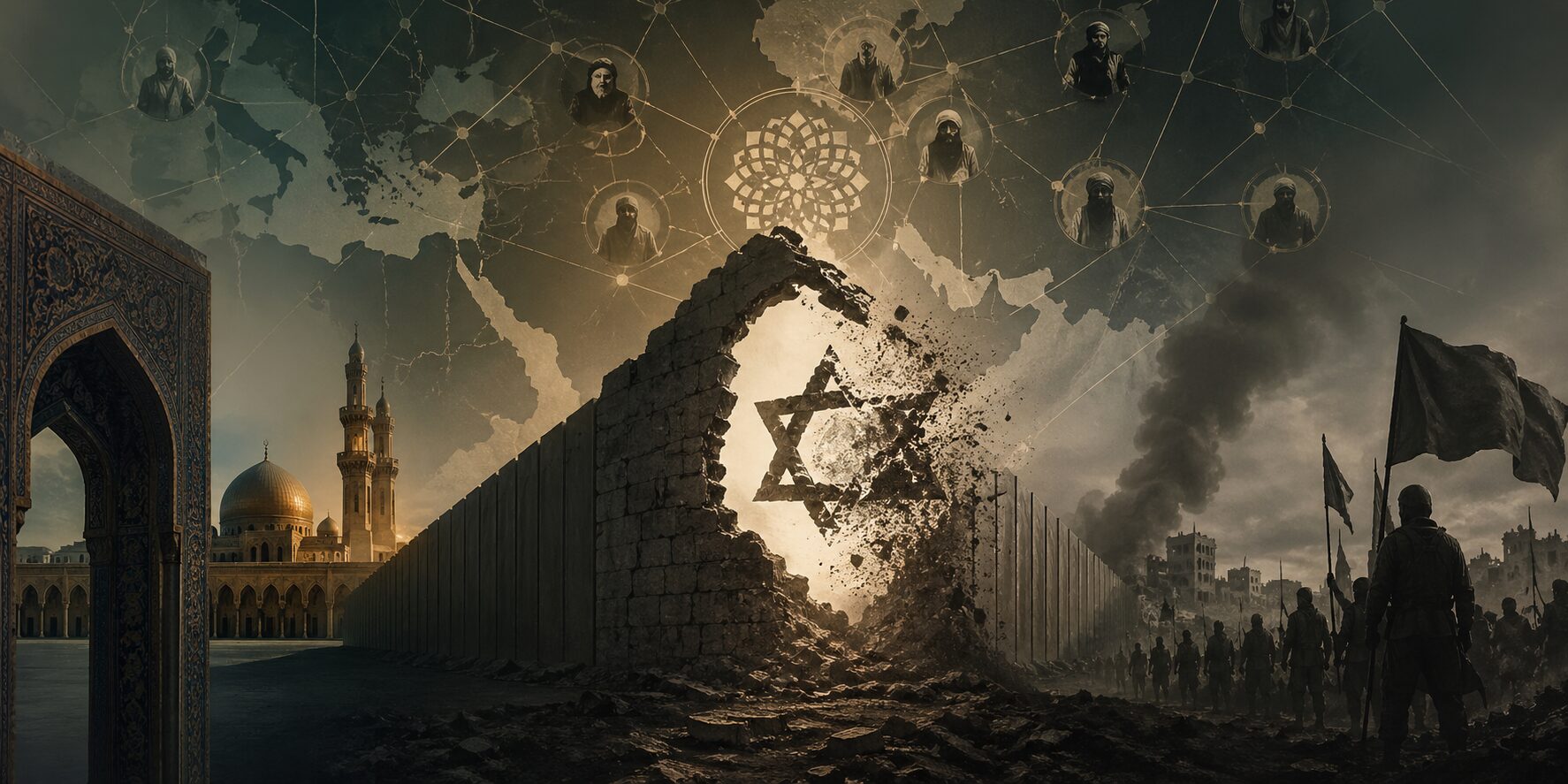
In the post October 7 regional environment, and particularly in the context of the 2026 Iran Israel escalation, these layered historical, mnemonic, and institutional structures converge into a more intensified and visible narrative system. What is often referred to as the Axis of Influence can be understood less as a fixed geopolitical formation and more as the contemporary expression of a longer historical process involving transnational Islamist linkages, sacred geography, war memory regimes, and competing models of memory governance.
During the 2026 escalation, referred to in some strategic and media discourse under operational designations such as Operation Epic Fury, the narrative architecture shifts in character. What were previously layered analytical frameworks become compressed into a real time system of meaning production shaped by direct interstate conflict. Sacred memory, war memory, and ideological narratives begin to operate simultaneously rather than sequentially.
In this environment, Israel is not only a geopolitical actor. It increasingly functions as a central adversarial narrative object, one through which meaning is organized, political coherence is maintained, and legitimacy is articulated within transnational narrative mobilization systems. This role is continuously reconstructed through discourse, framing, and symbolic repetition across different communicative spaces.
Across Iranian aligned and sympathetic media ecosystems, two dominant narrative frames appear with consistency.
The first is a civilizational erasure frame, which presents Israel as a force threatening Arab cultural continuity, historical memory, and collective identity.
The second is a sectarian securitization frame, which situates Israel within a broader field of perceived threats targeting Shiʿi communities and sacred geographies, particularly in fragmented conflict zones such as Syria and Iraq.
These frames do not simply describe geopolitical reality. Rather, they function as narrative activation mechanisms that intensify in group cohesion, heighten perceptions of existential threat, and reinforce identity formation within transnational narrative mobilization systems.
From this perspective, the post October 7 and 2026 war environment should not be read as a rupture. It reflects instead the reactivation and compression of pre existing narrative infrastructures shaped by earlier Islamist linkages, sacred memory systems, war memory regimes, and alternative models of memory governance such as Morocco’s integrative stabilization framework.

No responses yet