by Davood Moradian
International relations constitute the arena in which states—regardless of size—project power, interests, ideology, and prestige. Classical realists posit that power is the central currency governing outcomes in the international system, shaping decision-making and state behaviour.[1] Traditionally, scholarship has focused overwhelmingly on the conduct of major powers-states whose demographic, military, and territorial attributes predestinate them to global relevance. Yet the twenty-first century has witnessed the rise of a category of states that complicate traditional realist assumptions: small states endowed with extraordinary natural-resource wealth, capable of wielding global influence far beyond what their size would predict. Qatar stands as one of the most striking examples of this phenomenon.
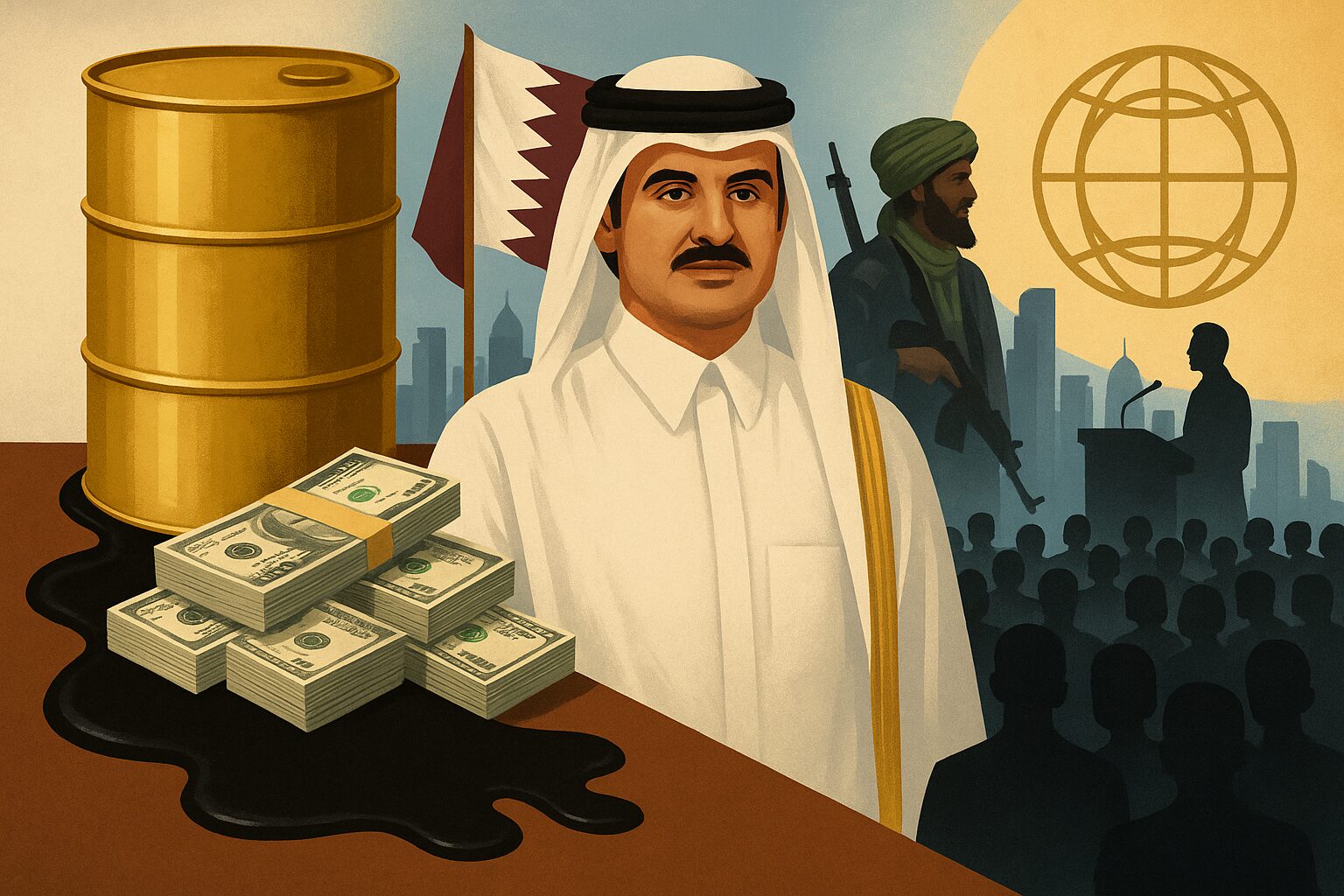
Despite possessing a native population of only a few hundred thousand and limited hard-power capabilities, Qatar has carved out a position in global politics disproportionate to its material endowments, other than wealth. Its involvement in conflicts from Gaza to Afghanistan, its role as mediator and host of influential diplomatic processes, and its deep financial penetration of Western institutions all suggest that Qatar has fashioned for itself a role akin to a “global influencer state.”[2] Understanding how Qatar achieved this position requires a close examination of its multifaceted strategy of petrodollar diplomacy, soft-power projection, and narrative management.
This essay examines the mechanisms through which Qatar leverages its wealth to shape global norms, with special attention to the 2025 Doha Forum. By analysing the Forum’s Afghanistan-focused panel and award ceremony, the paper argues that Qatar uses elite platforms not only to burnish its reputation but to reframe conflict narratives, legitimize preferred partners, and promote a curated vision of its foreign-policy identity.
Petrodollar Diplomacy and the Construction of Influence
Scholarship on Persian Gulf states emphasizes that natural-resource wealth provides certain microstates with what political scientist Michael Herb terms “surplus power”—financial resources far in excess of domestic absorptive capacity, enabling external projection on a scale normally associated with middle or major powers.[3] Qatar exemplifies this dynamic: its gas exports have financed a sophisticated machinery of influence that includes the Qatar Investment Authority, elite branding acquisitions, international philanthropy, educational investments, and extensive media holdings.
Qatar’s global spending serves several interrelated aims:
1. Prestige acquisition and reputation management, through investments in sports, real estate, and cultural institutions.
2. Network building, through financial engagement with Western universities and think tanks.
3. Narrative shaping, through its ownership of Al Jazeera and support for media across the broader Middle East.
4. Diplomatic positioning, through mediation roles and hosting political offices of contentious actors.
Various U.S. government databases and media investigations document that Qatari entities have donated billions of dollars to American universities, policy institutes, and research programs over the past two decades.[4] Scholars note that such funding often expands Qatar’s intellectual footprint in Western policy circles while generating soft goodwill that insulates Doha from criticism.[5] The line between philanthropy and geopolitical strategy is, in many cases, intentionally porous.
Global attention has also turned to allegations of foreign influence via illicit channels. Investigations by European authorities into what became known as the “Qatargate” scandal raised concerns about potentially unlawful influence operations within EU institutions.[6] While legal proceedings remain contested, these investigations highlight vulnerabilities in Western governance structures when confronted with immense flows of foreign capital.
Beyond institutional networks, Qatar’s foreign-policy portfolio includes complex relationships with non-state armed actors. Doha’s hosting of the Taliban political office since 2013, its engagement in Gaza, and its portrayals of regional conflicts through Al Jazeera illustrate a pattern in which Qatar positions itself as a mediator while simultaneously cultivating ties with groups others deem problematic.[7] Supporters argue Qatar enables diplomatic access unavailable through traditional channels; critics contend that the state’s relationships with armed groups risk prolonging conflicts or enhancing their legitimacy.
The Doha Forum as a Platform of Norm Production and Diplomatic Identity
One of Qatar’s most effective instruments for shaping global perceptions is the Doha Forum, an annual high-profile conference attended by diplomats, scholars, activists, and business elites. Far from being a neutral summit, the Forum functions as a platform for constructing and exporting a particular image of Qatar: progressive, humanitarian, cosmopolitan, and indispensable in conflict mediation.
As James Dorsey argues, such platforms constitute “public diplomacy theatres” through which Qatar curates its global brand and tests soft-power narratives.[8] The Doha Forum enables Qatar to position itself as a convener of global conversation, a bridge between East and West, and a mediator between adversaries—roles that stabilize its international relevance despite limited hard power.
The 2025 Doha Forum illustrates these dynamics vividly. Two events were particularly revealing: a panel on Afghanistan’s regional connectivity and the awarding of the Forum’s annual prize to two individuals with Afghanistan-related portfolios. A close reading of these events demonstrates how Qatar uses the Forum not merely for discussion, but for strategic reframing of contentious issues—especially its relationship with the Taliban.
Reframing Afghanistan: Connectivity over Crisis
The 2025 panel titled “Afghanistan’s Recovery Through Regional Connectivity” ostensibly explored the economic potential of regional trade corridors. At first glance, such a topic might appear technocratic, focusing on infrastructure finance, trade logistics, and economic integration. Yet the context in which this discussion occurred, the Taliban’s harsh governance, a humanitarian catastrophe, and international non-recognition rendered the panel far from neutral.
Afghanistan under the Taliban is “the hell hole on earth” according to two fundamentally different views, President Trump and Hannah Neumann, the leading member of the Green faction of the European Parliament. It is marked by gender apartheid, political repression, and widespread rights violations, as documented extensively by the United Nations Assistance Mission in Afghanistan (UNAMA).[9] Women and girls remain barred from secondary and higher education, most public employment, and numerous basic freedoms. Scholars and activists argue that these restrictions constitute one of the most severe gender-based oppressions in the world today.[10]
Despite this context, the panel moderator, an academic from Georgetown University’s Qatar campus, did not directly challenge the Taliban representative on women’s rights or other human rights abuses. This omission contributed to a soft normalization of Taliban rule, especially on a platform watched by global policymakers.[11]
The Taliban panelist himself symbolizes the intricate webs of connection that Qatar has cultivated over decades. He was introduced as the acting head of the Taliban-run’s Center for Strategic Studies within the Ministry of Foreign Affairs. His predecessor was a journalist at Al Jazeera, who was appointed shortly after the 2021 takeover. The new head of the Center studied at the Qatar-funded International Islamic University of Malaysia, an institution known for training many rising figures in Islamist movements across Asia.[12] Such educational and professional links exemplify the intellectual and ideological ecosystems Qatar has nurtured.
The panel’s framing—emphasizing connectivity, opportunity, and regional integration—obscured Afghanistan’s deepening humanitarian and political crises. Qatar, through its control of the conference agenda, effectively reframed Afghanistan from a site of suffering to a site of technocratic potential. This reframing served multiple purposes:
1. For Western audiences, it emphasized Qatar’s utility as a diplomatic broker capable of engaging the Taliban.
2. For Afghan audiences, particularly via Qatar-supported media such as TOLOnews, it suggested rising Taliban international acceptability.
3. For Qatari foreign policy, it legitimized ongoing engagement with Taliban leaders despite global criticism.
Media scholars note that illiberal regimes frequently use international conferences to bolster domestic legitimacy by showcasing foreign interlocutors expressing cautious optimism.[13] British politician Rory Stewart’s remarks to the Afghan audience —emphasizing cultural exchange and people-to-people connections—were heavily promoted by Afghan outlets aligned with Qatari funding. Rory Stewart heads a partly Qatari-funded organisation , the Turquoise Mountain Foundation, alongside his American wife who also attended the Doha Forum.
The Doha Forum Award: Legitimizing Partners in Qatar’s Afghanistan Strategy
The Forum’s annual award is a powerful narrative tool used to elevate individuals or institutions aligned with Qatar’s preferred diplomatic storylines. In 2025, the prize went jointly to Saad Mohseni and Alex Thier, both associated with the Lapis Company, a media and development consultancy deeply embedded in Afghanistan’s post-2001 landscape.
Saad Mohseni and the Evolution of Afghan Media
Mohseni, founder of Afghanistan’s first major private television network (TOLO TV), played a seminal role in cultivating the country’s independent media ecosystem during its democratic period.[14] Under his leadership, TOLO became a regional model for vibrant broadcasting and cultural content.
The Taliban takeover in 2021, however, radically altered media freedom in Afghanistan. According to Reporters Without Borders, Afghanistan now ranks among the world’s worst countries for press freedom.[15] Hundreds of journalists have fled; many media outlets have shut down. Analysts argue that TOLO’s survival amid severe repression required accommodating Taliban demands, including content vetting, approved commentators, and limitations on politically sensitive subjects.[16]
Qatar’s decision to honour Mohseni must therefore be situated within Doha’s broader effort to highlight moderate, pragmatic partners who can operate within Taliban constraints while maintaining ties to international donors.
Lapis and the Paradox of Education Under Taliban Rule
Lapis, the commercial affiliate of TOLO, lists education among its core objectives. Yet Afghanistan’s educational system faces profound barriers: unreliable electricity, expensive internet, and an explicitly ideological curriculum. More critically, the Taliban’s bans on girls’ secondary and university education have eliminated formal schooling opportunities for millions.[17]
Despite these realities, Lapis partners with major donors, including Qatar’s Education Above All (EAA) foundation. EAA has pledged significant funding for Afghan youth education, implemented through local partners. Development scholars note that such initiatives reflect a broader paradox: international aid to education often continues—even expands—under regimes that restrict educational access.[18] Qatar’s association with these programs reinforces its narrative of humanitarian commitment while sidestepping structural contradictions.
The Forum’s decision to celebrate Mohseni and Thier demonstrates Qatar’s use of awards to create a constellation of “acceptable intermediaries”—actors who can operate in Taliban-controlled environments while interfacing with Western institutions.
Petrodollar Power and the Transnational Resource Curse
Traditional literature on the resource curse focuses on domestic political decay induced by natural-resource revenues.[19] Qatar exemplifies a transnationalized form of this phenomenon: extraordinary wealth deployed internationally can reshape institutions, influence governance cultures, and enable illiberal actors abroad.
Qatar’s financial outreach has, intentionally or not, contributed to institutional weakening, media co-optation, and political manipulation in various countries.[20] Afghanistan, in particular, reflects the unintended consequences of external engagement strategies that lend the Taliban a veneer of legitimacy while millions suffer under their rule. The Doha Agreement and subsequent political processes—facilitated in large part by Qatar—accelerated the Taliban’s return to power and the collapse of Afghanistan’s fledgling constitutional democracy.21]
The implications for women are especially grave. By continuing to engage the Taliban diplomatically and through elite conferences, Qatar risks reinforcing a governance structure that systematically disenfranchises half the population.
Conclusion
Qatar’s ascent as a globally influential small state reflects a sophisticated strategy blending petrodollar diplomacy, soft-power projection, narrative management, and niche mediation. The Doha Forum embodies this strategy: it is both a stage and a tool, enabling Qatar to curate global narratives, elevate strategic partners, and frame contentious issues—such as Afghanistan—in ways that align with its foreign-policy objectives.
The 2025 Forum’s treatment of Afghanistan illustrates how Qatar uses international platforms to present its engagement with the Taliban as constructive, developmental, and forward-looking. Through selective agenda setting, award ceremonies, and curated discussions, Qatar performs a dual function: it shapes global perception while reinforcing its indispensability as a mediator.
As Qatar’s influence continues to grow, scholars and policymakers must critically examine the consequences of its strategies—not only for international governance, but for vulnerable populations living under regimes empowered, directly or indirectly, by Qatar’s petrodollar diplomacy.
__
- Hans J. Morgenthau, Politics Among Nations (New York: Knopf, 1948).
- Mehran Kamrava, Qatar: Small State, Big Politics (Ithaca: Cornell University Press, 2013).
- Andrew Cooper and Timothy Shaw, “The Diplomacies of Small States,” International Negotiation 14 (2009).
- Rory Miller, Desert Kingdoms to Global Powers (Yale University Press, 2016).
- U.S. media reporting on foreign donations to universities; see documentation compiled by the U.S. Department of Education (various reports 2019–2022).
- Marc Lynch, “Gulf Autocracies and the Arab Uprisings,” Project on Middle East Political Science (POMEPS), 2014.
- See European Parliament press releases and investigative reporting on alleged foreign influence (“Qatargate”).
- Kristian Coates Ulrichsen, Qatar and the Arab Spring (Oxford University Press, 2014).
- James M. Dorsey, “Qatar’s Public Diplomacy,” RSIS Working Papers (2019).
- UNAMA, Human Rights Update on Afghanistan (2023–2024).
- Human Rights Watch, “Afghanistan: Year Three Under the Taliban,” 2024.
- Sahar Fetrat, “Gender Apartheid in Afghanistan,” International Feminist Journal of Politics (2023).
- Mahjoob Zweiri, “Qatar’s Educational Influence Networks,” Journal of Arabian Studies (2020).
- Steven Freedom and Anne Nelson, Propaganda and Digital Authoritarianism (Columbia University Press, 2020).
- BBC Media Action, “Media Development in Afghanistan,” 2015.
- Reporters Without Borders, World Press Freedom Index (2023–2024).
- Thomas Ruttig, “Media Under the Taliban,” Afghanistan Analysts Network, 2022.
- UNICEF, Education Under Siege in Afghanistan, 2023.
- OECD, “Aid Effectiveness in Fragile States,” 2022.
- Terry Lynn Karl, The Paradox of Plenty (University of California Press, 1997).
- Ulrichsen, Qatar and the Arab Spring, chapters 3–4.
- U.S. Senate Foreign Relations Committee Hearings on Afghanistan Withdrawal (2021–2022
BBC Media Action. Media Development in Afghanistan: Reflections and Lessons from 10 Years of BBC Media Action’s Work. London: BBC Media Action, 2015.
Coates Ulrichsen, Kristian. Qatar and the Arab Spring. Oxford: Oxford University Press, 2014.
Cooper, Andrew F., and Timothy M. Shaw. “The Diplomacies of Small States: Between Vulnerability and Resilience.” International Negotiation 14, no. 2 (2009): 223–240.
Dorsey, James M. “Qatar’s Public Diplomacy.” RSIS Working Paper, S. Rajaratnam School of International Studies, Nanyang Technological University, 2019.
European Parliament. Press Releases and Reports on Foreign Interference and the “Qatargate” Investigations. Brussels: European Parliament, 2022–2023.
Fetrat, Sahar. “Gender Apartheid in Afghanistan: Women’s Rights under Taliban Rule.” International Feminist Journal of Politics 25, no. 4 (2023): 675–689.
Freedom, Steven, and Anne Nelson. Propaganda and Digital Authoritarianism. New York: Columbia University Press, 2020.
Herb, Michael. The Wages of Oil: Parliaments and Economic Development in Kuwait and the UAE. Ithaca, NY: Cornell University Press, 2014.
Human Rights Watch. Afghanistan: Year Three Under the Taliban. New York: HRW, 2024.
Karl, Terry Lynn. The Paradox of Plenty: Oil Booms and Petro-States. Berkeley: University of California Press, 1997.
Kamrava, Mehran. Qatar: Small State, Big Politics. Ithaca, NY: Cornell University Press, 2013.
Lynch, Marc. “Gulf Autocracies and the Arab Uprisings: Counterrevolutionary Coalitions.” In POMEPS Studies 12: The Arab Thermidor, 50–56. Washington, DC: Project on Middle East Political Science, 2014.
Miller, Rory. Desert Kingdoms to Global Powers: The Rise of the Arab Gulf. New Haven: Yale University Press, 2016.
Morgenthau, Hans J. Politics Among Nations: The Struggle for Power and Peace. New York: Alfred A. Knopf, 1948.
OECD. Aid Effectiveness in Fragile States. Paris: Organisation for Economic Co-operation and Development, 2022.
Reporters Without Borders (RSF). World Press Freedom Index. Paris: RSF, 2023–2024.
Ruttig, Thomas. “Media Under the Taliban: The Challenges of Journalism in a Controlled Environment.” Kabul: Afghanistan Analysts Network, 2022.
Senate Foreign Relations Committee. Hearings on Afghanistan Withdrawal. Washington, DC: U.S. Government Publishing Office, 2021–2022.
UNAMA (United Nations Assistance Mission in Afghanistan). Human Rights Update on Afghanistan. Kabul: UNAMA, 2023–2024.
UNICEF. Education Under Siege in Afghanistan: Impact of Restrictions on Girls’ Schooling. New York: UNICEF, 2023.
U.S. Department of Education. Foreign Gift and Contract Reports Submitted by Institutions of Higher Education. Washington, DC: U.S. DOE, 2019–2022.
Zweiri, Mahjoob. “Qatar’s Educational Influence Networks: Ideology, Soft Power, and Transnational Religious Politics.” Journal of Arabian Studies 10, no. 2 (2020): 145–160.

No responses yet