The aligned media network is a transmitter. This is the signal: a single trade, hedged across both sides of the dollar’s decline, that profits from instability itself and is protected by the vocabulary you have been taught to think in
Executive Summary
The previous instalment in this series mapped a formally chartered coordination mechanism between state broadcasters in Tehran, Moscow and Beijing, and traced its output down through a bench of ostensibly independent Western commentators to a field operative deployed at the UK Ministry of Defence. That piece ended on a question it deliberately left open. The network is a transmitter, but a transmitter carries a signal, and the signal has a purpose. This instalment names the purpose.
The signal is a vocabulary: “New Bretton Woods”, “multipolar transition”, “the weaponisation of the dollar”, “dedollarisation as decolonisation”. The vocabulary is not free-floating rhetoric. It defends a specific financial trade, and the trade is the point of this piece.
That trade has two legs and a brace. The first leg is stablecoin float: a private claim on United States Treasury yield wearing the costume of a payment instrument. The issuer takes dollars from the public, holds them in Treasury bills, pays the holder nothing and keeps the interest, at a current run-rate of eight to ten billion dollars a year of what was, until stablecoins existed, public revenue. Since July 2025 an Act of Congress has made the one arrangement that would return that yield to the public expressly illegal. The second leg is gold, and it pays on the opposite outcome: central banks have bought over a thousand tonnes a year since 2022, the dollar’s reserve share has fallen from seventy-one per cent to around fifty-six, and the United States carries its own bullion at a 1973 statutory price roughly sixty times below market, a latent gain of some three-quarters of a trillion dollars that a February 2025 executive order exists to monetise. Bracing both is the compute-and-resources build-out that fences physical scarcity and prices its admission.
The two legs sit in the same cabinet. The Commerce Secretary’s family bank custodies the reserves of the largest stablecoin issuer and holds roughly five per cent of its equity; the Treasury and Commerce Secretaries jointly hold the gold revaluation option. One position pays while the dollar is trusted, the other when the trust goes. They are not contradictory. They are one trade, and the only thing it requires is that the dollar’s status remain in question. Stability is the enemy of this position. Motion is the product, which is why the vocabulary that keeps the question open is worth paying for.
Every node in this structure is, taken singly, lawful. The vocabulary’s function is to make the structure, taken whole, invisible: to reframe each extraction as a reasonable response to a reasonable grievance, so that the cumulative machine dissolves into a series of unrelated developments that thoughtful people are entitled to disagree about.
The vocabulary has a documented origin, a documented personnel chain, and a documented terminus in two Western cabinets. It runs from the economic-publications desk of a convicted American fraudster’s organisation in the 1970s, through four decades of employment records, to the Policy Planning Staff of the United States Department of State and the vocabulary of a sitting Treasury Secretary. The same doctrine reached the Kremlin by the same method. The media network described in the last piece is the retail tier of this operation, the layer that carries the framings into audiences that would reject them on sight if they arrived under a state flag. This piece assembles the wholesale tier: the personnel pipeline, the cap table, the London letterhead, and the enforcement gap that lets all of it sit in the open, disclosed and unread.
This is not, in the end, a story about Russia. The clearest single illustration of the mechanism is American: since January 2026 the United States has held operational control of Venezuela’s oil exports, has sold more than thirteen billion dollars of crude, has accounted publicly for roughly three billion of it, and has declined to publish the ledger. That arrangement has the identical shape as the stablecoin leg, at the scale of a nation state, and no instrument in any jurisdiction currently has the job of asking about it.
None of what follows describes a conspiracy. It describes an enterprise: named individuals in named relationships producing coordinated outputs without a central command issuing orders. That distinction is the whole argument, and it is the reason the structure has been so difficult to see.
Part I – The vocabulary, and the men who carry it
Begin with the embarrassing part, because the embarrassment is the cover.
Lyndon LaRouche, a man with eight presidential campaigns, a 1989 federal conviction for mail fraud and a documented belief that the British Royal Family ran the international drug trade, published in April 1975 a document titled A Programme for the International Development Bank. Its elements were sovereign credit issued against physical infrastructure, gold remonetisation, and a framework for dismantling the post-war monetary order in the name of the developing world. Half a century later, those are the elements of the doctrine now branded “New Bretton Woods” in finance ministries and op-ed pages from Washington to Berlin to Moscow. The vocabulary did not change because it did not need to. It was built, deployed and redeployed for fifty years.
The doctrine did not travel by argument. It travelled by employment record, and the record is public.
David P. Goldman ran the economic-publications desk of LaRouche’s Executive Intelligence Review from 1976 to 1982. He then moved to Wall Street, taking in Credit Suisse and Bank of America, and between 2005 and 2008 served as Global Head of Fixed Income Research at Cantor Fitzgerald, which is to say he worked for Howard Lutnick. In 2015 he and his former LaRouche colleague Uwe Parpart took joint control of Asia Times, the Hong Kong outlet where Goldman writes the “Spengler” civilisational-decline column and Parpart serves as publisher. In May 2025, Goldman was appointed Senior Advisor in the State Department’s Policy Planning Staff, the Department’s internal think tank, founded by George Kennan in 1947. The chain from a 1976 economic-publications desk in Leesburg, Virginia to a 2025 State Department planning role is documented in employment records at every step.
Scott Bessent announced his candidacy for Treasury Secretary in November 2024 on Roger Stone’s WABC radio show, and told Stone, on air, that he wanted to be part of “Bretton Woods realignments”. The phrase has been a LaRouche organisational signature since the mid-1970s. Stone himself was introduced to LaRouche’s senior aide Harley Schlanger in early 2016. His own email, obtained by Mother Jones, reads: “Thanks for connecting me with Harley Schlanger, he is a great guy and shares our goals.” Stone keynoted a Schiller Institute conference in September 2018 and conducted LaRouchePAC interviews into 2020. The Schiller Institute is the LaRouche network’s surviving institutional face, founded in 1984 by Helga Zepp-LaRouche, and it is the doctrinal interface between Western policy elites and the BRICS bloc. At its July 2025 Berlin conference, the keynote on African cooperation was delivered by the chair of the Nelson Mandela Foundation.
The same doctrinal pipeline reached Moscow. Sergei Glazyev, whom EIR published in the 1990s with a LaRouche preface, became State Secretary of the Union State of Russia and Belarus in April 2025. On the centenary of LaRouche’s birth in 2022, with Russian tanks already inside Ukraine, Glazyev published a tribute through LaRouche’s own organisation. LaRouche, he wrote, “turned out to be right”. A serving senior Russian-state economic official, paying homage to a man convicted of mail fraud in a Virginia federal court, in the middle of a war.
The point is not that any of these men is a foreign agent. This Centre has traced adjacent branches of the same network into the Trump-Vance administration via Orbán’s inner circle and into Southern Europe via the Axis of Resistance convergence. The point is narrower and harder to answer. Two consecutive US Treasury Secretaries, from opposed parties, now begin from the same conclusion, which is that the dollar’s reserve role is something to be managed downward. The vocabulary in which that conclusion is stated has a traceable fifty-year provenance, a personnel chain that runs by payroll, and a terminus in the current cabinet. The cover was the felon and the cosmological pamphlets, thick enough that any analyst who took the underlying doctrine seriously could be discredited by association with it. The cover protected the asset. The asset is now operational.
Part II – The trade, named plainly
The vocabulary defends something. This is the something, and it is recoverable from cap tables and disclosure filings without requiring anyone to confess to anything.
The first leg is stablecoin float. A stablecoin is a private claim on United States Treasury yield wearing the costume of a payment instrument. The mechanics are worth stating precisely, because the mechanics are where the politics live. A wholesale market-maker wires dollars to the issuer. The issuer mints an equivalent quantity of tokens and delivers them. The tokens circulate through exchanges to retail users who never interact with the issuer at all. To redeem, the chain runs in reverse and the dollars are wired back.
Between the wire-in and the wire-out, the issuer holds the dollars. Early in the sector’s life that meant cash in commercial banks. As it matured, the reserves moved into short-duration US Treasury bills, which yield the risk-free rate and sit in custody at firms like Cantor Fitzgerald rather than in bank accounts that can be closed without warning. At roughly four and a half per cent over the 2023 to 2026 period, that yield accrues to the issuer. The holder receives the convenience of a dollar-denominated, blockchain-native asset. The issuer receives the interest on the dollar the holder surrendered for the convenience.
The aggregate is straightforward to compute and it is not small. Total stablecoin supply across the major issuers is approximately $300 billion. Roughly eighty per cent of that is backed by Treasury bills or near-equivalents, which puts the sector’s Treasury holding somewhere in the region of $240 to $260 billion. At the prevailing yield that is an income stream of $11 to $12 billion a year. Tether alone closed 2025 with around $141 billion of US Treasury exposure against roughly $186 billion of circulating USDT, disclosed a net profit for the year of over $10 billion, and distributed more than $10 billion in dividends across the first three quarters. Taken as a single entity, the stablecoin sector is now a larger holder of American government debt than South Korea or the United Arab Emirates.
Before stablecoins existed, that income accrued to the United States Treasury and through it to the federal balance sheet, where it offset interest payments on the public debt and reduced the effective cost of fiscal policy. It now does not. This is a transfer of a sovereign revenue stream into private hands, at a scale that compounds, and it was never voted on.
And it is now mandated by statute. The GENIUS Act of July 2025, the sector’s own enabling legislation, expressly forbids issuers from passing the yield through to holders. Read that twice. An interest-bearing stablecoin, the one arrangement that would have returned the seigniorage to the public, is the arrangement the law makes illegal. The Act does not merely permit the privatisation of seigniorage. It requires it. It passed quietly, and it is the most consequential piece of domestic monetary legislation of this decade.
The second leg is gold, and it pays on the opposite outcome. Central banks have bought more than a thousand tonnes a year since 2022, 1,237 tonnes in the most recent full year. BRICS-aligned reserves have risen from roughly eleven per cent of the global total in 2019 to over seventeen per cent. The dollar’s share of disclosed reserves has fallen from seventy-one per cent at the turn of the century to around fifty-six, its lowest in three decades. That is the largest sovereign reallocation away from dollar-denominated assets in modern history, and it is the market’s own forecast stated in bullion. If the dollar’s reserve role erodes, the metal reprices, and whoever holds the metal, the miners, or the revaluation option on a sovereign hoard collects the gain that dollar-holders lose.
The United States itself holds the largest single revaluation option in existence. Its gold reserve is carried on the books at the statutory 1973 price of $42.22 an ounce against a market price more than sixty times higher, a latent gain on the order of three-quarters of a trillion dollars. The executive order of February 2025 establishing a sovereign wealth fund, tasked jointly to the Treasury and Commerce Secretaries, exists precisely to monetise it, in the Treasury Secretary’s own phrase, by “monetising the asset side of the US balance sheet”. Federal Reserve guidance has confirmed the Treasury Secretary’s authority to issue gold certificates against the holdings. Gold is, by his own statement, his largest personal position.
Now put the two legs in the same room, because they are in the same room. The Commerce Secretary’s family bank custodies essentially all of the Treasury reserves of the largest stablecoin issuer in the world and holds roughly five per cent of its equity through convertible debt. That is the leg that pays while the dollar is still trusted. The Treasury and Commerce Secretaries jointly hold the gold revaluation option, written into an executive order. That is the leg that pays when the trust goes. A single administration is hedged across both sides of the dollar’s managed decline.
These are not contradictory positions held by people who have not noticed the contradiction. They are one trade. One leg pays on the way down, the other on the way up, and the only thing both require is that the dollar’s status remain in question. Stability is the enemy of this position. Motion is the product.
Bracing the two legs is the physical layer: the compute build-out and the resource positions that collateralise it, which is where the aluminium, the uranium and the rare earths enter, and where the trade stops being an abstraction and starts resting on contested ground. Power is the base commodity. A data centre and a mine both go where electricity is cheap and oversight is thin. The compute leg runs on advanced semiconductors, more than ninety per cent of which are made on one island that Beijing intends to absorb, which makes the optimistic half of the whole structure collateralised by a fabrication complex inside artillery range. The resource leg runs through Guinea, Namibia, the Congo, the copperbelt, and through a Russian-owned refinery on the Shannon estuary that this piece returns to below.
Part III – The table
There is a photograph that gathers much of this into one room.
In November 2025 the Byline Times editor Peter Jukes documented a dinner held in Brussels in 2017, the dinner at which Steve Bannon launched The Movement, his pan-European populist vehicle. It was fronted by Nigel Farage, structured by the Belgian lawyer Mischaël Modrikamen and by Laure Ferrari, and advised on the 501(c)(4) opacity that would shield its funding by Jeffrey Epstein. Jukes told that story as a Russian one, and told it well. It is only part of the picture.
There are eight people in the photograph. Jukes traced seven. The eighth, third from left, is John Thornton, and his presence extends the scene from a European political project into a story that also reaches Beijing’s gold complex. Thornton is executive chairman of Barrick Mining, the world’s second-largest gold miner, a post he took in September 2025. Barrick’s joint ventures include Shandong Gold and Zijin Mining, both owned by the Chinese state, and Thornton has sat on the China Investment Corporation’s International Advisory Council continuously since 2009.
Why does a gold miner with Chinese-state joint ventures sit at the founding dinner of a European populist movement? Because of the structure set out in the previous section. The stablecoin operators extract the dollar’s yield on the way down; the gold-side holders pre-position for the way up. Those are not two trades with an overlapping cast. They are two legs of one trade, and the 2017 photograph is the clearest single proof available, because the personnel for both legs are sitting at the same table, advised by the same man on how to keep the funding dark. The trade did not assemble itself by coincidence in two cabinets in 2025. It was introduced to itself over dinner in 2017.
The table has an afterlife. When Peter Mandelson arrived in Washington as British Ambassador in December 2024, an appointment his own government justified on the basis of his “existing high-level connections to figures like Elon Musk and Scott Bessent”, his first informal meeting was at Butterworth’s, the Capitol Hill restaurant co-owned by Raheem Kassam, who sat at that 2017 dinner. Mandelson had stayed with Bessent and his family two years earlier, before either man held public office. Sixteen years before that, in the summer of 2008, Mandelson had spent time on the yacht of the sanctioned Russian oligarch Oleg Deripaska off Corfu, hosted by Nathaniel Rothschild, alongside George Osborne. Mandelson was at the time the EU’s Trade Commissioner and had presided over a reduction in EU aluminium tariffs that benefited Deripaska’s UC Rusal. He was dismissed from the Washington post in September 2025 after the House Oversight Committee released his correspondence with Epstein.
None of these are coincidences in the sense of being surprising. They are the ordinary social geometry of a small set of operators who have been in named, documented relationships for as long as forty years, a pattern this Centre has mapped at length in Shadow Networks. What is not documented is a single command structure giving orders. Each operator continues to maximise returns within his own network. The structural outputs align because the positions are positioned in the same trade.
Part IV – The retail arteries
The wholesale trade needs a retail layer, and the retail layer is electoral. In Britain it runs through one artery in the open and a second in the shadows.
The open artery is Christopher Harborne: British-born, Cambridge-educated, resident in Thailand since 1996, a Thai citizen under the name Chakrit Sakunkrit, and the holder of a reported twelve per cent of Tether, the issuer behind roughly $184 billion of circulating USDT. The May 2026 Sunday Times Rich List placed him sixth, with an estimated £18.2 billion, almost all of it traceable to the Tether stake. He is also the largest single donor in the history of British party politics, having given more than £24 million to Reform UK since 2019, roughly two-thirds of everything the party has ever raised. Set the donations beside the policy. Reform’s platform includes opposition to Bank of England limits on stablecoin holdings, a state-held Bitcoin reserve and broad digital-asset deregulation. A man whose fortune is a twelve per cent claim on the largest private stablecoin float in the world funds, to two-thirds of its budget, a party whose flagship financial policy is the removal of limits on stablecoin holdings. The pattern alleges no crime and proves no quid pro quo. It does not need to. The alignment is not at the level of a single decision. It is at the level of every line of the platform.
There is a sharper object in the same file. The Parliamentary Standards Commissioner has opened an inquiry into whether Farage should have declared a £5 million personal gift from Harborne, made in early 2024, weeks before Farage announced his Clacton candidacy. The £24 million in party donations is transparent: registered, attributed, lawful on its face. The £5 million is the opposite on every axis. It went to Farage personally rather than to the party, it was not declared, and it has been explained only retrospectively and inconsistently. The non-declaration is the retail tell, the part someone chose to keep off the books.
The shadow artery runs through an offshore shell that appeared at Reform’s September 2025 conference fully formed, less than a month after it legally existed. Zebec Technologies plc was incorporated in London on 6 August 2025 with £50,000 in stated capital, a single controlling shareholder registered in the British Virgin Islands, and a sole director, Nicholas C. Andrews, previously a director of Binance’s UK arm from 2015 to 2020. A month later this brand-new shell was sponsoring a “rule of law” panel at Reform’s Birmingham conference. Under the Electoral Commission’s guidance, paying to sponsor a party conference panel is treated as a political donation, and only a permissible donor may make one, which for a company means a UK-incorporated firm actually carrying on business in the UK. Whether a shell with £50,000 of capital and a BVI parent was genuinely trading is precisely the question the foreign-donor ban exists to force. No such donation appears in the Commission’s register, which suggests the fee was booked as a commercial exhibitor charge rather than a declared donation. That is the wheel of fortune in miniature: the same money is either an innocuous stand rental or an impermissible foreign contribution depending on which slot it lands in, and the structure is built so that nobody has to say which.
The American case is the same shape, disclosed less, which is itself the tell. World Liberty Financial, majority-controlled by the Trump family, with Steve Witkoff’s son Zach among the founders and running it, launched the USD1 stablecoin in March 2025. Its reserves are cash and short-duration Treasury bills, holders receive no interest, and the yield accrues to the issuer. At four to five per cent on a float that passed $4 billion by April 2026, that is on the order of $160 to $200 million a year of gross interest into a structure beneficially controlled by the sitting President’s family. In May 2025 the Abu Dhabi state-linked firm MGX settled a $2 billion investment into Binance entirely in USD1. The custodial spine throughout is Cantor Fitzgerald, whose principal Howard Lutnick is now Commerce Secretary and whose family firm holds roughly five per cent of Tether through convertible debt. The yield that, before stablecoins existed, accrued to the US Treasury and through it to the public balance sheet, now accrues to a private holder whose political representatives sit in the cabinet that regulates it. The full cap table is set out elsewhere.
Part V – The materials, and the asymmetry of attention
The trade’s physical leg terminates in strategic materials, and one node of it returns us to the peace-movement finding the previous instalment left on the table.
Aughinish Alumina, on the Shannon estuary in County Limerick, is Europe’s largest alumina refinery. It is owned by the Russian metals giant Rusal, whose founder Oleg Deripaska was sanctioned by the United States in 2018 and the United Kingdom in 2022. Bauxite from Rusal’s mines in Guinea is refined at Aughinish, and since 2023 more than half of that alumina has gone to Rusal-owned smelters in Russia. The OCCRP and the Irish Times established in 2026 that aluminium from those smelters is bought by a Moscow trader, ASK, which supplies more than forty EU-sanctioned Russian arms manufacturers, many of them owned by the state conglomerate Rostec.
The care required here is real, and the previous work established it. The smelters blend alumina from many sources until no batch can be traced, so no specific weapon can be shown to contain Aughinish-origin metal, and nothing here claims otherwise. The link is at the level of the corporate structure and the supply chain, the aluminium economy of the makers, not the individual shell. Nor is any breach of Irish law alleged. Ireland’s 2008 investment provisions run in the other direction, and a refinery is not a munitions company under the Act. The finding is a contradiction of posture, not a crime.
The contradiction is stark. Ireland did not merely sign the global treaty banning cluster munitions; it wrote it. The Convention on Cluster Munitions was negotiated and adopted in Dublin in May 2008 under Irish chairmanship. At the United Nations in September 2025, Ireland stated that it opposes cluster-munition production “by all actors”, that this “extends to States not party”, and, in the load-bearing phrase the State chose for itself, that “the use of cluster munitions, or facilitation of such use, must never be normalised in any circumstances”. The Russian cluster-munition production base sits almost entirely inside the Rostec structure. NPO Splav in Tula builds the 9M27K Uragan cluster rocket, attributed by the Cluster Munition Monitor and Human Rights Watch to strikes on Sloviansk, Chuhuiv, Kherson and Kharkiv. NPO Bazalt makes the RBK-500 cluster bomb. NPK Tekhmash, the parent of both, makes the POM-3 scatterable anti-personnel mine. All three are EU-sanctioned. None of the three appears on Ireland’s own statutory exclusion list of April 2025. That list catches Motovilikha Plants, which builds the Uragan launcher vehicle, the truck, but not Splav, which builds the rocket it fires; not Bazalt, which builds the bomb; not Tekhmash, which builds the mine. Ireland blacklists the chassis and omits the ordnance.
This is where the media-network story of the previous instalment and the materials story converge, and it converges on a property this series has named before: the asymmetry of attention. Edward Horgan is a founding member of Shannonwatch and a board member of World Beyond War, and a genuine, lifelong peace campaigner: a retired Irish Army commandant, a former UN peacekeeper, an academic. A 2003 Irish Times profile records that after leaving the regular army in 1986 he worked for about ten years as a safety and security manager, including at Aughinish Alumina. No wrongdoing is alleged and none is implied. The dates pre-date the war by decades. The point is salience. Here is a peace network exquisitely attuned to American military logistics passing through County Limerick, in particular the transit of US aircraft through Shannon Airport, pursued over twenty years and a constitutional challenge in the High Court, and structurally silent on the Russian-owned heavy-industry plant in the same county feeding the aluminium economy of Moscow’s cluster-munition makers. The network notices American power with great sensitivity and Russian power with none, and the asymmetry runs, consistently and across the whole anti-war bench, in one direction.
The same organisation carries the other mechanism the previous instalment documented. David Swanson, World Beyond War’s co-founder and executive director, decorated twice with the US Peace Memorial Foundation’s prize, appears on a PressTV “Live Shots” invoice for a $100 guest fee against a live shot dated 7 February 2019, surfaced in the Black Reward hack. In September 2023 the US Treasury designated PressTV, stating that it “had been used by Iranian intelligence services to recruit sensitive assets, including U.S. persons”. No instruction, direction or knowledge is alleged. The name is on the books, because it is. The payment and the blind spot, in the same boardroom, under two peace prizes.
Part VI – Caracas, and the custody pattern
Everything to this point has run through Russian-linked structures, and a reader entitled to be sceptical might reasonably ask whether this is simply a Russia story wearing a monetary costume. It is not, and the clearest demonstration is a case in which the operator is Washington.
On 3 January 2026, United States forces captured Nicolás Maduro and his wife Cilia Flores in a military raid on Caracas. Venezuela’s defence ministry put the death toll at at least eighty-three. The Supreme Tribunal of Justice declared the presidency vacant by “forced absence” and installed Maduro’s former vice-president, Delcy Rodríguez, as acting head of state. She condemned the operation as an illegal kidnapping and has cooperated with Washington ever since. The United States assumed control of Venezuelan oil exports, suspended some sanctions, and the authorities in Caracas passed legislation sharply weakening the state oil company PDVSA and encouraging foreign participation.
Then the money started moving, and the interesting part is where it stopped.
On 27 July 2026 the President stated that the United States had sold more than thirteen billion dollars of Venezuelan oil since the capture. In April, the State Department official Michael Kozak told Congress that approximately three billion had been disbursed, to pay Venezuelan public salaries and to fund oil infrastructure. That leaves something in the order of ten billion dollars whose whereabouts have not been publicly accounted for. In June, the Secretary of State told Congress that the proceeds sit in a Citibank account and that every disbursement is audited by KPMG.
Both of those statements may be entirely true. Neither is verifiable. The administration has not published the account balances, the KPMG reports, the disbursement records, the management fees, or any reconciliation of oil sold against prices received against fees paid against sums returned against the balance still held. A House committee has opened an investigation into precisely that question. Meanwhile Venezuela, whose oil revenue is roughly a quarter of national income, was struck on 24 June by twin earthquakes of magnitude 7.2 and 7.5, the most severe in more than a century, with United Nations damage estimates running from below five billion dollars to figures many times that. Output held at around 1.2 million barrels a day throughout. The growth that the sanctions relief was supposed to produce has been revised downwards, which is itself a quiet data point about how much of the money has actually gone home.
Now look at the shape of the arrangement, because it is a shape this piece has already described in detail.
A stablecoin issuer takes dollars belonging to other people, holds them in an interest-bearing instrument, returns the holder none of the interest, keeps the benefit of the float, and satisfies the public interest in all this by way of a private attestation from an accounting firm whose full working nobody outside the arrangement sees.
The Venezuelan arrangement takes oil revenue belonging to another country, holds it in a commercial bank account, returns to the nominal owner a fraction of it, keeps the benefit of the balance, and satisfies the public interest in all this by way of a private audit engagement from an accounting firm whose reports have not been published.
That is the same structure twice, at two scales, under two flags. Someone else’s money, in your custody, with the advantage of the float accruing to the custodian and the accounting handled privately. The first version is legal because an Act of Congress made it so. The second is happening because there is no framework that contemplates it at all: no statute governs the position of a state that has taken operational control of another state’s principal export and is banking the proceeds.
It also completes an argument the underlying research made about sanctions. The finding there was that the sanctions instrument, the West’s principal lever short of war, is being converted from a public function into a private discretion, with the power to freeze a designated party’s holdings now residing in a commercial issuer aligned with one cabinet. Caracas is the next step along that line. The state is no longer merely freezing another country’s assets. It is operating the asset, selling the output and holding the receipts. Sanctions relief has become a revenue franchise, administered by the same government whose Treasury and Commerce Secretaries hold both legs of the trade described in Part II.
And it inverts, instructively, the methodological claim this piece has leaned on throughout. The argument elsewhere is that everything is disclosed and nobody totals it. Venezuela is the counter-case: here the structure simply does not disclose, because nothing compels it to. Which suggests that the transparency the rest of this investigation depends upon, the donation registers, the beneficial-ownership filings, the Companies House records, is not a norm anyone in this story holds. It is a legal artefact. Remove the legal compulsion, as the Venezuelan arrangement does, and the same operators publish nothing at all.
No allegation of theft is made here and none is implied. The money may be intact, prudently held, and destined in full for the Venezuelan people. The finding is narrower and, for the purposes of this series, more damaging: a cabinet positioned across both sides of the dollar’s decline has acquired custody of a third country’s oil revenue and has declined to show the ledger, and there is currently no instrument, in any jurisdiction, whose job it is to ask for it.
Part VII – The London letterhead
The legitimacy layer of the whole structure is a small bench of British peers and chairmen lending the honours system as an adjective to commodity and finance flows whose real owners sit elsewhere. The clearest single case is the one the last piece’s Africa focus circled without naming.
Lord St John of Bletso is a crossbench peer, a solicitor, and a longstanding parliamentary voice on African affairs, financial services and deregulation. His declared portfolio is investment in Africa and uranium. He chairs Yellow Cake plc, the uranium holding company, and Strand Hanson, financial advisers on African natural resources, among a tail of resource and finance directorships. His undeclared interest is the one that matters. Leaked OCCRP and Mauritius beneficial-ownership records list him as a beneficial owner of JUMO World Ltd, the Mauritius-registered banking-as-a-service platform that has disbursed some $3.5 billion in loans across seven African and South Asian markets, and that interest appears nowhere in his House of Lords Register of Interests. He has participated in Lords debates on AI regulation, defence AI and autonomous weapons systems while holding it.
JUMO is not a marginal fintech. Its backers include Goldman Sachs, Fidelity, in what was its first investment in any African company, along with Visa, Kingsway Capital, Odey Asset Management, LeapFrog and Gemcorp Capital. Gemcorp is the thread that binds this cluster to the Russian source-of-funds chain the Financial Times documented on 30 March 2022. It was founded in 2014 by Atanas Bostandjiev, the former CEO of VTB Capital UK, with $250 million in seed capital from a company controlled by Albert Avdolyan and Sergei Adonyev, whose wealth derived from the sale of a telecoms group backed by Rostec. That is the same Rostec that owns the cluster-munition makers, run by Sergey Chemezov, who served alongside Vladimir Putin in the KGB. Gemcorp’s London board today carries Lord Grimstone of Boscobel, the UK’s Minister for Investment from 2020 to 2022, as chairman, and Lord Udny-Lister, Boris Johnson’s former chief of staff, as a director. Their register entries list the roles. They do not carry the provenance.
In December 2025 the mechanism that is supposed to catch all this ran its test, and the result is the most useful document in the file. On 11 December, complaints were filed with the Lords Commissioner for Standards against four peers connected through the Gemcorp and JUMO chain. Five days later, on 16 December, all four were dismissed. The Bletso complaint was dismissed on the ground that the JUMO shareholding fell below the registrable threshold of a controlling interest, which is defensible on the registration rule and silent on the separate declaration duty, a duty that is broader and not threshold-bound. The Hollick complaint was dismissed as time-barred. The Grimstone and Udny-Lister complaints were dismissed as facially compliant on the register as it stood. Three different exits, each individually sound, each routing around the substance, all delivered inside a single working week. That is not corruption. It is the enforcement gap operating exactly as designed: a complaints architecture built to test isolated entries against isolated rules, confronted with an integrated structure it has no instrument to see whole, finding each fragment in order and the sum invisible.
Part VIII – The gap, and the response
The recurring feature of everything above is that almost no one named is breaking the law as currently written. That is not a weakness of the argument. It is the argument.
The legal architecture of the United Kingdom, the United States and the European Union was built for a world in which political influence, financial extraction and foreign interference were three separate offences, pursued by three separate agencies, under three separate statutes. The Electoral Commission polices donations. The Financial Conduct Authority polices markets. The Foreign Influence Registration Scheme polices agents of foreign powers. What has been assembled here is none of these things taken singly and all of them taken together: a continuing enterprise that earns in the financial layer, protects its earnings in the political layer, and draws its strategic cover from the foreign-policy layer, with the same people moving between the three. Each agency sees its own slice, finds it largely compliant, and files. The compliance is real. The slicing is the problem.
And in places the slicing is total. No regulator in any jurisdiction has responsibility for the Venezuelan arrangement described in Part VI. It is not a donation, so the Electoral Commission has no interest. It is not a market abuse, so the Financial Conduct Authority has none. It is not foreign influence on British politics, so the Foreign Influence Registration Scheme does not reach it. It is the conduct of a sovereign government towards a third state, which places it in the space between financial regulation and foreign policy where, on the evidence of this investigation, the most valuable positions are now routinely built. A House committee asking questions is not a supervisory framework. It is the absence of one, being noticed.
Britain has taken the first half of the response. The Rycroft Review, published on 25 March 2026, recommended a £100,000 annual cap on political donations from overseas-resident UK voters and a moratorium on donations made in cryptoassets. The government accepted both, legislating the moratorium to apply to every crypto donation of any value made on or after 25 March 2026, with a thirty-day window for previously accepted crypto donations to be returned or forfeited. Both the Harborne megadonor artery and the Zebec shell artery were clamped in the same month, which is itself a piece of evidence about what the reforms were for. Rycroft also recommended strengthened Electoral Commission information-sharing powers and routine inter-agency coordination. This is the right direction. It is also, on its own, not enough, because a donations cap reaches the funding vector and not the structure the funding vector feeds.
Reaching the structure would require an instrument built to see enterprise rather than transactions: a standing cross-agency unit with police, intelligence and treasury inputs, and behind it an enterprise statute on the RICO model that does not require proof of a central conspiracy, only proof of a continuing enterprise engaged in a pattern of qualifying acts. RICO was written for a world in which the Mafia was structured like a corporation but built for crime. The structures documented here are structured like investment vehicles and operate across the boundary between commercial activity and political influence. The objection to handing a state such a power is real and serious, and it should be argued in the open. But it should be argued against the actual alternative, which is not the status quo ante. It is a structure that the existing instruments have already demonstrated, in a single week of dismissal letters, they cannot touch.
Conclusion: the rake on everyone’s defeat
The evidence assembled here, like the evidence in the media-network instalment that preceded it, does not describe a monolithic conspiracy directed from a single command centre. It describes something more resilient: a set of operators occupying adjacent positions around one shared thesis, producing coordinated outputs without anyone issuing orders. Each maximises returns within his own position. The outputs align because the positions are positioned in the same trade, and a trade does not need a conductor any more than a shoal needs a choreographer.
But there is a further finding, and it is the one that makes this difficult to file as either pro-Western or anti-Western commentary. It concerns who has actually won.
Run the scoreboard on the states. Russia spent a quarter of a century and a generation of men on the restoration of an empire and has a smaller one than it began with: NATO larger by two members, the army ground down at an airport outside Kyiv, and its most reliable friend inside the European Union voted out in Budapest in April 2026 on a wave of leaked recordings. China spent two decades and a continent’s worth of credit on a restoration that was to include Taiwan, and holds an economy in a prolonged property collapse, the lowest growth target in its modern record, and a semiconductor industry that cannot yet make at scale the one component the future it is buying depends upon. Iran spent forty years building an arc from Tehran to the Mediterranean and watched the proxies degraded, the air defences breached and the wallets frozen to order. Three empires planned for. Three empires not built.
Now run it on the retailers. The American administration that was to deliver the protected settlement is fracturing, its approval rating around twenty points underwater, its answer to the coming midterms a mid-decade redistricting scramble rather than an argument. The alliance the doctrine was meant to peel apart is instead congealing. And in Britain the largest donor fortune in the country’s history has bought its recipient a Parliamentary Commissioner’s inquiry and a flank turned by the very techno-financier who once funded him, now backing the breakaway to his right. The retail layer is cannibalising itself, exactly as a set of self-interested positions with no conductor eventually must.
And yet the bill is paid in full, every year, on time.
It is paid because the people holding these positions were never backing any of those designs in the first place. They were not betting on Russia, or on China, or on the survival of an American administration. They were betting on the argument continuing, and the argument is the one thing that every failed design still reliably produces.
To see why that pays, follow the fear in both directions.
When people grow frightened about the dollar, they buy gold. That is what central banks have been doing at more than a thousand tonnes a year since 2022, and every tonne of it lifts the value of the metal, the miners and the revaluation option sitting on the American bullion reserve. Doubt about the dollar is, quite literally, the gold leg’s revenue.
Now turn it round. When people grow frightened about their own currency, they buy dollars, and increasingly the dollars they can actually get hold of are stablecoins. A saver in Buenos Aires watching the peso, a trader in Lagos who cannot move money through the formal banks, a family moving remittances across a border: each of them buys a token, hands over a real dollar, and receives no interest on it. That dollar goes into a Treasury bill and the interest goes to the issuer. Doubt about every other currency is the stablecoin leg’s revenue.
So the two positions are not a hedge in the ordinary sense of one cancelling out the other. They are a pair of tolls placed either side of the same road. Confidence in the dollar drains one way and it feeds the tokens; it drains the other way and it feeds the metal. The only condition that would genuinely hurt this structure is the one nobody is selling: a calm, boring, trusted monetary order in which savers in weak-currency countries have no reason to reach for a dollar token and reserve managers have no reason to reach for gold. Stability pays nobody in this room.
That is why the vocabulary matters, and why it is worth what it costs to maintain. It does not need to persuade anyone that the dollar is finished. It only needs to keep the question permanently open, respectable and in circulation, so that the doubt on which both legs feed never quite settles. Every conference paper on multipolar transition, every column on the weaponisation of the dollar, every state broadcast about the coming realignment does that work, whether or not the person producing it has the faintest idea whose position it services.
Which raises the last question the official literature never asks: who pays it? Seigniorage does not evaporate when it is privatised. It is transferred, and a transfer has a payer at each end. At one end stands the dollar-system taxpayer, because every dollar of yield an issuer keeps is a dollar the Treasury must instead raise by borrowing and then service, and the servicing falls on the public balance sheets of the United States, Britain and the rest of the dollar world. At the other end stands the stablecoin holder, and the holder is disproportionately the resident of the inflation-stricken, capital-controlled, under-banked economy: the Argentine protecting savings from the peso, the Nigerian moving money the formal banks will not move, the customer on the African mobile-money rail the previous instalment traced to a Mauritius vehicle and an undeclared seat in the House of Lords.
The float is built from the dollars of the world’s least powerful. The yield on those dollars is collected by some of the world’s most powerful. The gap in between is the trade. That is the incidence, stated plainly: a regressive transfer of the dollar’s public yield, upward and inward, running at the better part of ten billion dollars a year and engineered to grow.
None of it is secret. It is disclosed in prospectuses, attestations, donation registers, Companies House filings, sanctions designations and a statutory gold valuation, and the information operation is not concealment but distribution: the burying of a legible structure under so much volume, vocabulary and plausible deniability that it becomes invisible not because it is hidden but because it is everywhere. Every line item has been published. They have simply never been totalled, because totalling them requires reading the donations, the cabinet posts, the offshore owners and the dinner seating as a single document, and the people in that document have arranged, by spreading it across nine figures and three jurisdictions and fifty years, that nobody ever does.
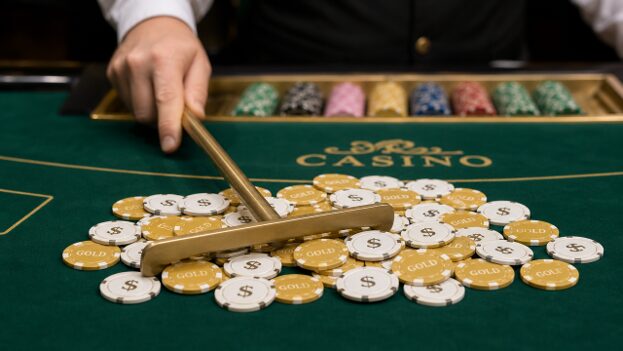
The oldest image for this is the right one. In a casino, the gamblers believe in systems, in destiny, in the turn of the next card, and they may be Russian or Chinese or Iranian or American, dreaming of empire or restoration or transcendence. The house believes in none of it. The house does not bet on red or black. It owns the table, takes a fixed cut of every wager placed on it, and is entirely indifferent to which gambler walks out happy tonight, because its cut is collected on the playing rather than on the winning.
The gamblers fought over the table, and they lost. The house took its cut, and won. That is not a story about one side’s victory over another. It is a charge levied on everybody’s defeat, paid by the taxpayer and the unbanked saver at either end, and noticing it requires you first to notice the words that were put in your mouth before the conversation began.
Further reading
This piece is the second in the Small Clues sequence on the aligned media network and the trade it protects. The first, Small Clues – Sovereign Media – Africa and Iran, maps the chartered coordination mechanism between state broadcasters in Tehran, Moscow and Beijing and its deployment on British soil.
The underlying financial research is set out in full in The New Bretton Woods, a nine-part investigation published at The Angry Dogs: Part 1, Bretton Woods: a history; Part 2, Lyndon LaRouche and Bretton Woods; Part 3, The Development of Crypto and Stablecoins; Part 4, Ross Ulbricht and Silk Road; Part 5, Later LaRouche; Part 6, AI, crypto, and the resource theft; Part 6B, the Alumina update; Part 7, Resurrection of the dead; Part 8, The Retailers; and Part 9, The bill.
Related Centre work: Politics of a Reimagined Past, on LaRouche-movement and Orbán-adjacent networks inside the Trump-Vance administration; Shadow Networks, on transnational influence, organised crime and political access in the United States; and The Saudi Old Guard and the Axis of Resistance Convergence Strategy, on Russian hybrid warfare and LaRouche-movement networks in Southern Europe.

No responses yet