
From the Russian Mob to the Inauguration Platform
EXECUTIVE SUMMARY:
- Ramez and Moutaz Al-Khayyat attended Donald Trump’s January 20, 2025 presidential inauguration while active civil litigation in London’s High Court alleged their coordination with Qatari state entities to channel funds to Jabhat al-Nusra, the Syrian affiliate of Al-Qaeda. Individual claims against the brothers were permitted to proceed by the court. No enhanced vetting of their inauguration access appears to have occurred. The failure has three possible explanations: U.S. intelligence agencies lacked information their British counterparts held; the information was shared but deemed insufficient to act on; or diplomatic considerations involving Qatar overrode security protocols.
- This investigation traces a continuous architecture of transnational influence from New York’s mob-controlled construction industry of the 1970s through the Gulf state access operations of 2025. The connective tissue is not assumption; It is documented transactions, corporate registrations, court filings, congressional testimony, intelligence assessments, and DOJ indictments.
- Trump Tower was one of only two Manhattan buildings that permitted purchases through anonymous shell companies. In 1984, David Bogatin, a central figure in the Daisy Chain fuel tax fraud linked to Semion Mogilevich’s transnational criminal network, purchased five units in cash through shell corporations created the same day as the closing. Federal authorities subsequently seized all five units explicitly for money laundering. Trump attended the closing personally. His attorney Roy Cohn simultaneously represented major Genovese and Gambino family figures. At least a dozen additional buyers across Trump-branded properties during the 1980s and 1990s had documented ties to Eurasian organized crime, following the same pattern: cash, shell companies, minimal scrutiny from the seller.
- Trump traveled to Moscow in 1987 on a fully Soviet-funded trip, toured hotel development sites with senior officials, and was treated as a person of strategic interest. Within weeks of returning, he purchased full-page advertisements in the New York Times, Washington Post, and Boston Globe advancing arguments that aligned closely with Soviet strategic messaging on NATO burden-sharing and U.S. defense commitments abroad. Former KGB officer Yuri Shvets and CIA veteran Glenn Carle both described the trip as following standard cultivation tradecraft: demonstrate access, provide resources, establish a relationship for long-term leverage
- The 2008 non-prosecution agreement, approved by U.S. Attorney Alexander Acosta, violated the Crime Victims’ Rights Act, was kept sealed from victims, and granted immunity to unnamed co-conspirators, an extraordinary provision with no standard prosecutorial justification. Acosta stated publicly at a Labor Department press conference that he had been told Epstein “belonged to intelligence” and to back off. Victims reported cameras in rooms where they were exploited. Ghislaine Maxwell, whose father Robert Maxwell had documented relationships with both Mossad and MI6 confirmed by former intelligence officials, ran the operation’s recruitment and logistics. The DOJ’s January 2026 release of over three million Epstein-related documents confirmed no single compiled list was recovered. That finding is consistent with how intelligence-adjacent collection operations manage sensitive material.
- Tayeb Benabderrahmane, a French-Algerian lobbyist who held material potentially implicating Al-Khelaifi in FIFA corruption, alleged that Al-Khelaifi arranged his detention in Qatar, where he was held for six months and subjected to torture before being released on the condition that he sign a confidentiality agreement. A Qatari criminal court subsequently sentenced Benabderrahmane to death in absentia for allegedly sharing information with French authorities. In July 2025, the UN Working Group on Arbitrary Detention found that his deprivation of liberty was arbitrary and violated due process standards. Al-Khelaifi, chairman of beIN Media and president of Paris Saint-Germain, twice acquitted in Switzerland on FIFA-related corruption charges, continues in all his positions without restriction.
- Al Jazeera, owned by the Qatari emir, signed a broadcast rights agreement with FIFA that included a $100 million bonus payable to FIFA if Qatar won hosting rights for the 2022 World Cup. That conflict of interest was set down in a written contract and accepted by FIFA governance. DOJ indictments confirmed systematic bribery of executive committee members. Fifteen of the twenty-two officials who voted for Qatar’s bid had received investments in their countries or direct payments traceable to the Qatari effort. The independent Garcia Report, commissioned by FIFA, was described by its own author as “materially incomplete” in FIFA’s published summary; Garcia resigned in protest and the full report was suppressed until it was leaked to German media in 2017
- n 2024, Kushner proposed converting Sazan Island, an Albanian military installation controlling maritime access to the Otranto Strait between the Adriatic and Ionian Seas, into an Aman-branded ultra-luxury resort. The island’s military status was removed by Albanian presidential decree in December 2024, five weeks before Trump’s inauguration. Kushner’s entity received strategic investor designation on January 15, 2025, five days before the inauguration. This designation came with accelerated permitting, consolidation of state-owned properties, and tax exemptions. His private equity firm, Affinity Partners, had already received a $2 billion commitment from Saudi Arabia’s Public Investment Fund over the explicit written objections of PIF’s own investment committee, which cited lack of track record, excessive fees, and an unclear investment strategy as disqualifying factors under standard institutional criteria. The committee’s assessment was overridden.
- The former head of the FBI’s New York counterintelligence division, the office responsible for monitoring Russian intelligence operations and handling the most sensitive espionage matters in the United States during the 2016 election period, was convicted of accepting at least $225,000 from Albanian intelligence-connected businessman Agron Neza while holding that position. After leaving the FBI, McGonigal worked for sanctioned Russian oligarch Oleg Deripaska in violation of U.S. sanctions, generating a second conviction. He was also employed as Chief Security Officer for Aman Resorts under Russian billionaire Vladislav Doronin, the same Aman brand Kushner proposed for Sazan Island.
- MBS launched Vision 2030 in 2016 with stated commitments to anti-corruption reform and combating religious extremism. The subversion of those commitments is documented and specific. PIF Governor Yasir Al-Rumayyan controlled the information flow between implementation and the crown prince, which meant he controlled both the decisions and the reporting on those decisions. He committed $2 billion to Kushner’s Affinity Partners over the written objections of PIF’s own investment committee, which found the fund disqualifying on every standard metric. He recommended AECOM for the Red Sea Project despite the firm’s supervision of worksites where over 6,500 migrant workers died during Qatar World Cup construction. MBS received the capability briefings. He did not receive the casualty figures. That is the mechanism: curated information, no independent verification, and advisors whose financial interests were served by problems persisting. The senior layer is Prince Turki Al-Faisal, former Director General of Saudi intelligence for nearly a quarter century, whose asset networks did not dissolve when he left the formal title. Alwaleed bin Talal functioned as the financial instrument of those networks, holding positions across Citigroup, Twitter, and major hotel brands. He walked out of the Ritz-Carlton in January 2018 after transferring approximately $6 billion under coercion, retained 78 percent of his Kingdom Holding stake, and resumed operations without charges or conditions, including no requirement to sever the Muslim Brotherhood-linked funding relationships that Vision 2030 had explicitly identified as threats.
- Barrack was acquitted in November 2022. The jury found prosecutors had not met the criminal standard on the foreign agent charges. What the trial established through documentary evidence was that Barrack shared non-public Trump campaign information with UAE officials, coordinated messaging with them during the transition period, inserted UAE-favorable language into a Trump campaign energy speech after consultations with Emirati counterparts, and arranged for senior UAE officials to meet directly with Trump transition team members to discuss foreign policy priorities.
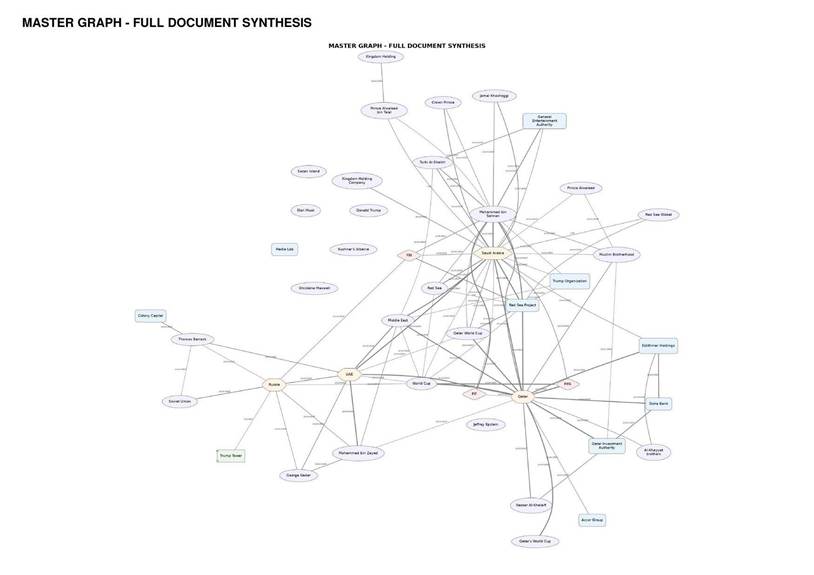
Network diagram: Master Graph Full Document Synthesis. Nodes represent key actors, institutions, and entities documented across all sections. Central hubs include Saudi Arabia, Qatar, UAE, Russia, and the Trump Organization, with edge labels indicating documented relationship types.
Principal Characters & Groups
The Al-Khayyat Brothers: Ramez and Moutaz
Chairmen of Estithmar Holdings, a Qatari conglomerate operating across eighty-two subsidiaries spanning healthcare, hospitality, agriculture, and real estate across multiple countries. Both brothers hold principal board positions at Estithmar alongside Sheikh Suhaim Bin Abdulaziz Al-Thani, whose brother chairs Doha Bank. In 2023, eight Syrian nationals filed civil litigation in London’s High Court alleging the brothers, working in coordination with Doha Bank and Qatari state entities, routed financial support to Jabhat al-Nusra, the Syrian affiliate of Al-Qaeda later rebranded as Hayat Tahrir al-Sham. The brothers attended Donald Trump’s second presidential inauguration on January 20, 2025, despite that pending litigation. The claims against state entities were dismissed on sovereign immunity grounds; the claims against the brothers as individuals were permitted to proceed. Ramez Al-Khayyat is active on the Qatari-Algerian Business Council and Moutaz Al-Khayyat chairs Baladna, a publicly listed Qatari food company in which the General Retirement and Pension Authority of Qatar holds a 9.4 percent stake. Estithmar’s largest single shareholder is Sumaia Saber Hamcho, a sanctioned Syrian national holding 20 percent. The Al-Khayyat Foundation is registered as a nonprofit entity in both the United States and Canada, with IRS filings reflecting minimal assets.
Nasser Al-Khelaifi
Born November 12, 1973, in Doha. Former professional tennis player turned sports executive and government minister. Chairman of beIN Media Group, president and CEO of Paris Saint-Germain Football Club (acquired through Qatar Sports Investments), and member of the Qatar Investment Authority board. Holds ministerial rank within the Qatari government as Minister without Portfolio. Acquitted twice by Swiss courts in connection with FIFA broadcasting rights corruption allegations involving former FIFA Secretary General Jérôme Valcke. Subject of French criminal investigation opened in 2023 based on allegations by French-Algerian lobbyist Tayeb Benabderrahmane that Al-Khelaifi sponsored Benabderrahmane’s detention in Qatar, where Benabderrahmane alleges he was held for six months and subjected to torture before being released on condition that he sign a confidentiality agreement. A Qatari criminal court sentenced Benabderrahmane to death in absentia in May 2023. The UN Working Group on Arbitrary Detention found in July 2025 that Benabderrahmane’s deprivation of liberty was arbitrary and violated due process. Al-Khelaifi is also linked through board positions and PSG’s shirt partnership with Accor Group to Rixos Hotels and, indirectly, to the Al-Khayyat brothers’ Estithmar Holdings.
Fettah Tamince
Turkish businessman and founder and chairman of Rixos Hotels, established in 2000. Rixos grew from a Turkish coastal resort brand to an international luxury hospitality network through a staged acquisition by French multinational Accor Group, which holds a seventy percent stake acquired beginning in 2017. Rixos properties provided significant accommodation and hospitality infrastructure during the 2022 FIFA World Cup in Qatar, opening in time for tournament kickoff. Estithmar Holdings provided financial support for Rixos expansion through loan structures, equity participation in property-specific special purpose vehicles, and joint venture arrangements. Tamince maintains deep relationships with the Erdogan administration in Turkey and has prior documented affiliations with the Gülen movement (FETO). Rixos operates properties across Turkey, UAE, Saudi Arabia, Egypt, Albania, Croatia, Switzerland, and other markets. The brand’s connection to PSG through Accor’s shirt sponsorship ties it indirectly to Al-Khelaifi. Tamince met Trump-affiliated individuals, including Tevfik Arif of Bayrock Group, in overlapping business circles.
Jared Kushner
Son-in-law of Donald Trump. Served as senior adviser to the Trump administration from 2017 through January 2021, handling a portfolio that included Middle East policy, trade, and criminal justice reform. After leaving government, founded Affinity Partners, a private equity firm that received a $2 billion commitment from Saudi Arabia’s Public Investment Fund despite a Saudi government assessment committee initially recommending against the investment due to due diligence concerns. Conducted exploratory visits to Albania in 2021 alongside Ivanka Trump and Nasser Al-Khelaifi, surveying potential development sites along the Albanian coast. In 2024, proposed developing Sazan Island (an Albanian military installation controlling access to the Otranto Strait) as an ultra-luxury Aman-branded resort. The island’s military status was removed by presidential decree in December 2024, weeks before Trump’s inauguration. Kushner’s Albania entity received strategic investor designation on January 15, 2025, five days before the inauguration. Has maintained business relationships in Saudi Arabia, UAE, Albania, and Serbia.
Thomas J. Barrack Jr.
Born 1947 in Culver City, California, of Lebanese Christian descent. After law school, worked in Saudi Arabia for the Fluor Corporation from 1972, developing deep Gulf business relationships. Befriended Paul Manafort in 1970s Beirut while both were representing Saudi interests. Later joined the Reagan administration, served briefly as deputy undersecretary of Interior, and then moved into investment, eventually founding Colony Capital in 1990. Developed a thirty-year friendship with Donald Trump, selling him a stake in Alexander’s department stores in 1985. Served as chairman of Trump’s 2017 inaugural committee, raising a record $107 million. Tried in 2021 on charges of acting as an unregistered agent of the UAE, obstruction of justice, and making false statements to federal agents; acquitted in November 2022. Trial evidence nevertheless documented extensive communications with UAE officials during the campaign and transition period in which Barrack shared non-public information and coordinated campaign messaging.
Donald J. Trump
45th and 47th President of the United States. Real estate developer who built his Manhattan portfolio during the 1980s in a construction economy where organized crime controlled concrete supply, demolition, and waste removal. Trump Tower, opened in 1983, permitted purchases through anonymous shell companies, one of only two Manhattan buildings with this feature, attracting buyers later identified by federal investigators as connected to Russian organized crime and money laundering. In 1984, attended the closing when Soviet émigré David Bogatin, a central figure in the Daisy Chain fuel tax fraud connected to Semion Mogilevich’s organization, purchased five units through shell companies. Traveled to Moscow in 1987 on a Soviet-funded trip; within weeks, purchased full-page advertisements in major U.S. newspapers critical of NATO and U.S. foreign policy commitments. After six corporate bankruptcies in the 1990s left him cut off from conventional financing, turned to licensing arrangements with Bayrock Group, operated by Tevfik Arif and Felix Sater, both of whom had documented post-Soviet criminal connections. Maintained social relationship with Jeffrey Epstein during the 1980s and 1990s. Maintained business relationships with Gulf sovereign capital through Thomas Barrack and inaugural committee arrangements. Elected president in November 2016 and re-elected in November 2024.
Erik Prince
Founder of Blackwater USA (later renamed Xe Services and Academi), the private military contractor that held hundreds of millions in State Department, Defense Department, and CIA contracts during the Iraq and Afghanistan wars. The 2007 Nisour Square incident in Baghdad, where Blackwater contractors killed seventeen Iraqi civilians, triggered criminal prosecutions and congressional investigations revealing that the company operated with minimal oversight. Maintained close relationships with CIA officials and coordinated covert operations providing plausible deniability for government agencies. Developed relationship with UAE Crown Prince Mohammed bin Zayed Al Nahyan through contracts training Emirati special forces. Moved to Abu Dhabi in 2010 amid increasing legal pressure on Blackwater. On January 11, 2017, met with Kirill Dmitriev, CEO of Russia’s sanctioned Direct Investment Fund, at the Four Seasons in the Seychelles in a meeting arranged by George Nader. Testified to Congress that the encounter was spontaneous; Mueller investigation contradicted this account with text messages, location data, and Nader’s testimony. No perjury charges were filed.
George Aref Nader
Lebanese-American businessman who arrived in the United States in the mid-1970s. Founded Middle East Insight magazine in 1981 as an operational credential providing access to U.S. senators, presidents, and Middle Eastern heads of state. Convicted in 1991 in federal court in Virginia on a felony charge of transporting child pornography; the case was sealed “due to the extremely sensitive nature of Mr. Nader’s work in the Middle East.” Convicted again in 2003 in Prague of sexually abusing ten boys, serving one year in Czech prison. Continued operating in U.S. policy circles after both convictions. Served as adviser to UAE Crown Prince Mohammed bin Zayed Al Nahyan. Arranged the January 2017 Seychelles meeting between Erik Prince and Russian sovereign wealth fund chief Kirill Dmitriev. Granted limited immunity by Mueller investigation in exchange for cooperation. Sentenced in 2019 to ten years in federal prison on separate child sex offense charges. Currently incarcerated.
The Al-Thani Family (Qatar) and Associated Entities
Qatar’s ruling family. Sheikh Fahad Bin Mohammad Bin Jabor Al-Thani serves as chairman of Doha Bank, the financial institution named in the London terrorism financing litigation against the Al-Khayyat brothers. His brother, Sheikh Suhaim Bin Abdulaziz Al-Thani, sits on the board of Estithmar Holdings alongside the Al-Khayyats. The Qatar Investment Authority, Qatar’s sovereign wealth fund, holds a majority stake in Doha Bank and is overseen by a board that includes Al-Khelaifi. Qatar hosts Al Udeid Air Base, the forward headquarters of U.S. Central Command, a basing relationship that creates conflicting equities when counterterrorism concerns about Qatari entities arise. Qatar’s foreign policy during the 2010s supported the Muslim Brotherhood, provided haven to Hamas leadership, maintained relations with Iran, and backed armed groups in Syria and Libya whose objectives did not consistently align with U.S. stabilization efforts. The 2017–2021 Gulf blockade, imposed by Saudi Arabia, UAE, Bahrain, and Egypt, failed to extract meaningful concessions and ended without Qatari policy change.
Prince Alwaleed bin Talal al Saud
Born March 7, 1955. Grandson of Saudi Arabia’s founder King Abdulaziz and Lebanon’s first Prime Minister Riad Al Solh. Founder and chairman of Kingdom Holding Company. Invested $797 million in Citicorp in 1991 during its financial crisis, becoming its largest shareholder and, in Sandy Weill’s public assessment, saving the institution. Accumulated major stakes in Apple, News Corporation, Twitter (becoming its second-largest shareholder), Snap, Lyft, and multiple luxury hotel brands including Four Seasons and the Plaza Hotel. Detained at the Ritz-Carlton Riyadh on November 4, 2017 during MBS’s anti-corruption operation; released in January 2018 following reported settlement. Subsequently sold 625 million shares of Kingdom Holding to Saudi Arabia’s Public Investment Fund for $1.5 billion, reducing his stake from 95 percent to 78 percent. Rolled his Twitter stake into Elon Musk’s 2022 acquisition of the platform despite initially opposing the deal. His detention and partial expropriation illustrate that even the most internationally prominent Saudi royals operate without reliable protection from arbitrary state action under MBS.
Jeffrey Epstein
Financial manager and convicted sex offender. Rose to prominence through an unexplained relationship with Leslie Wexner, founder of L Brands, who granted Epstein power of attorney over his finances. Constructed an exploitation network that recruited vulnerable young women and girls through financial inducements, using properties including his Manhattan townhouse, Palm Beach estate, private island in the U.S. Virgin Islands, a New Mexico ranch, and Paris apartment. Cultivated relationships with academics at Harvard and MIT through targeted philanthropic donations, maintaining office access and visiting privileges at elite institutions years after his 2008 conviction for soliciting prostitution from a minor. The 2008 non-prosecution agreement, approved by then-U.S. Attorney Alexander Acosta, violated the Crime Victims’ Rights Act by concealing the agreement from victims and included broad immunity for unnamed co-conspirators. Acosta later stated he had been told Epstein “belonged to intelligence.” Arrested on federal sex trafficking charges in July 2019 and died in custody at MCC Manhattan on August 10, 2019, ruled a suicide by hanging.
Jean-Luc Brunel
Born September 18, 1946, in France. Model scout and agency operator who discovered Christy Turlington and Sharon Stone in the 1970s and 1980s. Subject of a 1988 CBS 60 Minutes investigation into sexual assault allegations; investigated again in 1999 by BBC’s MacIntyre Undercover, after which he was banned from his European agency. Received financial backing from Epstein, reportedly up to $1 million, to establish MC2 Model Management in 2005 with offices in New York, Miami, and Tel Aviv. MC2 placed models with Nordstrom, Macy’s, Saks Fifth Avenue, and other major U.S. retailers while allegedly serving as a recruitment pipeline for Epstein’s trafficking network. Virginia Giuffre stated in a 2015 affidavit that Epstein told her he had “slept with over 1,000 of Brunel’s girls.” Arrested in December 2020 at Charles de Gaulle Airport attempting to board a flight to Senegal; charged by French prosecutors with rape, sexual assault, criminal conspiracy, and human trafficking. Found dead in his cell at La Santé Prison on February 19, 2022, ruled a suicide by hanging, while awaiting trial.
Richard Attias
French-Moroccan event producer and communications strategist. Founder of Richard Attias & Associates, a global events and strategic communications firm. Married to Cecilia Ciganer-Albénin, former wife of French President Nicolas Sarkozy. Organized multiple high-profile international forums in Saudi Arabia, UAE, Qatar, and other Gulf states, including the Future Investment Initiative in Riyadh, a forum that attracted global financial figures to Riyadh even as international condemnation of the Khashoggi murder mounted. Attias’s events operation created a direct infrastructure connecting Gulf sovereign wealth ambitions with international media and financial elites, providing the optics of legitimacy for projects with documented governance failures. Connected to the Trump-Doronin-McGonigal network through the Aman Resorts hospitality circuit and luxury branding in Gulf mega-projects. His role as reputational infrastructure for Saudi and Qatari state ambitions represents one of the most visible yet least examined nodes in the broader network documented here.
AECOM
Fortune 500 American engineering and construction management firm with annual revenue exceeding $8 billion and operations in more than 140 countries. Served as design consultant for Al Wakrah Stadium in Qatar, project manager for Al-Rayyan Stadium, and program management services provider for Hamad International Airport expansion ahead of the 2022 World Cup. Had been embedded in Qatar’s infrastructure since 2008, when it received a six-year, $149 million contract for the New Doha Port project. Marketed its Qatar World Cup experience as a credential when seeking contracts for Saudi Arabia’s Red Sea Global project and the King Fahd International Stadium renovation in 2025, treating a project characterized by documented mass migrant worker exploitation as a career highlight. The firm’s role placed it with comprehensive visibility into labor conditions, procurement irregularities, and safety failures on World Cup sites, while its contractual scope excluded human rights monitoring. AECOM’s continued Gulf expansion illustrates the absence of meaningful reputational consequences for professional services firms participating in projects with documented human rights abuses.
Accor Group and the Rixos Network
Accor is a French multinational hospitality company operating more than 5,000 hotels in over 100 countries. Beginning in 2017, Accor acquired a staged stake in Rixos Hotels, Fettah Tamince’s Turkish luxury brand, ultimately reaching 70 percent ownership. The partnership integrated Estithmar Holdings’ Qatari capital, Tamince’s Turkish hospitality operations, and Accor’s Western European distribution network into a structure that operates across Gulf states, North Africa, and the Balkans. Accor’s shirt partnership with Paris Saint-Germain, negotiated with Al-Khelaifi as PSG president, ties it into the same network whose members sit on the QIA board and Doha Bank’s governance structure. Accor’s aggressive expansion in Algeria alongside Al-Khayyat brothers’ parallel healthcare and agricultural investments in the same jurisdiction and time period creates patterns consistent with coordinated deployment of capital in a jurisdiction with limited financial transparency. Accor announced 293 new hotel openings in 2024 and maintains that 60 percent of planned future openings will be in the Middle East, Africa, and Asia-Pacific regions.
Leon Black
Co-founder and former CEO of Apollo Global Management, one of the world’s largest private equity firms. Maintained a documented financial relationship with Jeffrey Epstein after Epstein’s 2008 conviction, paying Epstein approximately $158 million through 2017 for financial and tax advisory services according to an independent review commissioned by Apollo’s board. Provided $5 million to MIT’s Media Lab facilitated through Epstein’s intermediation and $2 million to George Church’s Harvard genetics research following Epstein’s introduction. Black resigned as Apollo CEO in 2021 following disclosure of the extent of his Epstein relationship. The payments to Epstein, continuing for nearly a decade after Epstein’s sex offense conviction, represent the most substantial documented financial relationship between a major Western financial executive and Epstein beyond Wexner.
Red Sea Global (Saudi Arabia)
Saudi government-owned development company created to execute MBS’s flagship Vision 2030 luxury tourism project along Saudi Arabia’s Red Sea coast. The project spans 28,000 square kilometers between Umluj and Al Wajh, including 90 planned hotels with 8,000 rooms, 22 islands, an international airport, marina facilities, golf courses, and supporting infrastructure. Total investment exceeds $5 billion through initial project phases. AECOM serves as master planning and project management consultant; Foster + Partners and Arup provide architecture and engineering. Accor Group will manage multiple properties under Raffles, Fairmont, and Sofitel brands. The project was formally announced on April 25, 2016, four months before the November 2017 Ritz-Carlton purge, and proceeds in the context of MBS’s consolidation of authority through mechanisms including forced asset transfers. Migrant worker conditions on Red Sea Global construction sites follow patterns documented in Qatar, including kafala sponsorship constraints, wage withholding, and inadequate safety enforcement.
John Bolton
Former U.S. National Security Adviser (April 2018 – September 2019). Former U.S. Ambassador to the United Nations. Bolton’s tenure overlapped with the aftermath of the Ritz-Carlton purge, the Khashoggi murder, the Gulf Crisis, and the Seychelles back-channel revelations. His memoir, “The Room Where It Happened,” documented internal administration decision-making regarding Saudi Arabia and UAE relationships. Bolton was a known Qatar skeptic and has spoken publicly about Qatar’s support for extremist organizations in ways that created tension with the Qatar basing relationship. His departure preceded the period of most intensive Trump administration alignment with Gulf state preferences documented in later sections of this investigation.
Epstein’s Academic Network: Harvard, MIT, and Arizona State
Key institutional nodes in the academic legitimization infrastructure Epstein constructed. Martin Nowak, director of Harvard’s Program for Evolutionary Dynamics, received a $6.5 million Epstein donation in 2003 and maintained contact with Epstein for more than a decade after his conviction. Office 610 at the PED building was known internally as “Jeffrey’s Office”; Harvard’s 2020 investigation found Epstein maintained keycard access and visited more than forty times between 2010 and 2018. Joi Ito, director of MIT’s Media Lab from 2011 to 2019, accepted $525,000 from Epstein for the Media Lab and $1.2 million for his private investment funds; internal emails showed systematic concealment of Epstein’s role, with staff referring to him as “Voldemort.” Epstein facilitated an additional $7.5 million in donations from other wealthy donors including $2 million from Bill Gates and $5 million from Leon Black through MIT channels. Seth Lloyd accepted $225,000 from Epstein post-conviction while concealing the source from MIT administration. Lawrence Krauss at Arizona State traveled with Epstein post-conviction. George Church at Harvard received $2 million through Epstein’s introductions. These relationships served Epstein by providing intellectual credibility, physical office space at elite institutions, and cover for exploitation that leveraged the “science philanthropist” persona.
Qatar 2022 FIFA World Cup and Associated Entities
The 2022 FIFA World Cup was awarded to Qatar on December 2, 2010 by a vote of FIFA’s executive committee; fifteen of the twenty-two voting officials were subsequently fined, banned, or indicted for corruption-related offenses. The al-Khayyat brothers’ construction entity, Urbacon Trading & Contracting (UCC), played a significant role in World Cup infrastructure, including construction of the Lekhwiya Sports Complex. Hassan Al-Thawadi served as Secretary General of Qatar’s Supreme Committee for Delivery and Legacy. Al Jazeera, owned by the Qatari emir, signed a broadcast rights contract with FIFA that included a clause providing FIFA an additional $100 million if Qatar won hosting rights, a conflict of interest that FIFA governance structures tolerated. Total infrastructure expenditure exceeded $220 billion. At least 6,500 migrant workers from South Asian labor-sending countries died in Qatar between 2010 and 2022 according to embassy mortality data; FIFA acknowledges only 37 deaths directly linked to World Cup construction sites.
Tayeb Benabderrahmane (Torture Victim)
French-Algerian lobbyist who entered Qatar in January 2020 reportedly in possession of documents and a mobile phone belonging to Nasser Al-Khelaifi, obtained through Al-Khelaifi’s former butler. Benabderrahmane alleges he was detained by Qatari authorities, held for six months in conditions he describes as torture involving physical abuse and psychological coercion, and released only after signing a confidentiality agreement pledging not to disclose the materials. Filed complaints with French authorities in 2022 implicating Al-Khelaifi in his detention; the Paris prosecutor’s office opened a preliminary investigation in January 2023. A Qatari criminal court sentenced Benabderrahmane to death in absentia in May 2023 on charges of intelligence with a foreign power, a sentence issued while French authorities were investigating his allegations against Al-Khelaifi. The International Centre for Settlement of Investment Disputes ordered Qatar not to enforce the conviction or seek Benabderrahmane’s extradition through Interpol. The UN Working Group on Arbitrary Detention issued Opinion No. 28/2025 in July 2025 finding his deprivation of liberty arbitrary and in violation of due process guarantees.
Sheikh Al-Attiyah and Timbakji (Qatar State Security)
Two defendants in the London High Court terrorism financing litigation believed to be members of Qatar State Security (QSS). Sheikh Al-Attiyah, believed to be Abdullah bin Hamad Al Attiyah, is assessed to hold a senior rank within Qatar’s intelligence services, though no public evidence confirms his specific position. The defendant identified as Timbakji is believed to have served as an operative or operative-equivalent in the alleged financing operation. The presence of QSS personnel as named defendants in the London litigation reinforces witness testimony that the alleged financial flows to Jabhat al-Nusra involved state-level participation rather than purely private criminal activity, though the state immunity ruling prevented claims against state entities from proceeding to the merits.
Ivanka Trump
Daughter of Donald Trump and former senior adviser in the Trump White House. Accompanied Jared Kushner on the 2021 Albania coastal survey. No direct documented dealings with Fettah Tamince have been established through public records, though both moved in overlapping Gulf hospitality and luxury development circles. Her presence alongside Kushner and Al-Khelaifi during the 2021 Albania visits, photographed with Prime Minister Edi Rama and local delegations at potential development sites including Cape Rodon and Sazan Island, places her within the network of relationships that preceded Kushner’s formal investment proposals and the Albanian government’s subsequent grant of strategic investor status.
The 2017 Gulf Crisis
On June 5, 2017, Saudi Arabia, UAE, Bahrain, and Egypt severed diplomatic relations with Qatar and imposed a comprehensive blockade. The blockading states issued thirteen demands including closure of Al Jazeera, removal of a Turkish military base, reduction of Iran ties, and cessation of support to designated terrorist organizations. Qatar refused compliance. Trump initially supported the blockade on Twitter; Secretary of State Tillerson, Secretary of Defense Mattis, and National Security Adviser McMaster worked to defuse tensions given Qatar’s hosting of Al Udeid Air Base. Tillerson’s mediation failed. The blockade lasted three and a half years, ending with the Al-Ula Declaration in January 2021 under pressure from the incoming Biden administration, without Qatar making meaningful concessions on any of the original demands. The crisis demonstrated both the willingness of Gulf states to use economic coercion against one another and the limits of that coercion against a target with sufficient natural gas wealth.
Qatar Investment Authority (QIA)
Qatar’s sovereign wealth fund, governed by a board that includes Al-Khelaifi and members of the Al-Thani ruling family. Holds majority ownership in Doha Bank, the institution named in the London terrorism financing litigation. Through its investment portfolio spanning real estate, financial institutions, and commercial enterprises across Europe and North America, QIA integrates Qatari state capital into Western economies in ways that create conflicting interests when U.S. counterterrorism officials attempt to address Qatari support for extremist organizations. QIA investments include significant positions in European real estate, logistics companies, and financial institutions including Credit Suisse and Barclays during past recapitalization periods.
Russia and the Russian Organized Crime Network
Post-Soviet organized crime networks, particularly those associated with Semion Mogilevich, identified by the FBI as the “boss of bosses” of Russian organized crime, are documented as having acquired units in Trump Tower and other Trump-branded properties from the 1980s through the 1990s. David Bogatin, a central figure in the Daisy Chain fuel tax fraud connected to Mogilevich, purchased five Trump Tower condominiums in 1984 for $5.8 million in cash through shell companies created the same day; units were later seized by federal authorities on the explicit grounds that Bogatin had purchased them to launder money. Felix Sater, managing director of Bayrock Group, had ties to Mogilevich’s organization through his father and had pleaded guilty in 1998 to a $40 million stock fraud involving Russian-Jewish organized crime figures before becoming a protected FBI informant. Russia’s Direct Investment Fund CEO Kirill Dmitriev participated in the Seychelles back-channel meeting. Russian interference in the 2016 U.S. election was documented comprehensively in the Mueller Report and the Senate Intelligence Committee’s five-volume assessment of Russian active measures.
INTRODUCTION: THE INAUGURATION ANOMALY
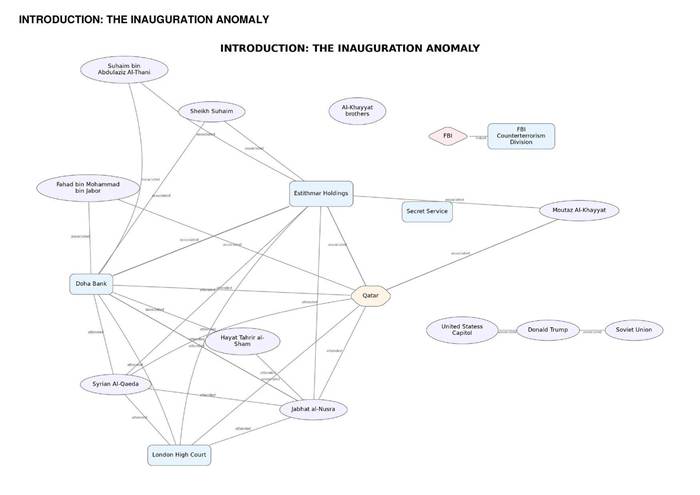
Network diagram: Introduction, The Inauguration Anomaly. Maps the Al-Khayyat brothers’ connections to Estithmar Holdings, Doha Bank, the Al-Thani family, Jabhat al-Nusra, and the London High Court proceedings, alongside the U.S. security architecture that failed to flag their attendance.

Donald J. Trump approaches the podium at the U.S. Capitol, January 20, 2025. The ceremony drew a guest list that conformed, on the surface, to standard protocols. Two attendees, the Al-Khayyat brothers, represented a failure none of those protocols caught.

Trump takes the oath of office, January 20, 2025. The moment of constitutional transfer also marked the formal opening of access to individuals whose presence should have triggered enhanced interagency scrutiny.
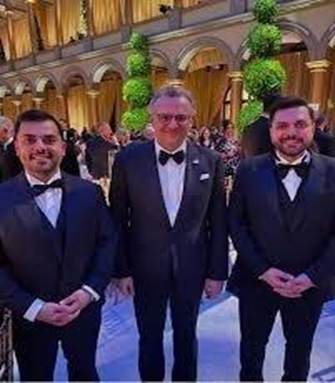
The Al-Khayyat brothers at a Trump 2025 Innaguration. Ramez and Moutaz Al-Khayyat, chairmen of Estithmar Holdings, attended the inauguration despite pending civil litigation in London alleging coordination with Qatari state entities in channeling financial support to Jabhat al-Nusra, the Syrian affiliate of Al-Qaeda.
January 20, 2025. The Capitol steps, the oath, the crowd spreading across the National Mall. Donald J. Trump’s second inauguration unfolded according to protocol. Secret Service perimeters were established weeks in advance. Federal, state, and local law enforcement coordinated security sweeps. Diplomatic credentials were verified. Political donors were cross-referenced against watchlists. The event proceeded without incident. Most guests cleared every checkpoint. Their presence could be explained through documented channels: campaign contributions, diplomatic postings, congressional invitations, and business relationships with transparent ownership structures. The system, for the most part, functioned. Two attendees, however, represented an anomaly that the system failed to flag. Ramez and Moutaz Al-Khayyat, brothers and international businessmen based primarily in Qatar, attended the inauguration. Their presence would have been unremarkable if assessed solely on wealth or business credentials.
Qatar maintains diplomatic relations with the United States, which have been upgraded by the Biden administration to the status of a major non-NATO ally.. Qatari businessmen regularly attend high-profile American political events. The brothers chair Estithmar Holdings, a conglomerate operating across multiple sectors, including healthcare, hospitality, and agriculture. On paper, they appeared to fit within standard parameters for VIP access. But existing records suggested their attendance should have triggered enhanced scrutiny, if not outright exclusion. In 2023, eight Syrian nationals filed civil litigation in a London court [6] alleging that the Al-Khayyat brothers, working in coordination with Doha Bank and Qatari state entities, provided financial support to Jabhat al-Nusra, the Syrian affiliate of Al-Qaeda, that later rebranded as Hayat Tahrir al-Sham. The claimants alleged that funds were routed through Doha Bank, where Sheikh Fahad Bin Mohammad Bin Jabor Al-Thani serves as chairman. The Al-Thani family holds the ruling authority in Qatar. Sheikh Suhaim Bin Abdulaziz Al-Thani, brother to Doha Bank’s chairman, sits on Estithmar Holdings’ board alongside the Al-Khayyats. The London case invoked state immunity and jurisdictional complexity [6], delaying resolution. Witness testimony included allegations that senior Qatari officials were aware of and involved in the financing operations.
The court ultimately ruled that claims against state entities could not proceed due to sovereign immunity, but the case was not dismissed on factual grounds. The allegations remained unresolved. Intelligence agencies in the United States, United Kingdom, and France maintained reporting on Qatar’s relationships with extremist organizations operating in Syria, Libya, and across the Sahel region. These reports documented financial flows, logistical support, and diplomatic coordination that suggested state-level involvement rather than rogue actors. The Al-Khayyat brothers appeared in multiple intelligence assessments related to these activities. Under standard protocols for presidential security events, individuals with pending litigation involving terrorism financing allegations, particularly when those allegations involve state actors and have supporting intelligence reporting, should face elevated vetting. Access to restricted zones, close proximity to the president-elect, and inclusion in official ceremony areas should require interagency clearance at senior levels. No such process appears to have occurred. The Secret Service, which coordinates security for presidential inaugurations, maintains its own protective intelligence unit.
The FBI’s Counterterrorism Division maintains databases of individuals linked to terrorism financing networks. The Treasury Department’s Office of Foreign Assets Control tracks financial flows between foreign entities and designated terrorist organizations. The State Department’s Bureau of Counterterrorism evaluates security risks posed by foreign nationals attending diplomatic functions. The Office of the Director of National Intelligence consolidates threat assessments from across the intelligence community. Somewhere within this architecture, the Al-Khayyat brothers should have appeared as a security concern requiring resolution before access was granted. Either the information did not reach the appropriate screening authorities, or it reached them and was not acted upon. Both possibilities represent significant failures. This was not a perimeter breach. It was not an individual who evaded security checkpoints or presented fraudulent credentials. The Al-Khayyats attended through legitimate channels, implying that someone with authority either granted them access or failed to prevent it despite available information suggesting they posed a security risk. The question that emerges is not simply how two specific individuals gained access to a specific event.
The question is structural: how do individuals connected to unresolved allegations of extremist financing maintain access to influential political environments in Western capitals, including proximity to the highest levels of American political power? Answering that question requires moving beyond the inauguration itself. It requires understanding that the AlKhayyats’ presence was not an isolated failure but a visible manifestation of networks that have operated largely without sustained scrutiny for decades. These networks do not exist in conspiracy or shadow. They function through documented business relationships, political donations, diplomatic channels, legal representation, and strategic investments. They operate within systems designed to be permissive toward capital and accommodating to foreign influence when that influence arrives with wealth and institutional endorsement. Understanding how the Al-Khayyats reached the Capitol steps in January 2025 requires tracing the architecture of informal influence that made their attendance possible. That architecture was not constructed recently. It was built over four decades, beginning in the late Cold War, when three separate but eventually convergent threads emerged: the integration of Eastern European organized crime into American real estate and finance, the rise of systematic child exploitation networks protected by wealth and power, and the deliberate cultivation of Gulf state influence through investment capital and strategic relationships with political figures.
These threads were woven together by individuals who learned to exploit institutional weaknesses, regulatory gaps, and the willingness of powerful actors to ignore warning signs when profit or political advantage was at stake. The Al-Khayyats’ presence at the inauguration was not the beginning of the problem. It was evidence that the problem remains unsolved. What follows is an investigation into how that architecture was constructed, who built it, and how it continues to function despite decades of criminal prosecutions, journalistic exposure, and intelligence reporting. This investigation does not proceed from assumptions about conspiracy. It proceeds from documented fact: business transactions, court filings, intelligence assessments, property records, corporate registrations, diplomatic cables, and witness testimony. It examines networks that operated in plain view, often with legal cover, regulatory approval, and institutional complicity. The investigation begins in New York in the 1970s and 1980s, where organized crime from the former Soviet Union found willing accommodation in Manhattan real estate, and where a young developer named Donald Trump learned to operate in an environment where legality was negotiable and transactional relationships replaced regulatory compliance
SECTION I: FOUNDATIONS (1970s-1980s)
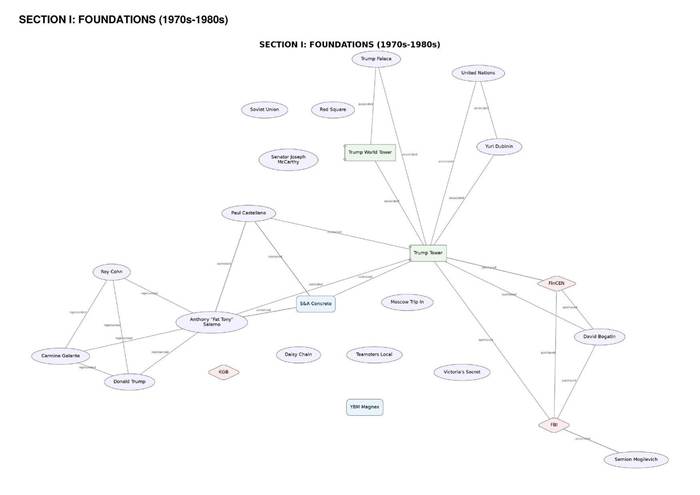
Network diagram: Section I Foundations (1970s–1980s). Documents Trump Tower’s position at the intersection of Roy Cohn, S&A Concrete, Anthony “Fat Tony” Salerno, Paul Castellano, David Bogatin, and Semion Mogilevich, with KGB cultivation operations running in parallel.
The New York Construction Economy and the Integration of Organized Crime:

Donald Trump photographed in his Manhattan apartment, late 1970s. He was transitioning from managing his father’s outer-borough rental portfolio to pursuing high-profile Manhattan developments in a construction economy that ran on accommodation with organized crime.
Manhattan in the late 1970s operated under economic conditions that made organized crime not an external threat to legitimate business but an internal structural requirement. The construction industry, in particular, functioned through a system in which mob control of key inputs (concrete supply, demolition, waste removal, and labor unions) meant that any large-scale development project required accommodation with criminal networks. This was not hidden. Federal prosecutors later established through RICO cases that major construction in New York City during this period could not proceed without paying tribute, directly or indirectly, to organized crime families. The Commission case, United States v. Salerno et al. (S.D.N.Y. 1985) [79], established definitively that the five New York families had divided the concrete industry among themselves and that no major construction project could proceed without tribute payments to organized crime, a finding further detailed in Selwyn Raab’s Five Families (2005) [86]. By the early 1980s, S&A Concrete controlled the market for ready-mix concrete on large Manhattan construction projects. The company was a joint venture controlled by Anthony Salerno and Paul Castellano, as Wayne Barrett documented in Trump: The Deals and the Downfall (1992) [80] and David Cay Johnston confirmed in The Making of Donald Trump (2016) [35]. Trump Tower was built using concrete supplied through S&A Concrete. The Trump Organization paid $8 million to the company despite documented ties to the Genovese and Gambino crime families, a transactional reality any developer of that scale could not have been unaware of.
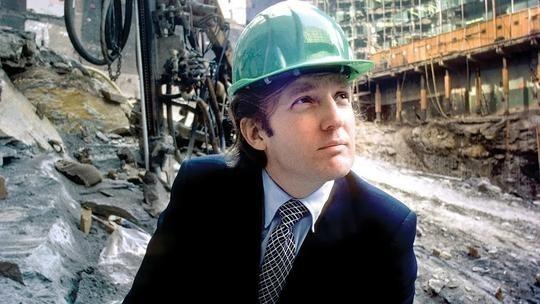
Trump at a Manhattan construction site, early 1980s. Trump Tower required concrete sourced through a cartel controlled by the Genovese and Gambino crime families. S&A Concrete, the supplier, was directly controlled by Anthony ‘Fat Tony’ Salerno and Paul Castellano.
Donald J. Trump entered this environment in the late 1970s as he transitioned from managing his father’s outer borough rental properties to pursuing high-profile Manhattan developments. His first major project, the transformation of the Commodore Hotel into the Grand Hyatt through a partnership with the Hyatt Corporation, required navigating city bureaucracy, securing tax abatements, and managing construction contracts in an industry where organized crime controlled essential supply chains. Trump’s subsequent project, Trump Tower on Fifth Avenue, placed him at the center of this system. The 58-story mixed-use development required massive quantities of concrete. In New York at that time, concrete supply for major projects was controlled by a cartel involving the Genovese and Colombo crime families, along with Teamsters Local 282. Developers had no practical alternative. The mob set prices, controlled delivery schedules, and determined which projects received priority. Attempting to source concrete outside this system invited sabotage, labor disruptions, or physical threats.
Michael Franzese, a former Colombo family captain who later cooperated with federal authorities, confirmed the reality in a 2016 Business Insider interview [81]: “Every construction job in New York had to go through us. There was no way around it. If you didn’t pay, you didn’t build. It’s that simple.” Roy Cohn’s role deserves emphasis. Cohn, who had risen to prominence as chief counsel to Senator Joseph McCarthy during the anti-communist investigations of the 1950s, operated a private law practice in New York that served as a bridge between legitimate business, organized crime, and political power. Cohn represented mob figures including Fat Tony Salerno, Carmine Galante, and members of the Gambino family. He simultaneously represented major real estate developers, including Donald Trump. Cohn’s value lay in his ability to navigate between these worlds, providing legal cover, making introductions, and ensuring that his clients understood the rules of a system where formal law mattered less than transactional relationships and mutual accommodation.
As David Cay Johnston documented in The Making of Donald Trump (2016) [35] and Jonathan Mahler and Matt Flegenheimer reported in the New York Times in June 2016 [82], “The relationship between Trump and the mob went back to the 1970s, long before Trump Tower. Roy Cohn was the conduit. Cohn represented Fat Tony Salerno, Paul Castellano, and the Teamsters while simultaneously representing Trump.” Michael Franzese, in the same Business Insider interview, publicly confirmed that Trump operated within this system. Franzese stated that no major construction project in Manhattan during that period could proceed without mob involvement in concrete supply and labor. Trump, according to Franzese, was not unique in making these accommodations. What was unique was the scale of his ambition and his willingness to cultivate relationships that would prove useful as his business model evolved. Trump Tower opened in 1983 to significant commercial success. The building’s luxury condominiums attracted wealthy buyers, including foreign nationals seeking to park capital in stable American real estate. The building’s sales practices, however, also attracted a different category of buyer one that would prove significant in understanding Trump’s later exposure to foreign intelligence interest and transnational organized crime.
Trump Tower was one of only two buildings in Manhattan at that time that allowed purchases through anonymous shell companies. Buyers could hold units through opaque corporate structures registered in jurisdictions with minimal disclosure requirements. This feature made the building attractive to individuals seeking to conceal asset ownership, whether for legitimate privacy reasons or for money laundering purposes. Federal investigators and financial crimes experts later identified Trump Tower as a textbook example of how luxury real estate in the United States functioned as a money laundering vehicle during this period. A U.S. Senate Permanent Subcommittee on Investigations [83] staff memorandum on money laundering through real estate, cited by Craig Unger in House of Trump, House of Putin (2018) [33], found that investigators discovered “a dozen buyers with documented ties to organized crime or foreign intelligence services. The pattern was consistent: cash, shell companies, no background checks.”
The Treasury Department’s Financial Crimes Enforcement Network (FinCEN) and academic researchers have documented that high-value real estate transactions represent a primary method for converting illicit funds into legitimate assets through the use of shell companies, cash purchases, and opaque ownership structures (FinCEN Advisory FIN-2017-A003 [67]; U.S. GAO, Real Estate: Additional Actions Needed to Address Money Laundering Risks, GAO-20-328, 2020 [66]). The process is straightforward: criminal proceeds, generated through narcotics trafficking, racketeering, corruption, or other activities, are converted into cash. The cash is used to purchase luxury real estate, often through shell companies that obscure the true owner’s identity. Once purchased, the property can be held, generating no taxable rental income but appreciating in value, or it can be resold, converting the original criminal proceeds into apparently legitimate capital gain

Anthony ‘Fat Tony’ Salerno FBI New York field office booking photograph, February 25, 1985. As Genovese boss, Salerno cocontrolled S&A Concrete and extracted tribute from every major Manhattan construction project of the period.
Trump Tower’s structure facilitated this process. In 1984, a buyer named David Bogatin purchased five luxury condominiums in the building for $5.8 million, paid in cash. Trump personally attended the closing. Four of the five units were held not in Bogatin’s name but through shell companies created the same day by an attorney specializing in forming shelf corporations. The transaction carried every hallmark of a money laundering operation: cash payment, multiple units purchased simultaneously by a single buyer, shell company ownership, and minimal due diligence.
David Bogatin was not a legitimate businessman. He was a key figure in one of the most lucrative criminal schemes operating in New York at the time: the Daisy Chain fuel tax fraud. This operation, run in partnership with members of the Colombo crime family, exploited weaknesses in the way gasoline excise taxes were collected. Fuel would be sold through a chain of shell companies, with tax obligations nominally falling on entities that existed only on paper. By the time tax authorities attempted collection, the responsible entity would have disappeared, and the fuel would have already been sold to retail stations. Participants pocketed the uncollected taxes. According to the U.S. Senate Permanent Subcommittee on Investigations [83] and Robert I. Friedman’s Red Mafiya (2000) [84], “The Daisy Chain fuel tax scheme defrauded federal and state governments of over $1 billion in gasoline excise taxes. Russian organized crime figures, including associates of Semion Mogilevich, were central participants.”
Bogatin’s involvement in this scheme generated enormous cash flows that needed to be laundered. Trump Tower provided an ideal vehicle. In 1987, three years after purchasing the condominiums, Bogatin pleaded guilty to conspiracy to evade taxes and fled the country. Federal authorities seized the five Trump Tower units, explicitly stating in court filings (In re: Forfeiture of Five Condominium Units at Trump Tower, S.D.N.Y. 1987 [85]) that Bogatin had purchased them to launder money and shelter assets. Selwyn Raab reported the seizure in the New York Times in June 1988 [86].
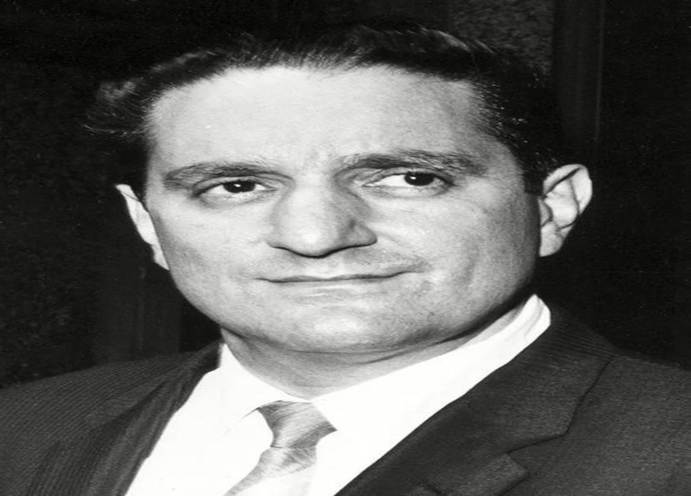
Carmine Galante, Bonanno crime family boss. Roy Cohn’s law practice served as connective tissue between figures like Galante and Salerno on one side, and major real estate developers including Trump on the other.
Bogatin’s ties extended beyond the Colombo family. According to FBI files and Senate investigations into organized crime [70] [70], Bogatin was closely associated with Semion Mogilevich, whom the FBI identified as the “boss of bosses” of Russian organized crime. Mogilevich, a Ukrainian-born organized crime figure, operated a transnational criminal network involved in weapons trafficking, prostitution, money laundering, and sophisticated financial frauds. His organization represented the emerging post-Soviet criminal networks that were beginning to establish footholds in the United States as emigres from the former Soviet Union arrived in large numbers during the 1970s and 1980s.
Bogatin’s brother, Jacob Bogatin, was later indicted alongside Mogilevich in a $150 million stock fraud scheme involving YBM Magnex, a publicly traded company purportedly manufacturing bicycles and industrial magnets. The company was, in fact, a front for money laundering operations. The YBM case, prosecuted in the late 1990s, provided federal authorities with detailed evidence of how Mogilevich’s organization operated in the United States using seemingly legitimate businesses, Western financial institutions, and regulatory gaps to move and legitimize criminal proceeds.

FBI wanted notice for Semion Mogilevich, identified by the Bureau as the ‘boss of bosses’ of Russian organized crime. Trump Tower buyer David Bogatin was directly associated with Mogilevich’s transnational network, which operated through seemingly legitimate businesses and Western financial institutions.
David Bogatin was not the only figure connected to Russian organized crime who purchased property in Trump buildings. Investigative reporting and federal records identified at least a dozen other buyers with documented or suspected ties to Eurasian organized crime who owned units in Trump Tower, Trump World Tower, Trump Palace, or other Trump-branded properties during the 1980s and 1990s. These purchases followed similar patterns: cash payments, shell company ownership, and minimal scrutiny from the seller. As Louise Story and Stephanie Saul reported in the New York Times in February 2015 [20] [101], and as Craig Unger synthesized in House of Trump, House of Putin, Trump Tower condominiums were among the most frequently identified properties in federal investigations of money laundering through Manhattan real estate during the 1980s and 1990s. Trump, for his part, maintained that he had no knowledge of buyers’ backgrounds and that he was simply selling real estate.
Legally, this position had some protection. Real estate developers were not, at that time, subject to the same anti-money laundering obligations that applied to banks and other financial institutions. There was no legal requirement for Trump to conduct background checks on buyers or to report suspicious transactions. However, the concentration of buyers with mob ties, the prevalence of cash transactions, and the use of anonymous shell companies created an environment that federal prosecutors and financial intelligence analysts later identified as a significant vulnerability in the U.S. financial system. The significance of these transactions lies not in whether Trump knowingly participated in money laundering (no criminal charges were ever filed against him on this basis) but in what the transactions revealed about the business model he was developing. Trump was learning that foreign capital, particularly from sources that preferred anonymity and were willing to pay premium prices, represented a reliable market for his properties. This model would become central to his business operations in subsequent decades, particularly after his casino bankruptcies in the 1990s left him unable to secure conventional financing from U.S. banks.

President Ronald Reagan meets with Soviet counterparts during the mid-1980s. Soviet intelligence services maintained systematic cultivation programs targeting Western business figures who exhibited susceptibility to flattery, attraction to large-scale projects, and a transactional worldview, characteristics that Trump exhibited openly.
Soviet Intelligence Interest and the 1987 Moscow Trip
In 1986, Trump received an unusual invitation. Yuri Dubinin, the Soviet ambassador to the United Nations, visited Trump Tower and personally invited Trump to visit Moscow to explore potential real estate development opportunities. Trump himself described the encounter in The Art of the Deal (1987) [87]: “Ambassador Dubinin showed up at my office unannounced. He had read about Trump Tower. We talked, and the next thing I knew, I was being invited to come to Moscow.” The invitation included all expenses paid by the Soviet government a significant gesture that indicated Trump had been identified as a person of interest by Soviet officials. This invitation did not occur in a vacuum. Soviet intelligence services, particularly the KGB, maintained systematic programs to identify and cultivate relationships with Western business figures, politicians, journalists, and other individuals who might prove useful for intelligence collection, influence operations, or long-term strategic advantage. These cultivation efforts did not always involve recruitment in the traditional sense.
Often, the objective was simply to establish a relationship, provide the target with positive experiences and flattering attention, and create conditions where the target might, over time, become receptive to requests for information, introductions, or favorable treatment of Soviet interests. Craig Unger, drawing on former KGB officer accounts and U.S. intelligence assessments documented in House of Trump, House of Putin (2018) [33], found that “Soviet intelligence identified Trump as a potential target for cultivation as early as 1977 based on his frequent travel to European capitals and his stated interest in doing business in the USSR.” Yuri Shvets, a former KGB officer, described the standard approach to the BBC’s Newsnight in September 2016 [88]: “KGB cultivation operations targeting Western businessmen followed a standard playbook: identify targets with ego, financial ambition, and susceptibility to flattery; provide all-expenses-paid trips; create relationships that could be leveraged over time.” Trump fit the profile of a cultivation target. He was wealthy, ambitious, sought public attention, and operated in real estate a sector where Soviet officials had legitimate interests in fostering Western investment as the Soviet economy struggled under the weight of systemic inefficiency and military expenditures. Trump also exhibited psychological characteristics that intelligence professionals recognize as useful: susceptibility to flattery, attraction to grand projects, and a transactional worldview in which relationships were evaluated based on immediate benefit rather than ideological or strategic considerations. .

Donald and Ivana Trump in Palace Square, Leningrad (now St. Petersburg), July 1987. The trip fully hosted and funded by Soviet officials followed the standard pattern of KGB cultivation operations: demonstrate access, create a sense of mutual benefit, and establish a relationship for long-term leverage.
In July 1987, Trump and his first wife, Ivana Trump, who spoke Russian, traveled to Moscow and Leningrad. The trip was facilitated and hosted by Soviet officials. Trump toured potential development sites, including locations near Red Square where Soviet authorities suggested a luxury hotel could be built. He was given access to senior officials and treated as a VIP. The trip followed the standard pattern of KGB cultivation operations: demonstrate access, provide opportunities, and create a sense of mutual benefit.
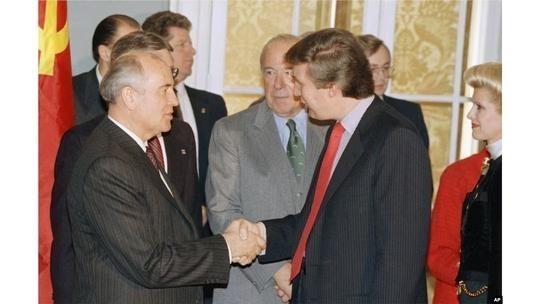
Trump shakes hands with Soviet General Secretary Mikhail Gorbachev, 1988. Within weeks of returning from the 1987 Moscow trip, Trump purchased full-page advertisements in three major newspapers criticizing U.S. foreign policy in terms that aligned closely with Soviet strategic messaging.
Upon returning to the United States, Trump took an unusual step for a real estate developer. He purchased full-page advertisements in The New York Times, The Washington Post, and The Boston Globe criticizing U.S. foreign policy. The ads, which cost approximately $95,000, argued that the United States was being taken advantage of by its allies, particularly in terms of defense spending and trade relationships. The tone and arguments in the ads aligned closely with Soviet strategic messaging at the time, which sought to weaken NATO cohesion and reduce U.S. military commitments abroad. As Luke Harding documented in Collusion (2017) [36], the advertisements appeared in those papers on September 2, 1987. Glenn Carle, a former CIA officer who testified before the Senate Judiciary Committee in May 2017 [89], assessed the episode plainly: “From a counterintelligence standpoint, the 1987 Moscow trip followed the pattern of what the Soviets called ‘active measures’: not necessarily recruiting someone as a formal agent, but influencing behavior through relationship and incentive.” Trump later stated that he had been considering a presidential run and wanted to share his views on foreign policy. However, the timing (immediately following a Soviet-sponsored trip) and the content (echoing Soviet critiques of U.S. alliances) raised questions among counterintelligence professionals about whether Trump had been influenced, however indirectly, by his hosts in Moscow. .
Intelligence services invest in relationships that may not yield immediate results but establish patterns of access and influence that can be leveraged over time. Trump’s 1987 trip established him as a known quantity to Soviet intelligence, demonstrated his receptiveness to foreign government attention, and revealed his willingness to publicly advocate positions that aligned with Soviet strategic interests. The trip also foreshadowed a pattern that would recur throughout Trump’s career: the intersection of business ambition, foreign government interest, and vulnerability to influence. Trump wanted to build in Moscow. Soviet authorities wanted to cultivate a relationship with a wealthy American who might someday hold political influence. Both parties pursued their interests transactionally, without apparent concern for the counterintelligence implications or the conflicts of interest that such relationships create.
Jeffrey Epstein: Origins and Early Network Development
While Trump was building his Manhattan real estate portfolio and navigating organized crime and Soviet intelligence interests, another figure was establishing himself in New York’s elite circles through a very different but equally opaque path: Jeffrey Epstein. Epstein’s origins remain subject to conflicting accounts. He claimed to have worked as a calculus and physics teacher at the Dalton School, a prestigious Manhattan prep school, in the mid-1970s despite lacking a college degree. He later claimed to have worked at Bear Stearns, the investment bank, where he purportedly specialized in tax strategies for high-net-worth clients. However, Epstein’s rapid rise to managing significant wealth occurred through mechanisms that were never clearly explained. By the early 1980s, Epstein had established himself as a financial manager for wealthy clients, operating initially out of offices provided by Leslie Wexner, the billionaire founder of L Brands (formerly The Limited), which owned Victoria’s Secret and other retail chains. Wexner became Epstein’s most important patron, providing not only financial backing but also social credibility and access to elite networks.
The exact nature of Epstein’s services to Wexner has never been fully disclosed. Epstein held power of attorney over Wexner’s finances, a level of control that is extraordinarily rare in wealth management relationships. A former Bear Stearns colleague of Epstein, quoted in Julie K. Brown’s Perversion of Justice (2021) [38], described the arrangement: “The relationship between Jeffrey Epstein and Leslie Wexner was unlike any I had ever seen in finance. Epstein had virtually unlimited authority over Wexner’s personal accounts.” Brown further documented that “Epstein used his position as Wexner’s financial manager to transfer millions in assets to himself, including the $77 million Manhattan townhouse that became his primary residence and exploitation hub.” The scope of Epstein’s authority over Wexner’s finances (covering power of attorney, investment decisions, and real estate transactions) remains incompletely explained in public records and has never been the subject of criminal charges (Miami Herald, November 28, 2018 [22]; Department of Justice Epstein Files Release, January 2026 [10]). During the 1980s, Epstein also developed relationships with academic institutions, particularly those involved in mathematical and scientific research. He cultivated associations with scientists at Harvard, MIT, and other elite universities, offering funding for research and positioning himself as a patron of cutting-edge science.
These relationships were strategic. They provided Epstein with intellectual credibility, access to prestigious institutions, and cover for frequent travel and complex financial arrangements. Epstein’s social network during this period included not only Wexner but also other prominent figures in finance, entertainment, academia, and politics. He attended elite social events, cultivated relationships with individuals who could provide access or influence, and built a reputation as a sophisticated financier with interests in science and philanthropy. This reputation would prove essential in allowing Epstein to operate for decades despite accumulating evidence of criminal conduct. The precise point at which Epstein began systematically recruiting and exploiting underage girls is unclear from public records, but allegations and legal documents suggest that by the late 1980s or early 1990s, a pattern had been established. Epstein’s model involved identifying vulnerable young women and girls, often from economically disadvantaged backgrounds, offering them money for what was initially described as massage services, and then coercing or manipulating them into sexual activity. Victims who complied were sometimes recruited to bring other girls into the network, creating a self-sustaining supply chain of exploitation.
This activity did not occur in isolation. It required infrastructure: properties where the abuse could occur, staff who facilitated logistics, associates who helped identify and recruit victims, and a network of enablers who either participated directly or maintained willful ignorance. Epstein’s Manhattan townhouse, his estate in Palm Beach, Florida, and later his private island in the U.S. Virgin Islands served as primary locations for these operations. Critically, Epstein’s exploitation network functioned alongside his legitimate business activities and social relationships. He continued to manage finances for wealthy clients, cultivate relationships with scientists and academics, and attend social events with powerful individuals. This dual existence (criminal predator and sophisticated financier) was possible because the systems that might have detected and stopped him either failed to look, chose not to act, or were compromised by Epstein’s wealth and connections. Epstein’s relationship with Trump began during this period, though the exact timeline is disputed. Both men operated in Manhattan’s social scene during the 1980s and 1990s. They attended the same parties, belonged to the same clubs, and socialized with overlapping groups of wealthy individuals. Flight logs, photographs, and witness statements confirm that Trump flew on Epstein’s private jet, attended events at Epstein’s properties, and that Epstein attended events at Trump properties, including Mar-a-Lago.
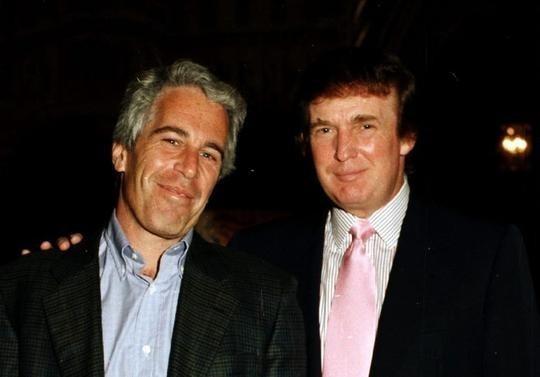
Jeffrey Epstein and Donald Trump at a social event, circa 1990s. Flight logs, photographs, and witness statements confirm both men moved through overlapping social ecosystems in Manhattan and Palm Beach during the period when Epstein was building the exploitation network that would result in his federal prosecution for sex trafficking.
Trump later claimed that he banned Epstein from Mar-a-Lago after learning of inappropriate conduct toward a member’s daughter, though the timeline of this alleged ban is unclear and conflicting accounts exist. What is clear from the public record is that Trump and Epstein maintained social contact during the period when Epstein was actively building the network that would later result in his conviction for sex trafficking. The significance of this relationship, for purposes of this investigation, is not about establishing Trump’s knowledge of or participation in Epstein’s crimes. No credible evidence has emerged of Trump’s direct involvement in Epstein’s trafficking network. The significance lies in what the relationship reveals about the social ecosystem in which both men operated: one in which wealth provided access, where transactional relationships were normalized, and where institutions failed to intervene despite warning signs that, in retrospect, were visible to those willing to look.
This ecosystem (characterized by organized crime integration, foreign intelligence interest, systematic exploitation protected by wealth, and institutional failure to enforce boundaries) formed the foundation for the networks that would expand significantly in the following decades. The patterns established in the 1980s would recur with increasing sophistication as new actors entered the system and as regulatory weaknesses became more apparent to those willing to exploit them.
The New York construction economy taught Trump that success required accommodation with criminal networks. Soviet intelligence taught him that foreign governments would provide resources and attention to those who might prove useful. Epstein demonstrated that wealth and social position could insulate even systematic predation from accountability. These lessons, learned independently by different actors operating in parallel, would eventually converge as the networks expanded and as the individuals who navigated them successfully rose to positions of greater power and influence
SECTION II: EXPANSION AND CONVERGENCE (Late 1980s-1990s)
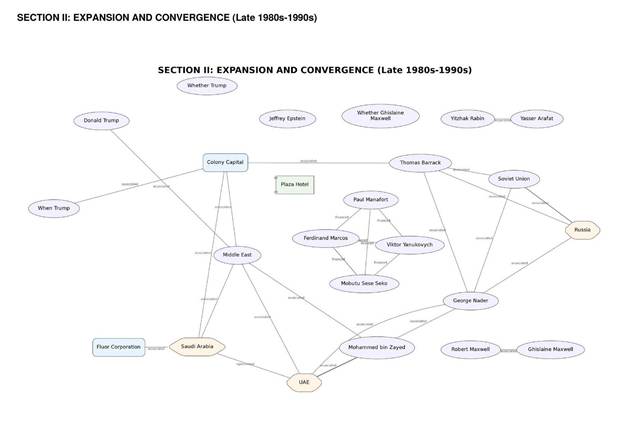
Network diagram: Section II Expansion and Convergence (Late 1980s–1990s). Traces the convergence of Colony Capital, Thomas Barrack, George Nader, Mohammed bin Zayed, Paul Manafort, and Jeffrey Epstein around shared access to Gulf capital and post-Soviet financial networks.
The Emergence of George Nader: Shadow Diplomacy and Systematic Access

George Nader speaking as president and editor of Middle East Insight, C-SPAN broadcast, June 20, 1998. Nader founded the magazine in 1981 as an operational credential securing access to sitting U.S. senators, two presidents, and Middle Eastern heads of state who would not have granted audiences to an ordinary businessman.
Members of this ecosystem often shared several traits: mysterious backgrounds behind meteoric and often inexplicable rise, high-profile careers in business and foreign affairs, often crossing party lines, and predilection for sexual offenses. George Nader was one of the most colorful characters in this seemingly incongruous constellation. George Aref Nader arrived in the United States from Lebanon as a teenager in the mid-1970s, speaking minimal English. By the early 1980s, he had positioned himself as a figure of unusual access across multiple power centers. In 1981, while attending Cleveland State University, Nader founded Middle East Insight, a policy magazine that would serve as both his calling card and his operational platform for the next two decades. The magazine’s stated purpose was to facilitate dialogue on Middle Eastern affairs, but its operational significance lay in the access it provided. By presenting himself as a journalist and publisher, Nader secured interviews with senior U.S. officials, Middle Eastern heads of state, and intelligence figures who would not have granted meetings to an ordinary businessman or political operative. The magazine featured original interviews with Senators Mitch McConnell, John McCain, Dianne Feinstein, and then-Senator Joe Biden. Nader’s writers interviewed Presidents Bill Clinton and George W. Bush. Middle Eastern subjects included Yasser Arafat, Yitzhak Rabin, Muammar Gaddafi, Hosni Mubarak, and Saudi Prince Alwaleed bin Talal.
This access was hardly incidental. Nader cultivated it systematically, using each connection to gain credibility for the next introduction. The magazine operated with minimal staff and inconsistent publication schedules, but it provided Nader with a credential that opened doors. Congressional offices treated him as a legitimate journalist. Foreign ministries granted him interviews. Intelligence services monitored him but did not initially classify him as an agent of influence, despite patterns that should have raised concerns. In 1987, Nader found himself in the home of Ayatollah Ruhollah Khomeini, Iran’s supreme leader, alongside Afghan mujahideen fighters, Egyptian Islamic fundamentalists, and Hezbollah leaders. The circumstances of how a Lebanese-American magazine editor gained access to such a meeting were never fully explained, but the episode demonstrated Nader’s ability to position himself at the intersection of conflicting interests and hostile parties.
During the Clinton administration, Nader attempted to broker an Israeli-Syrian peace agreement, working with Ronald Lauder, heir to the Estee Lauder cosmetics fortune. Nimrod Novik, then chief adviser on foreign policy to Israeli Prime Minister Shimon Peres, later recalled Nader showing up at Israeli government offices, dropping names, and offering to connect Israeli officials with Syrian and Lebanese counterparts. According to Novik, these offers “never fully materialized,” but they established Nader’s pattern: positioning himself as an indispensable intermediary, promising access and influence that sometimes delivered results and sometimes evaporated, but always left him embedded in new networks.
Hisham Melhem, a columnist for the Lebanese daily An-Nahar and a non-resident fellow at the Arab Gulf States Institute, described Nader’s approach to the New York Times in March 2018: “He wanted to put himself as a useful go-between, as a useful carrier of messages, and he did that successfully between Syrians and Israelis.” What made Nader operationally significant, beyond the access he cultivated, was what emerged decades later about his parallel activities during this period. In 1991, Nader was convicted in federal court in Virginia on a felony charge of transporting pornographic videotapes from Germany depicting boys approximately 13 or 14 years old. He received a six-month sentence. Court records cited by David D. Kirkpatrick and Sharon LaFraniere in the New York Times on March 23, 2018 noted that prosecutors agreed to put the case under seal “due to the extremely sensitive nature of Mr. Nader’s work in the Middle East.”
This sealing decision is worth examining. Federal prosecutors do not routinely seal child pornography cases to protect a defendant’s professional interests. The decision to do so suggests that Nader had convinced federal authorities, likely in coordination with intelligence agencies, that his access to Middle Eastern officials was sufficiently valuable to U.S. interests that public disclosure of his conviction would compromise that access. This meant that by 1991, Nader had established himself as someone whose activities, however legally problematic, were considered useful enough to warrant protection. In 2003, Nader was convicted in Prague, Czech Republic, of sexually abusing ten boys. The crimes occurred between 1999 and 2002. In one documented case, at his room in the Hilton Prague Hotel, Nader requested oral sex from a 14-year-old boy. When the boy refused, Nader masturbated in front of him and paid him 2,000 koruna, approximately $60. Nader served one year in prison in the Czech Republic. Czech court records, cited in the same New York Times investigation and confirmed by The Intercept on June 3, 2019, documented the pattern: systematic exploitation of minors, often in hotel rooms, often involving payment.
As the New York Times and Robert Mueller’s subsequent report both noted, “Despite two child sex offense convictions in separate jurisdictions, Nader continued to be granted access to U.S. policymakers, Middle Eastern heads of state, and intelligence community figures. No vetting system raised a flag until investigative journalists did.” The significance of Nader’s criminal conduct, for purposes of this investigation, is not simply its moral reprehensibility but what it reveals about the systems that continued to grant him access despite these convictions. After his 1991 U.S. conviction and his 2003 Czech conviction, Nader continued to operate in U.S. policy circles, continued to cultivate relationships with Middle Eastern officials, and continued to position himself as a trusted intermediary. This continuity suggests either that the officials granting him access were unaware of his criminal history (a failure of vetting) or that they were aware and determined that his utility outweighed the risks and ethical concerns his presence created.
During the 2000s, Nader left Washington and spent most of his time in the Middle East, particularly in Iraq after the 2003 U.S. invasion. He volunteered to act as what he called a “shadow diplomat,” connecting U.S. politicians and military officials with Iraqi government figures and other Middle Eastern actors. Erik Prince, founder of the private military contractor Blackwater, hired Nader to help secure contracts with the Iraqi government. In a 2010 deposition, Prince identified Nader as a “business development consultant.” The contracts Nader was supposed to facilitate never fully materialized, but the relationship between Prince and Nader persisted and would become significant during the 2016 U.S. presidential election. By the early 2010s, Nader had positioned himself as an adviser to Crown Prince Mohammed bin Zayed Al Nahyan of the United Arab Emirates. This relationship represented Nader’s most significant achievement in terms of sustained access to a foreign power center. Nader’s role as an adviser to MBZ gave him credibility in approaching U.S. officials and positioning himself as a channel for UAE interests. Mueller’s report documented that “Nader provided the Special Counsel with extensive information about UAE efforts to influence U.S. political processes and about the planning and execution of the Seychelles meeting between Erik Prince and Kirill Dmitriev” (Mueller Report, Vol. I, pp. 147-162; Senate Intelligence Committee, Report on Russian Active Measures, 2020, Vol. 5, pp. 890-912).
Thomas Barrack: From Beirut to Colony Capital

Thomas J. Barrack Jr. photographed at the United States Embassy in Ankara, Turkey. Barrack’s trajectory from Saudi Arabia energy projects in the early 1970s through Colony Capital’s Gulf investment strategy to chairmanship of Trump’s 2017 inaugural committee represented one of the most consequential circuits of Gulf capital and Washington access operating in plain sight.
Yet another, coincidentally, also Lebanese-American, associate of Donald Trump played a central role in the ecosystem that made Trump’s business and political rise as visible as it was from the very early days of his career. Arguably, Barrack was one of the key players in cultivating the business and foreign government networks indispensable to to Trump’s positioning – but also to the interests of the Middle Eastern and other elites, for whom he became not only a liaison with the US, but a champion and a strategist. Thomas Joseph Barrack Jr., born in 1947 in Culver City, California, came from Lebanese Christian immigrant grandparents who arrived in the United States in 1900 from Zahle. His father operated a grocery store; his mother worked as a secretary. Barrack attended the University of Southern California, where he played varsity rugby, graduating in 1969. He earned a law degree from the University of San Diego School of Law in 1972. Barrack’s path to wealth and political influence began not in California but in the Middle East. After law school, he joined the law firm of Herbert W. Kalmbach, who would later be convicted and imprisoned for his role in President Richard Nixon’s illegal fundraising operations. This early connection to political scandal did not damage Barrack’s career; it appears to have taught him that proximity to power came with risks that could be managed through legal maneuvering and strategic positioning.
In 1972, the Fluor Corporation, a global engineering and construction firm, sent Barrack to Saudi Arabia to work on energy projects. This assignment proved transformative. Barrack learned to navigate Saudi business culture, became a squash partner to a Saudi prince, and developed relationships that would define his career for the next five decades. Saudi Arabia in the 1970s offered extraordinary opportunities for Americans who could bridge Western business practices with Saudi royal patronage.
It was in Beirut during the 1970s that Barrack met Paul Manafort. Both men, in their twenties, were living in Beirut while representing Saudi business interests. They became close friends. As the Eastern District of New York indictment of Barrack noted (U.S. v. Thomas Barrack, Case 21-cr-371, 2021, paragraph 15), and as Rick Gates’ cooperating witness testimony confirmed, this friendship formed in that environment would prove consequential four decades later when Barrack recommended Manafort to Donald Trump as campaign manager. In the early 1980s, Barrack joined the Reagan administration as deputy undersecretary of the Department of the Interior under James G. Watt.
However, Barrack’s government service was short-lived. He was forced to testify before a congressional committee regarding the purchase of Attorney General Edwin Meese’s house at what appeared to be an inflated price, a transaction that raised questions about whether Barrack had arranged a favor for a senior government official. Barrack left government and joined the Robert M. Bass Group, a Texas-based investment firm focused on leveraged buyouts and distressed assets. In 1985, Barrack facilitated a transaction that would mark the beginning of his long association with Donald Trump: he sold Trump a one-fifth interest in Alexander’s department stores. Three years later, in 1988, Trump paid Barrack $410 million for full ownership of the Plaza Hotel. Trump later assessed his old friend to the Los Angeles Times on August 5, 2016: “Tom Barrack has been a great friend of mine for 35 years. He’s very smart and very talented. His track record is extraordinary.”
In 1990, Barrack founded Colony Capital with initial investments from Robert M. Bass, GE Capital, Eli Broad, Merrill Lynch, and Taiwanese businessman Koo Chen-fu. The firm’s strategy focused on distressed properties (real estate that had declined in value due to market conditions, overleveraging, or management failure). Barrack achieved 50% profits in his first two years. Colony Capital grew rapidly throughout the 1990s, expanding beyond U.S. distressed properties into international real estate investment. Colony Capital investor documents from 2001 to 2010 and reporting by the Los Angeles Times on August 5, 2016 confirm that the firm invested approximately $200 million in Middle East real estate and $534 million in non-performing German real estate loans, with the portfolio eventually growing to $25 billion in assets under management, including hotels, resorts, and entertainment properties.
Barrack’s investment strategy prioritized assets that could benefit from his political and business relationships. His connections in the Middle East, established during his time in Saudi Arabia, gave Colony Capital access to capital and deal flow that other U.S. investment firms lacked. The French government awarded Barrack the Chevalier de la Legion d’honneur in recognition of his business activities in France. Critically, as the Eastern District of New York indictment alleged in July 2021, “at the direction of senior UAE officials, Barrack worked to influence the 2016 Trump campaign’s positions on Middle East policy, promoted UAE interests in U.S. media, and facilitated meetings between UAE officials and members of the Trump campaign,” a finding confirmed by Kenneth Vogel in the New York Times on July 23, 2021.
During this period, Barrack also maintained contact with Paul Manafort, who had become one of Washington’s most successful and ethically compromised political consultants. Manafort, along with Roger Stone and Charlie Black, founded Black, Manafort, Stone and Kelly in 1980, a lobbying and political consulting firm that represented foreign governments and leaders with problematic human rights records. The firm’s clients included Ferdinand Marcos of the Philippines, Mobutu Sese Seko of Zaire, and Jonas Savimbi of Angola. Manafort specialized in helping authoritarian leaders improve their image in Washington while simultaneously helping them access U.S. political figures and maintain favorable policy treatment. By the end of the 1990s, Barrack had established himself as a billionaire with deep connections in the Middle East, a close relationship with Donald Trump, and a business model predicated on exploiting regulatory weaknesses, market dislocations, and the intersection of capital and political power. These attributes would make him extraordinarily valuable when Trump entered presidential politics in 2015.
Trump’s Financial Crisis and the Turn to Opaque Foreign Capital
The 1990s represented a period of severe financial distress for Donald Trump. His aggressive expansion during the 1980s, financed largely through high-interest debt, collapsed when the real estate market softened and his casino operations in Atlantic City began hemorrhaging cash. Trump filed for corporate bankruptcy protection six times between 1991 and 2009: five casino bankruptcies and one bankruptcy for the Plaza Hotel. These bankruptcies did not represent personal insolvency, but they destroyed his credibility with U.S. financial institutions. As Tim O’Brien documented in TrumpNation (2005), “After his Atlantic City casino bankruptcies, virtually no major U.S. bank would lend to Trump. He was essentially persona non grata at the institutions that had previously extended him hundreds of millions in credit.” David Cay Johnston calculated in The Making of Donald Trump (2016) that “Trump’s six corporate bankruptcies cost creditors, including Chase Manhattan and Citibank, an estimated $912 million in losses. By 1994, no major Wall Street bank would extend him credit without extraordinary collateral requirements.”
Deutsche Bank became virtually Trump’s sole major institutional lender after his bankruptcies. As the New York Times reported in May 2019 and as David Enrich detailed in Dark Towers (2020), the bank “extended him over $2 billion in loans over two decades, despite his defaults and despite internal risk management recommendations against lending.” The gap left by U.S. banks was filled, as Craig Unger documented in House of Trump, House of Putin (2018), by “buyers paying cash for Trump properties through shell companies, many of them connected to Russian organized crime, Kazakh oligarchs, and other post-Soviet capital sources that asked no questions and paid premium prices.”
Trump’s solution was to transition from a model based on building and owning properties to one based on licensing his name. However, the licensing model had a critical vulnerability: it depended on buyers who valued the Trump brand sufficiently to pay premium prices. These buyers increasingly came from abroad, particularly from Russia and the former Soviet Union, where newly wealthy oligarchs and organized crime figures were seeking to move capital out of unstable post-Soviet economies and into stable Western assets. Investigative journalists and congressional inquiries later documented that at least 13 individuals with documented ties to Russian organized crime purchased units in Trump properties during the 1990s and 2000s.
In 2008, Donald Trump Jr. told a real estate conference in New York: “Russians make up a pretty disproportionate cross-section of a lot of our assets. We see a lot of money pouring in from Russia.” This statement, later confirmed by Eric Trump in separate interviews, acknowledged what property records already demonstrated: Trump’s business model had become substantially dependent on capital from Russia and the former Soviet Union. The investigative question is not whether this dependency existed (it did) but what vulnerabilities it created. When a businessman depends on capital from sources that prefer anonymity, conduct transactions through opaque structures, and sometimes have ties to organized crime or intelligence services, that businessman becomes exposed to leverage. He cannot easily refuse future transactions without jeopardizing existing relationships. He becomes invested in maintaining a permissive regulatory environment for anonymous foreign investment. He develops a worldview in which scrutiny of foreign capital flows is bad for business.
Epstein’s Network Expansion: The Recruitment Model and Elite Protection
By the 1990s, Jeffrey Epstein had refined the operational model that would allow him to exploit hundreds of young women and girls over the next two decades while maintaining protection from law enforcement and social ostracism. The most detailed public documentation of this model came from civil litigation and, later, from the 2008 non-prosecution agreement in Florida and subsequent federal prosecutions in 2019. The 2019 indictment alleged that “between 2002 and 2005, Epstein sexually exploited and abused dozens of minor girls, paying some victims to recruit additional girls and creating a network that required the participation and willful ignorance of a substantial support structure” (United States v. Jeffrey Epstein, Case 19-cr-490, S.D.N.Y., July 2019). Victims described being approached with offers of $200 or more to give Epstein a “massage” at his Palm Beach mansion. Once at the property, they encountered a situation that escalated from massage to sexual contact. Victims who complied were sometimes asked to recruit friends or acquaintances, with financial incentives for bringing in additional girls.
During the 1990s, Epstein acquired additional properties that expanded his operational capacity. In addition to his Manhattan townhouse and Palm Beach estate, Epstein purchased Little St. James Island in the U.S. Virgin Islands in 1998 for $7.95 million. The 70-acre private island provided Epstein with an isolated location where victims could be transported, where privacy was absolute, and where local law enforcement had minimal presence or interest in intervening.
Critically, Epstein’s expanding operations during the 1990s coincided with his deepening relationships with powerful individuals. His association with Leslie Wexner continued, but Epstein also cultivated relationships with prominent academics, politicians, and business figures. Prince Andrew, Duke of York, became a close associate. Bill Clinton flew on Epstein’s private jet multiple times, including trips to Africa for Clinton Foundation activities. Donald Trump socialized with Epstein in Palm Beach and Manhattan. Alan Dershowitz, the prominent Harvard law professor and criminal defense attorney, became both a social acquaintance and, later, part of Epstein’s legal defense team.
The significance of these relationships lies in what they provided Epstein: social legitimacy, access to additional networks, and insurance against aggressive prosecution. This dynamic would prove decisive in 2008 when Epstein faced federal sex trafficking charges. Alexander Acosta, then the U.S. Attorney for the Southern District of Florida, approved a non-prosecution agreement that allowed Epstein to plead guilty to minor state charges (soliciting prostitution from a minor) and serve 13 months in county jail with work-release privileges. As Julie K. Brown documented in Perversion of Justice (2021), “The non-prosecution agreement included immunity not only for Epstein but for ‘any potential co-conspirators,’ an extraordinary and highly unusual provision that effectively barred prosecution of anyone in Epstein’s network who might have been involved in the trafficking operation.” Federal prosecutors failed to confer with victims before entering into the agreement, in violation of the Crime Victims’ Rights Act, a finding confirmed in Lehr v. United States, Case 9:08-cv-80736 (S.D. Fla., 2019). Palm Beach County Sheriff’s Office records released in 2019 confirmed that Epstein “spent the bulk of his ‘sentence’ outside the Palm Beach County Jail through a work-release arrangement that allowed him to leave the facility for up to 16 hours a day, 6 days a week, to his private office.”
The justification provided by Acosta years later, confirmed by his own public statement at a Labor Department press conference on July 10, 2019 and reported by Vicky Ward in The Daily Beast the previous day, was that he had been told to “back off” because Epstein “belonged to intelligence.” This statement raises questions that have never been satisfactorily answered: What intelligence agency considered Epstein an asset? What services did Epstein provide that warranted protection from prosecution? Why did federal authorities determine that protecting Epstein’s intelligence relationships was more important than holding him accountable for sex trafficking? Ghislaine Maxwell, daughter of the late British media mogul Robert Maxwell, whose suspicious death in 1991 was ruled either accident or suicide, became integral to Epstein’s operations during the 1990s. Robert Maxwell had extensive connections to Israeli intelligence and British intelligence services, according to investigative reporting and statements by former intelligence officials.
Ghislaine Maxwell’s role in Epstein’s network involved recruitment, management of household staff, and social facilitation. Victims described Maxwell as the person who initially recruited them, who provided instructions on what Epstein expected, and who sometimes participated in the abuse. Maxwell’s presence also provided Epstein with social credibility (she was from British aristocratic circles, had connections to royalty, and helped Epstein gain acceptance in elite social environments). Whether Ghislaine Maxwell brought intelligence connections from her father’s network into Epstein’s operations remains a subject of investigation and speculation. What is documented is that Epstein’s network during the 1990s operated with a level of sophistication and protection that suggests more than simple criminal enterprise. The systematic nature of the exploitation, the geographic diversity of operations, the technological infrastructure, and the protection from prosecution all point to an organization that functioned more like an intelligence operation than a conventional criminal network.
SECTION III: DEEPENING INTEGRATION (Late 1990s through 2000s)
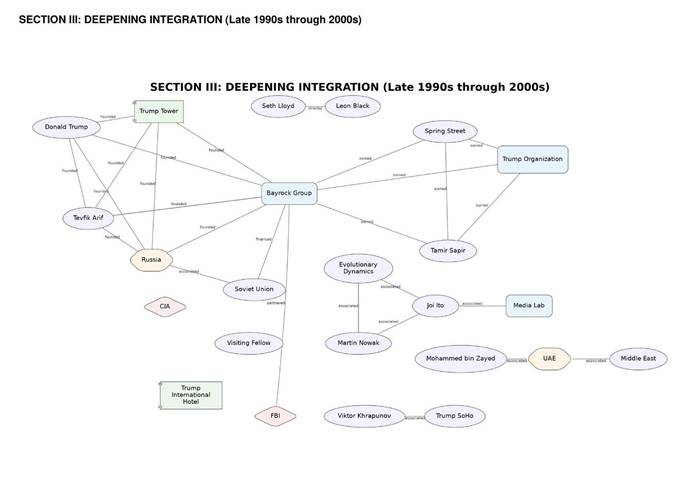
Network diagram: Section III — Deepening Integration (Late 1990s through 2000s). Centers on Bayrock Group as the nexus linking Tevfik Arif, Felix Sater, the Trump Organization, post-Soviet capital flows, Joi Ito, the MIT Media Lab, and the Epstein academic network.
Bayrock Group: The Trump-Russia Real Estate Nexus
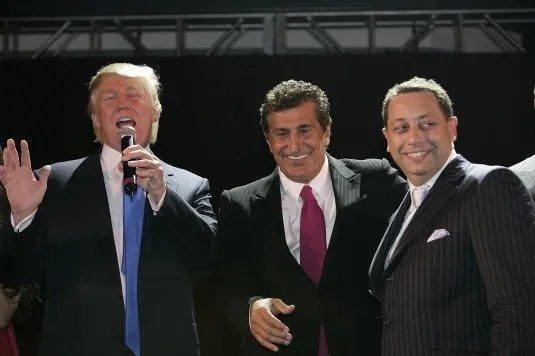
Donald Trump with Felix Sater (center) at a Trump Organization event. Sater served as Bayrock’s managing director and the primary interface between Trump’s licensing operation and the postSoviet capital networks Bayrock tapped for project financing.
As the Epstein network expanded beyond its original social and financial circles into overlapping spheres of luxury real estate, political influence, and transnational business dealings, it increasingly intersected with figures and intermediaries tied to Donald Trump’s property empire, including a constellation of Turkish, Russian, Ukrainian, and Kazakh actors operating at the nexus of capital flows, hospitality ventures, and post Soviet elite networks. In 2001, Tevfik Arif, a former Soviet official from Kazakhstan, founded Bayrock Group LLC and established offices in Trump Tower on the 24th floor, two floors directly below Donald Trump’s personal offices. This physical proximity would facilitate a business relationship that lasted nearly a decade and produced some of Trump’s most problematic real estate ventures. Bayrock specialized in developing luxury properties bearing the Trump brand, providing Trump with licensing fees and equity stakes while Bayrock secured financing and managed construction.
Arif’s background raised questions from the start. Born in 1953 in Kazakhstan, then part of the Soviet Union, Arif worked as an economist for the USSR Ministry of Commerce and Trade before transitioning into private business after the Soviet collapse. During the 1990s, as Kazakhstan privatized state assets, Arif’s family acquired the Aktyubinsk Chromium Chemicals Plant (ACCP) in Aktobe, Kazakhstan. The privatization process in Kazakhstan, like in Russia, was characterized by insider deals that transferred state assets to politically connected individuals at prices far below market value.
Bayrock’s corporate structure mirrored this opacity. According to Forbes, Bayrock was “a series of commonly controlled, but not wholly owned, limited liability companies” arranged in tiers. Bayrock Group LLC held majority or plurality interests in approximately 12 subsidiary holding companies, which in turn held majority interests in lower-tier companies corresponding to individual real estate projects. This structure made it difficult for regulators, creditors, or counterparties to trace ownership, liability, or capital flows.
In 2003, Bayrock hired Felix Sater as managing director. Sater, born Felix Mikhailovich Sheferovsky in Moscow in 1966, emigrated to Israel with his family before settling in Brighton Beach, Brooklyn. Sater’s father, Mikhail Sheferovsky, was identified by law enforcement as an underboss in Mogilevich’s organization. In 1991, while working as a broker at Bear Stearns, Sater got into an argument at the El Rio Grande restaurant in Manhattan that ended with Sater stabbing the other man in the face and neck with a broken cocktail glass stem, breaking his jaw and severing nerves. Sater was convicted of first-degree assault and served 15 months in minimum security.
In 1998, Sater pleaded guilty to participating in a $40 million stock fraud scheme orchestrated by Russian-Jewish organized crime figures. Faced with substantial prison time, Sater became a cooperating witness for the FBI. His cooperation was sealed under extraordinary secrecy, reportedly because he provided information related to national security matters. Attorney General Loretta Lynch, during her January 2015 confirmation hearings, testified that Sater “provided information crucial to national security and the conviction of over 20 individuals, including those responsible for committing massive financial fraud and members of Cosa Nostra.”
The Trump SoHo project, announced in 2006, exemplified this model. The $450 million, 46-story hotel-condominium at 246 Spring Street in Manhattan’s SoHo neighborhood was a joint venture between the Trump Organization, Bayrock Group, and the Sapir Organization. Trump contributed his brand in exchange for an 18% equity stake and management fees, while Bayrock and Sapir handled financing and construction.
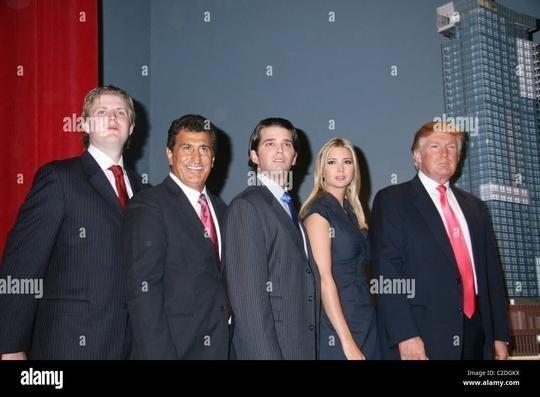
The Trump SoHo announcement event: Eric Trump, Felix Sater, Donald Trump Jr., Ivanka Trump, and Donald Trump before a scale model of the building. The $450 million project was financed in part through a loan chain that led to entities later named in a Kazakh money laundering lawsuit.
The financing for Trump SoHo came from sources that would later attract legal scrutiny. In 2007, Bayrock traded future profits from Trump SoHo and other projects in exchange for $50 million in financing from FL Group, an Icelandic investment company. As Icelandic Special Investigation Commission reporting and Luke Harding’s Collusion (2017) documented, “The FL Group financing for Trump SoHo reportedly included backing from companies with ties to the former Soviet Union. Icelandic investigators later documented its use as a conduit for post-Soviet capital.”
In 2010, Jody Kriss, a former Bayrock finance director, filed a racketeering lawsuit alleging that Bayrock was “substantially and covertly mob-owned and operated” (Kriss v. Bayrock [2] Group LLC, Case 10-cv-3959, E.D.N.Y., 2010). The suit claimed that Arif started the firm “backed by oligarchs and money they stole from the Russian people after the Soviet Union fell” and that the company’s real purpose was to “use the projects to launder money and evade taxes.” Kriss’s lawsuit also alleged that Sater threatened him when he raised concerns about Bayrock’s practices, threatening, according to court filings, to have Kriss electrically shocked, cut off his legs, and put him in the trunk of a car. The lawsuit was settled in 2018 after eight years of litigation, with no admission of guilt by either party.
In 2019, BTA Bank of Kazakhstan filed a separate civil lawsuit naming Sater and others, alleging they laundered approximately $40 million stolen from the bank through various schemes, including the Trump SoHo project. The lawsuit alleged that Sater helped Ilyas Khrapunov mask $3 million as down payments on three Trump SoHo condominiums. One exhibit included emails to Sater with SWIFT code details for an account at FBME Bank, a Tanzania-headquartered institution that was banned from operating in the United States in 2015 due to money laundering and terror financing allegations. In October 2025, after a retrial, Sater was found liable and ordered to pay $52 million in damages related to these money laundering allegations (BTA Bank v. Khrapunov [3] et al., Case 15-cv-5345, S.D.N.Y., 2019; Reuters, October 2025).
The 2009 Turkey Yacht Incident: Trafficking Allegations and Intelligence Implications
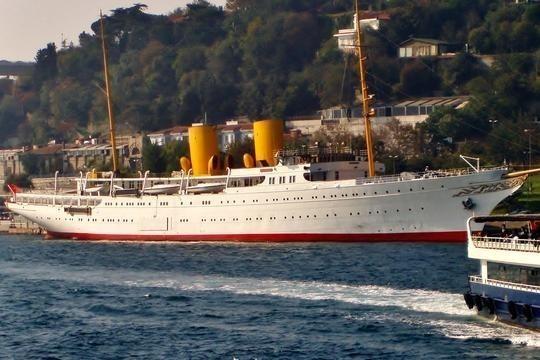
The Savarona, a historic yacht moored on the Bosphorus. In September 2009, Turkish police raided a luxury yacht moored off Antalya, uncovering what authorities described as a prostitution ring at a party that included Tevfik Arif.
In September 2009, Turkish police raided a luxury yacht called the Savarona moored off the coast of Antalya, Turkey. The raid uncovered what Turkish authorities described as a prostitution operation involving 10 Russian and Ukrainian women, several of whom were underage. Among those arrested was Tevfik Arif, founder of Bayrock Group, who was on the yacht with several business associates and the women.
Turkish prosecutors charged Arif and others with human trafficking and organizing prostitution. The charges alleged that the women, some as young as 16, had been brought to Turkey under false pretenses and coerced into providing sexual services to wealthy businessmen.
Also present on the yacht, though not charged, was Alexander Mashkevitch, a Kazakh-Israeli billionaire with extensive mining and natural resource holdings in Kazakhstan. Mashkevitch, along with partners Alijan Ibragimov and Patokh Chodiev, controlled the Eurasian Natural Resources Corporation (ENRC), one of the world’s largest mining companies. The trio, often referred to as “The Trio,” were accused by Belgian prosecutors of money laundering and corruption related to their acquisition of mining concessions in Kazakhstan during the privatization era.
The Turkish case against Arif eventually collapsed under circumstances that raised additional questions. Despite initial evidence and witness testimony, prosecutors dropped the charges in 2010, citing insufficient evidence. Arif was acquitted. However, the incident left a documented record of Arif’s presence in a situation involving underage women on a yacht with other businessmen connected to post-Soviet wealth and, through Bayrock, to Donald Trump.
What is documented is that Trump’s business partnerships with Bayrock continued until 2008, when the relationship ended following the financial crisis and the exposure of Sater’s criminal background by The New York Times. By that point, Trump had spent nearly a decade in business partnership with a company founded by an individual who would later be arrested in a trafficking investigation, managed by a convicted felon with ties to Russian organized crime, and financed through opaque structures connected to post-Soviet capital.
The Academic Legitimization Infrastructure
Jeffrey Epstein’s cultivation of academic relationships extended far beyond simple philanthropy, creating an infrastructure that provided legitimacy, intellectual cover, and access to elite institutions that facilitated his broader operations.
Epstein’s most significant academic relationship was with Martin Nowak, a mathematical biologist who Epstein cold-called while Nowak was a researcher at the Institute for Advanced Study in Princeton, New Jersey. In his 2011 book SuperCooperators, Nowak described how Epstein promised to build an institute for him. This promise materialized in 2003 when Nowak moved to Harvard University and established the Program for Evolutionary Dynamics with a $6.5 million donation from Epstein, Harvard’s largest single donation from Epstein, as Harvard’s 2020 investigation confirmed (Harvard Report Concerning Jeffrey E. Epstein’s Connections to Harvard University, May 2020, pp. 4-11).
The Program for Evolutionary Dynamics became the physical center of Epstein’s academic operations. Office 610 of the PED building was referred to by some as “Jeffrey’s Office.” Harvard’s 2020 investigation found that “Epstein maintained keycard and passcode access to PED’s offices and visited more than 40 times between 2010 and 2018,” well after his 2008 conviction for soliciting prostitution from a minor. These visits occurred as recently as October 2018, less than a year before his July 2019 arrest on federal sex trafficking charges. During these visits, Epstein was typically accompanied by young women described as his assistants, raising questions about whether Harvard facilities were being used to facilitate activities related to his exploitation network.

Jeffrey Epstein at Harvard. By the time this photograph was taken, Epstein had been convicted of a sex offense in Florida yet Harvard’s Program for Evolutionary Dynamics maintained an office known internally as ‘Jeffrey’s Office,’ with Epstein retaining keycard access
The MIT Media Lab relationship, directed by Joi Ito from 2011 through his September 2019 resignation, represented Epstein’s most extensive institutional integration in the post-conviction period. Ito initially acknowledged accepting $525,000 from Epstein for the Lab and $1.2 million for his personal investment funds. Internal MIT emails obtained by Ronan Farrow’s investigation, published in The New Yorker on September 6, 2019, showed Ito and Media Lab staff systematically concealing Epstein’s role as donor and intermediary. When an Epstein donation appeared in MIT’s system, Peter Cohen flagged it saying “Jeffrey has an account that is supposed to allow him to make small gifts anonymously.” In another email, Cohen wrote plainly: “Jeffrey money, needs to be anonymous.” On one occasion, Ito emailed staff that a $2 million gift from Bill Gates was “directed by Jeffrey Epstein,” to which Cohen responded: “For gift recording purposes, we will not be mentioning Jeffrey’s name as the impetus for this gift.” Media Lab staff referred to Epstein as “Voldemort” or “he who must not be named,” a designation, as The New Yorker noted, that “acknowledged both his toxicity and the deliberate institutional choice to maintain the relationship despite that toxicity.”
Seth Lloyd, MIT professor of mechanical engineering specializing in quantum computing, accepted $225,000 from Epstein after his conviction, with payments occurring in 2012 and 2017 according to IRS filings from Epstein’s foundations. MIT’s 2020 investigation concluded that Lloyd “purposefully failed to inform MIT that Epstein, a convicted sex offender, was the source of two donations to support his research” (MIT Report on Engagements with Jeffrey Epstein, January 2020, p. 23). Lloyd was placed on administrative leave in 2020 and received a five-year period of restrictions, though he maintained that “Epstein did support some good science: perhaps the only good thing he did.”
Nicholas Negroponte, who co-founded the Media Lab in 1985 and served as its director for twenty years, defended accepting Epstein’s money during a September 4, 2019 all-hands meeting. Negroponte stated that if he could “wind back the clock,” he would still say “Take it,” repeating more emphatically, “Take it.” The comment shocked many in the audience, with at least one person sobbing, another telling Negroponte to shut up, and many walking out of the meeting.
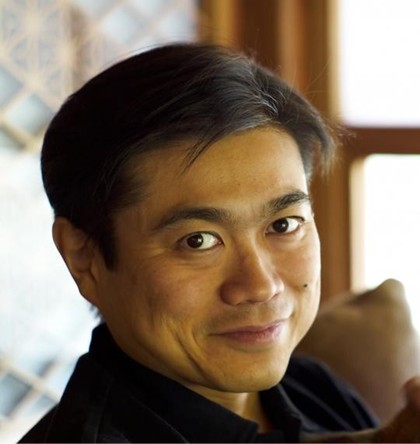
Ito, director of the MIT Media Lab from 2011 until his September 2019 resignation. Internal MIT emails showed that Ito and Media Lab staff systematically concealed Epstein’s role as donor and intermediary, referring to him internally as ‘Voldemort’ or ‘he who must not be named.’
George Church, professor of genetics at Harvard Medical School, maintained extensive contact with Epstein following his conviction. Church’s 2014 calendar documented multiple meetings and phone calls with Epstein, including a November 30 dinner with Epstein, Joi Ito, Reid Hoffman, and Martin Nowak at the Program for Evolutionary Dynamics, six years after Epstein’s conviction. As BuzzFeed News documented in August 2019, “George Church received $2 million for his Harvard genetics research through Epstein’s introduction of Leon Black, who made the donation after Epstein facilitated the connection, illustrating Epstein’s value as a network node providing access to wealthy donors.”
The DOJ files released in January 2026 contain more than 4,000 documents referencing Nowak, illustrating the extent of his communication with Epstein over many years. These documents include a 2014 message from Nowak to Epstein stating “our spy was captured after completing her mission,” to which Epstein responded “did you torture her,” suggesting either inappropriate humor or references to activities whose nature cannot be determined from available context, as reported by Inside Higher Ed in February 2026. Harvard’s decision to admit Epstein as a Visiting Fellow in the Psychology Department for the 2005-2006 academic year exemplifies how institutions compromised standards to accommodate wealthy donors. Stephen Kosslyn, then psychology department chairman, recommended Epstein’s admission despite Epstein’s lack of a bachelor’s degree and qualifications to conduct research required of the position. Between 1998 and 2002, Epstein had given Harvard $200,000 to support Kosslyn’s work, creating a financial relationship that preceded the Visiting Fellow recommendation. In his application for a second year as visiting fellow, Epstein wrote that he planned to study the “derivation of ‘power’ (Why does everybody want it?) in an ecological social system that would include variables for reputation, trust or awe, and the inherent strategically diverse tactics of deception.” He was forced to withdraw from the fellowship in fall 2006 when he faced Florida charges of unlawful sex with minors. The academic network’s persistence after Epstein’s conviction demonstrates institutional and individual failures of judgment. These responses came only after intense media pressure and public outcry following Epstein’s July 2019 arrest and August 2019 death in custody, suggesting that institutions would have continued accommodating Epstein indefinitely without external accountability
Erik Prince: From Blackwater to Shadow Diplomacy

Erik Prince, founder of Blackwater USA, photographed at a policy forum. Prince’s trajectory from Navy SEAL to founder of the largest private military contractor in American history and ultimately to back-channel operator connecting the UAE and the incoming Trump administration traces a consistent line: the privatization of state power and its conversion into financial and political leverage.
Erik Prince, founder of the private military contractor Blackwater USA (later renamed Xe Services and Academi), emerged during the 2000s as a significant figure at the intersection of military operations, intelligence activities, and international business. Prince founded Blackwater in 1997 in Moyock, North Carolina, initially as a training facility for military and law enforcement personnel. Following the September 11, 2001 attacks, Blackwater expanded rapidly as the U.S. government outsourced security operations in Iraq and Afghanistan to private contractors. By the mid-2000s, Blackwater employed thousands of personnel and held contracts worth hundreds of millions of dollars with the State Department, the Defense Department, and the CIA. Blackwater’s operations in Iraq became controversial following the 2007 Nisour Square incident in Baghdad, where Blackwater contractors killed 17 Iraqi civilians and wounded 20 others. The incident sparked international outrage and led to criminal prosecutions of several Blackwater employees. Congressional investigations revealed that Blackwater had operated with minimal oversight, had engaged in conduct that violated rules of engagement, and had cultivated relationships with U.S. military and intelligence officials that allowed the company to avoid accountability.
Prince personally maintained close relationships with CIA officials and coordinated operations that went beyond conventional security contracting. According to testimony from former CIA officers and investigative reporting, Prince was involved in covert operations including targeted assassination programs, intelligence collection in denied areas, and logistics support for CIA operations that could not be conducted through official channels. During this period, Prince also developed business relationships in the Middle East, particularly with the United Arab Emirates. The UAE hired Blackwater-affiliated contractors to train Emirati special forces units. This work provided Prince with access to UAE leadership, including Crown Prince Mohammed bin Zayed Al Nahyan (MBZ), and positioned him as a trusted advisor on security matters. Prince’s relationship with George Nader developed through these Middle Eastern operations. Nader, as an adviser to MBZ, connected Prince to Emirati officials and facilitated business opportunities.
In a 2010 deposition related to Blackwater’s operations in Iraq, Prince identified Nader as a “business development consultant.” This relationship, formed during the 2000s, would become significant during the 2016 U.S. presidential election when Nader and Prince participated in a controversial meeting in the Seychelles that attracted special counsel scrutiny, documented in the Mueller Report (Vol. I, pp. 147-162) [11]. In 2010, Prince moved to Abu Dhabi, where he continued working with Emirati security forces while developing other business interests. Prince’s departure from the United States also occurred as Blackwater faced increasing legal and financial pressure from lawsuits, criminal investigations, and congressional scrutiny. The pattern that emerges from Prince’s activities during this period is of an individual who learned to operate across boundaries: between military and civilian spheres, between government operations and private business, between legitimate security contracting and activities that raised legal and ethical questions. Prince cultivated relationships with intelligence officials who valued his willingness to undertake operations that required plausible deniability. He developed expertise in regions where U.S. interests overlapped with authoritarian regimes seeking military capabilities. He built a business model predicated on operating in spaces where conventional rules were ambiguous or not enforced. These capabilities would make Prince valuable to actors seeking to conduct influence operations, facilitate covert transactions, or provide informal channels between governments.
SECTION IV: CONSOLIDATION AND EXPOSURE (2010-2020)

Network diagram: Section IV — Consolidation and Exposure (2010–2020). Maps Mohammed bin Salman’s position relative to Turki Al-Sheikh, the Public Investment Fund, the Red Sea Project, Prince Alwaleed, Jamal Khashoggi, Qatar, FIFA, and the interconnected Gulf advisory networks operating around Vision 2030.
The 2008 Financial Crisis and Accelerated Capital Flight
The global financial crisis of 2008 had a paradoxical effect on the networks under investigation. While the crisis destroyed wealth on a massive scale and led to increased regulatory scrutiny of financial institutions, it also accelerated capital flight from unstable economies and created distressed asset opportunities that individuals with access to liquid capital could exploit. As the Financial Action Task Force [41] documented in its 2010 report on money laundering vulnerabilities, the crisis left alternative channels for capital movement, including those used for money laundering and illicit capital movement, relatively intact or even strengthened, as legitimate institutions contracted and compliance weakened.
In the United States, the collapse of the subprime mortgage market and the failure of major financial institutions led to massive government intervention, including bailouts of banks deemed too large to fail. Real estate values collapsed, unemployment rose, and credit markets froze. Developers who had relied on conventional financing found themselves unable to secure loans, and many projects were abandoned or foreclosed. For individuals and entities with access to cash, particularly cash held outside the regulated banking system, the crisis created opportunities. Distressed properties could be purchased at steep discounts. Sellers desperate for liquidity accepted terms they would have rejected in normal markets. Due diligence processes, already inconsistent, became more perfunctory as survival took priority over compliance.
Russian and post-Soviet capital, much of which was held in cash or near-cash instruments outside Western banking systems, was particularly well-positioned to exploit these opportunities. As Craig Unger documented in House of Trump, House of Putin (2018) and as FinCEN Advisory FIN-2017-A003 [67] and the U.S. GAO report GAO-20-328 (2020) confirmed, oligarchs and organized crime figures who had spent the 1990s and 2000s accumulating wealth in Russia, Kazakhstan, and other former Soviet republics now sought to move that wealth into Western assets at historically undervalued prices. The crisis created ideal conditions for money laundering: sellers needed liquidity, regulators were focused on preventing systemic collapse rather than monitoring individual transactions, and the volume of distressed transactions made it difficult to distinguish legitimate investment from capital flight.
Trump’s business model during this period aligned perfectly with these conditions. Having largely exited the development business in favor of licensing, Trump did not face the same financing pressures as developers relying on bank loans. As Louise Story and Stephanie Saul reported in the New York Times in February 2015 [20] [101], and as Unger detailed in Chapter 7 of House of Trump, House of Putin, individuals with Russian passports or connections continued acquiring units in Trump-branded buildings despite the financial crisis, suggesting Trump properties served as capital preservation vehicles for foreign wealth during economic uncertainty.
Thomas Barrack’s Colony Capital benefited significantly from this dynamic. The firm’s focus on distressed assets positioned it to acquire properties from overleveraged developers and financial institutions forced to liquidate holdings. As the Los Angeles Times reported on August 5, 2016, and as the Eastern District of New York’s 2021 indictment of Barrack confirmed (U.S. v. Thomas Barrack, paragraphs 12-18), Barrack’s relationships in the Middle East provided access to sovereign wealth capital from Gulf funds seeking discounted entry into U.S. real estate. The crisis was, from Barrack’s position, an opportunity.
Simultaneously, sovereign wealth funds from the Middle East, particularly from the UAE, Qatar, and Saudi Arabia, expanded their investments in Western real estate and financial institutions. These funds, capitalized by oil revenues that remained substantial despite commodity price volatility, sought to diversify away from energy-dependent portfolios and to gain influence in Western economies. The financial crisis provided entry points into prestigious properties and institutions that would have been difficult to access in normal markets. The crisis also accelerated regulatory discussions about money laundering and terrorist financing through real estate. Treasury Department officials and congressional investigators recognized that the collapse in real estate values and the increase in distressed transactions created vulnerabilities that bad actors could exploit. However, the real estate industry successfully resisted efforts to impose anti-money laundering obligations comparable to those faced by banks. Purchases through shell companies remained legal and common. This regulatory failure meant that the networks documented in this investigation could continue operating largely as before, but with even better opportunities to acquire assets at favorable prices.
By the end of the 2000s, the foundational elements identified in earlier periods had evolved into mature operational networks. Trump’s dependency on foreign capital from opaque sources had deepened. Epstein’s exploitation network had survived prosecution through the 2008 non-prosecution agreement and continued operating. Nader had positioned himself as an adviser to UAE leadership. Barrack had built a real estate empire that bridged U.S. capital markets and Middle Eastern sovereign wealth. Prince had transitioned from military contractor to informal operative capable of facilitating covert operations and diplomatic back channels.
Part 1: The FIFA Nexus and Qatar’s Ascendancy
FIFA World Cup Qatar 2022 official branding. The tournament, awarded amid a Swiss criminal investigation into FIFA corruption, became the centerpiece of a decade-long Qatari soft power campaign. DOJ prosecutions in the FIFA scandal documented how sports governance organizations could be systematically captured through targeted disbursements that exploited structural weaknesses and insider self-interest.
Yet the portrayal of Barrack as a discreet strategic conduit to the UAE obscures the extent to which he also operated as an opportunistic power broker whose overlapping financial, political, and international interests frequently cut across competing Gulf agendas, including his reported role in facilitating Qatar’s ascent within global football circles and the broader constellation of relationships surrounding Doha’s deeply controversial FIFA World Cup bid. The 2010s began with a decision that would expose the architecture of transnational influence that had developed over the previous three decades. On December 2, 2010, FIFA awarded hosting rights for the 2022 World Cup to Qatar, a nation smaller than Connecticut with summer temperatures exceeding 120 degrees Fahrenheit and no existing football infrastructure capable of hosting a tournament of that scale.
The decision defied conventional expectations and triggered investigations that would reveal systematic corruption extending across multiple continents and involving government officials, sports executives, financial institutions, and the informal influence networks documented in earlier sections of this report. Qatar’s bid was led by Hassan Al-Thawadi, who would serve as secretary general of the Supreme Committee for Delivery and Legacy. Behind the public narrative, however, was a systematic campaign involving payments to FIFA officials, strategic media investments, and the cultivation of relationships with individuals who could influence votes or silence criticism.
The Al-Khayyat brothers, Ramez and Moutaz, occupied an important position within Qatar’s business infrastructure during this period. As chairmen of Estithmar Holdings, they controlled a conglomerate operating across healthcare, hospitality, and agriculture with extensive operations in Qatar and growing investments internationally. Their relationship with the Qatari ruling family, particularly through Doha Bank connections, positioned them as individuals who could facilitate transactions and relationships that official state entities preferred to keep at arm’s length.
Doha Bank’s structure is critical to understanding these relationships. Sheikh Fahad Bin Mohammad Bin Jabor Al-Thani, a member of Qatar’s ruling family with military background, serves as the bank’s chairman. His brother, Sheikh Suhaim Bin Abdulaziz Al-Thani, sits on the board of Estithmar Holdings alongside the Al-Khayyats. The Qatar Investment Authority [50], Qatar’s sovereign wealth fund, holds a majority stake in Doha Bank. This web of relationships meant that major financial decisions involving Doha Bank could be coordinated with state interests, while maintaining the appearance of private sector activity. The London litigation filed in 2023 by eight Syrian nationals [6] would later allege that the Al-Khayyats, working through Doha Bank and with the knowledge of Qatari state entities, provided financial support to Jabhat al-Nusra during Syria’s civil war. The allegations describe a system where funds moved through Doha Bank accounts, were routed to entities controlled or influenced by the Al-Khayyats, and ultimately reached armed groups operating in Syria. Witness testimony in the case included claims [6] that senior Qatari officials were aware of and involved in these financial flows.
The case has not proceeded to final judgment due to rulings on state immunity and jurisdictional issues. However, the allegations are consistent with intelligence reporting from multiple Western intelligence services documenting Qatar’s financial relationships with extremist organizations in Syria, Libya, and across North Africa. Qatar’s foreign policy during the 2010s was characterized by aggressive regional ambitions that often conflicted with U.S. policy priorities. Qatar supported the Muslim Brotherhood across the Middle East, provided haven to Hamas leadership, maintained relationships with Iran despite that country’s adversarial posture toward U.S. allies, and backed armed groups in Syria and Libya whose objectives did not align with U.S. stabilization efforts. However, Qatar simultaneously maintained critical relationships with the United States. Al Udeid Air Base [45], located in Qatar, serves as the forward headquarters for U.S. Central Command and hosts thousands of U.S. military personnel. Qatar invested billions in U.S. real estate, held substantial positions in U.S. financial institutions, and cultivated relationships with former U.S. officials who could advise on navigating Washington’s political landscape. This dual-track approach created space for Qatar to pursue objectives that would otherwise face more sustained opposition.
Nasser Al-Khelaifi: Media Power and Alleged Torture
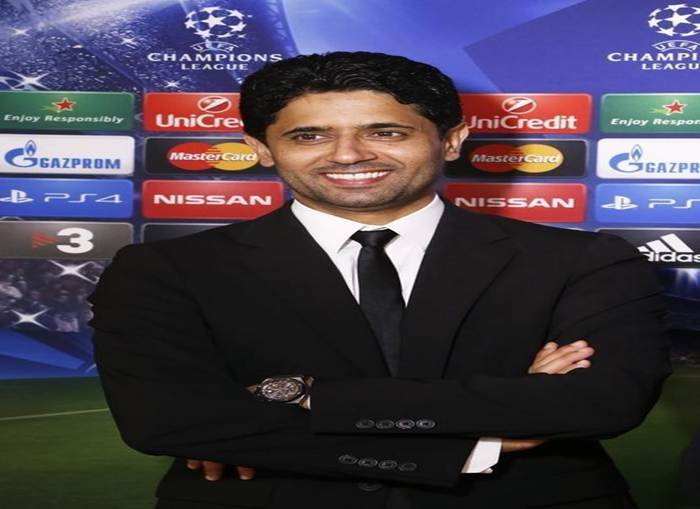
Nasser Al-Khelaifi, chairman of Paris Saint-Germain FC and head of beIN Media Group, at a UEFA Champions League event. Al-Khelaifi’s simultaneous control of Qatar’s state sports broadcasting infrastructure and its flagship European football club exemplifies the Qatari state’s strategy of using sports and media assets as instruments of geopolitical positioning.
Nasser Al-Khelaifi emerged during the 2010s as one of Qatar’s most visible international figures. Born in 1973, Al-Khelaifi was a professional tennis player before transitioning into business and government roles. In 2011, he became chairman of Qatar Sports Investments, the sovereign wealth fund vehicle through which Qatar acquired Paris Saint-Germain Football Club. Al-Khelaifi simultaneously served as chairman of beIN Media Group, Qatar’s international sports broadcasting company, and held the position of minister without portfolio in the Qatari government. As the Brookings Institution [45] and Carnegie Endowment for International Peace [44] have both documented, Al-Khelaifi’s simultaneous control of Qatar’s state sports broadcasting infrastructure and its flagship European football club exemplifies the Qatari state’s strategy of using sports and media assets as instruments of geopolitical positioning.
This concentration of roles positioned Al-Khelaifi as a crucial node in Qatar’s soft power strategy. Paris Saint-Germain’s transformation from a mid-tier French club into a global brand occurred through massive Qatari investment in player acquisitions, including record-breaking transfers that reshaped European football’s financial landscape. BeIN Media Group’s acquisition of sports broadcasting rights across multiple territories gave Qatar leverage over how sporting events were covered and which narratives received amplification. Al-Khelaifi’s relationship with FIFA and its officials became the subject of Swiss criminal investigations. In 2020, Swiss federal prosecutors charged Al-Khelaifi [7] in connection with a broader investigation into television rights for the 2026 and 2030 World Cups. The allegations centered on meetings between Al-Khelaifi and Jerome Valcke, then FIFA’s secretary general, regarding beIN Media’s acquisition of Middle Eastern broadcasting rights. Prosecutors alleged that Al-Khelaifi provided Valcke with benefits, including use of a luxury villa in Sardinia, in exchange for favorable decisions on broadcasting contracts. Al-Khelaifi was acquitted twice by Swiss courts, with judges determining that prosecutors had not proven criminal conduct beyond reasonable doubt. However, the investigations exposed the ecosystem in which FIFA decisions were made.
In January 2020, a French-Algerian lobbyist named Tayeb Benabderrahmane entered Qatar on a business visa. According to Benabderrahmane’s later testimony, he had acquired through Al-Khelaifi’s former butler documents and a mobile phone belonging to Al-Khelaifi containing sensitive information relating to both the 2022 World Cup bid and beIN Media’s acquisition of broadcasting rights for subsequent tournaments. Benabderrahmane alleges that he was detained by Qatari authorities shortly after arrival, held in confinement for six months, and subjected to torture to force him to surrender the documents and agree not to disclose their contents. The torture allegations, filed with French authorities in 2022 and confirmed by the Paris prosecutor’s opening of a preliminary investigation in January 2023 [16], include physical abuse and psychological coercion conducted under conditions Benabderrahmane describes as brutal. After six months, Benabderrahmane was released from formal detention but placed under house arrest until November 2020, when he signed a confidentiality agreement pledging not to disclose the materials he had obtained.
In 2022, Benabderrahmane filed complaints with French authorities implicating Al-Khelaifi as the sponsor of his detention and torture. By March 2023, three investigating judges had been assigned to examine the allegations under French law provisions addressing kidnapping, sequestration with torture, extortion, and criminal association. Al-Khelaifi has strenuously denied all allegations, with his legal representatives characterizing Benabderrahmane as a professional criminal who had changed his story multiple times. They note that Benabderrahmane, along with two former French police officers, faced separate charges in France for theft, invasion of privacy, and conspiracy to commit blackmail using the materials allegedly taken from Al-Khelaifi. In May 2023, a Qatari criminal court sentenced Benabderrahmane to death in absentia on charges of intelligence with a foreign power, a sentence issued while French authorities were simultaneously investigating his allegations against Al-Khelaifi.
Qatar officially notified French authorities of this conviction in July 2023. The United Nations Working Group on Arbitrary Detention subsequently issued Opinion No. 28/2025 in July 2025 [16], concluding that Benabderrahmane’s deprivation of liberty in Qatar was arbitrary and violated due process guarantees under international human rights law. The International Centre for Settlement of Investment Disputes ordered Qatar not to enforce the conviction or seek Benabderrahmane’s extradition through Interpol. The death sentence against Benabderrahmane, issued while French authorities were investigating his allegations against Al-Khelaifi, suggests coordination between Qatar’s judicial system and efforts to intimidate or silence individuals who threaten to expose compromising information about powerful Qataris.
The Broader FIFA Corruption Exposure
On May 27, 2015, Swiss police, acting on U.S. arrest warrants, raided the Baur au Lac hotel [7] in Zurich where FIFA officials were staying ahead of FIFA’s annual congress. Seven officials were arrested, marking the beginning of a massive U.S. Department of Justice investigation into corruption [7] spanning multiple World Cup bidding processes and commercial contracts. The indictments, which would eventually expand to include dozens of defendants [7], alleged racketeering, wire fraud, and money laundering involving bribes totaling over $150 million.
The investigation exposed FIFA’s governance as systemically compromised. Votes for World Cup hosting rights were sold to the highest bidder. Broadcasting contracts were awarded based on bribes rather than competitive bidding. Commercial partnerships were secured through payments to FIFA officials rather than legitimate business negotiations. The corruption was not isolated to particular regions or individuals but represented the dominant operating model across FIFA’s executive committee and regional confederations. Qatar’s successful 2022 bid occurred within this environment [17]. While the U.S. investigation did not result in charges specifically related to the Qatar bid, investigations by European authorities and journalistic inquiries documented extensive irregularities. These included financial payments to African football federations around the time of the vote, strategic partnerships and investments with individuals connected to FIFA voting members, and the cultivation of relationships with intermediaries who could deliver votes in exchange for various forms of consideration.
Critically, the FIFA investigations [7] revealed how sovereign wealth and state resources could be deployed to capture international institutions. Qatar was not simply bribing individuals; it was offering investments, commercial partnerships, infrastructure development in home countries of FIFA voters, and long-term business relationships that provided benefits far exceeding simple cash payments. This approach made traditional anticorruption frameworks inadequate.
The Al-Khayyats’ position within this ecosystem was structural rather than transactional. As chairmen of a major Qatari conglomerate with ruling family connections, they represented the type of entity through which such relationships could be facilitated. Their construction company, Urbacon Trading and Contracting, played a significant role in the World Cup, specifically with the construction of critical facilities including the Lekhwiya Sports Complex. If Qatar needed to make investments in countries with FIFA voters, to provide business opportunities to individuals connected to FIFA officials, or to route funds through apparently private entities to obscure state involvement, Estithmar Holdings represented exactly the kind of vehicle that could accomplish those objectives.
Part 2: The Seychelles Meeting and Back-Channel Diplomacy
On January 11, 2017, nine days before Donald Trump’s inauguration, a meeting occurred at the Four Seasons Hotel in the Seychelles Islands that would become a focal point of special counsel investigations into Russian interference in the 2016 election and potential coordination with Trump associates. The meeting brought together Erik Prince, founder of Blackwater and informal Trump adviser; Kirill Dmitriev, CEO of the Russian Direct Investment Fund (RDIF), Russia’s $10 billion sovereign wealth fund sanctioned by the United States after Russia’s 2014 annexation of Crimea; and George Nader, Lebanese-American businessman serving as adviser to UAE Crown Prince Mohammed bin Zayed Al Nahyan. Prince testified to the House Permanent Select Committee on Intelligence in November 2017 that he traveled to the Seychelles to meet with UAE officials about potential business opportunities and that his encounter with Dmitriev was spontaneous, claiming the meeting occurred “down in the bar after dinner” and lasted approximately 30 minutes “over a beer,” during which they discussed “topics ranging from oil and commodity prices to how much his country wished for resumption of normal trade relations.”
However, evidence obtained by Special Counsel Robert Mueller contradicted Prince’s account. George Nader, granted limited immunity in exchange for cooperation, told investigators that he had arranged the meeting specifically to establish a line of communication between the incoming Trump administration and the Russian government. Mueller’s investigation uncovered text messages and documents revealing pre-meeting coordination. On January 3, 2017, Nader sent Dmitriev information about Prince. On January 9, two days before the Seychelles meeting, Nader texted Prince: “This guy [Prince] is designated by Steve [Bannon] to meet you! I know him and he is very very well connected and trusted by the New Team.” The reference to Bannon, Trump’s incoming chief strategist, suggested Prince was acting with knowledge or authorization from the transition team, as documented in the Mueller Report (Vol. I, pp. 147-162) [11] and the Senate Intelligence Committee’s Report on Russian Active Measures (2020, Vol. 5, pp. 890-912) [12] [11].
Location data from Prince’s mobile phone placed him at Trump Tower in New York City on January 4, 2017, meeting with Trump transition officials for approximately three hours. During this time, Prince received and opened email attachments about Dmitriev. When questioned about whether he discussed Dmitriev with Bannon during this period, Prince stated he could not recall. Dmitriev traveled to the Seychelles on January 11 with his wife, Natalia Popova, who is reportedly close to Putin’s family and sits on the board of Innopraktika, a technology foundation owned by Putin’s daughter. After the meeting, Dmitriev prepared a memo describing discussions with Prince that proposed specific initiatives to improve U.S.-Russia relations, including a joint special forces mission targeting ISIS, easing of sanctions in exchange for Russian concessions, investment by Russian entities in U.S. Midwest infrastructure, cooperation on Syria, and nuclear weapons discussions. The memo was sent to Richard Gerson, head of Falcon Edge Capital hedge fund in New York, who was reportedly in the Seychelles during the same period. Dmitriev’s reaction to the meeting was negative. According to Mueller’s report, Dmitriev expressed disappointment for two reasons: first, he believed Prince lacked sufficient authority within the incoming administration to establish meaningful communications; second, he had hoped for more substantive strategic discussions.
When Prince returned to the United States on January 12, he contacted Bannon’s personal assistant to arrange a meeting. Bannon later told Mueller’s office that he never discussed Dmitriev, RDIF, or any meetings with Russian individuals with Prince, and stated that had Prince mentioned such a meeting, Bannon would have remembered and objected. The contradictions between Prince’s testimony, Nader’s account, documentary evidence, and Bannon’s statements raised serious questions about whether Prince lied to Congress, though no charges were filed. The Seychelles meeting’s significance extends beyond the question of whether it constituted an attempt to establish a Trump-Russia back channel. The meeting reveals the UAE’s role as convener and facilitator: MBZ, through Nader, brought together a Trump associate and a Putin confidant on UAE territory, at a resort owned by MBZ.
The UAE positioned itself as intermediary between the incoming U.S. administration and Russia, demonstrating its ambitions to play a larger role in geopolitics beyond traditional Gulf concerns. George Nader’s position in this operation is particularly revealing. His criminal history, two child sex offense convictions in separate jurisdictions, did not prevent him from operating in these networks or from maintaining access to senior officials in multiple countries. Nader’s cooperation with Mueller provided investigators with extensive information about UAE efforts to influence U.S. policy and about coordination between Trump associates and foreign governments during the transition period. Nader’s role as an intermediary in overlapping foreign influence operations ultimately unfolded against a broader regional backdrop in which Mohammed bin Salman’s ambitious restructuring of the Saudi state and economy increasingly became entangled in factional rivalries, external lobbying networks, and competing geopolitical agendas that often diluted, redirected, or sidelined elements of his reform program.
MOHAMMED BIN SALMAN: FROM REFORMER TO BEING SIDELINED BY CORRUPT ADVISORS, AND SENIOR MEMBERS OF THE OLD GUARD
Mohammed bin Salman’s Stated Anti-Corruption Rationale Versus Implementation Reality The November 4 and 5, 2017, detention of over 200 Saudi princes, ministers, businessmen, and senior officials at the Ritz-Carlton in Riyadh has been analyzed, almost universally, as either a bold anti-corruption initiative or a nakedly cynical power grab. Both framings are insufficient, and both obscure the more consequential story: what began as a genuine, if blunt, attempt by Mohammed bin Salman to break the financial networks that had consistently frustrated Vision 2030 was systematically captured by the senior figures those networks served, redirected to serve their own consolidation purposes, and ultimately concluded in ways that left the most structurally dangerous individuals not only free but better positioned than before. The purge was real. So was its subversion. Compounding the problem was the extent to which the Crown Prince appeared unaware of how completely he was encircled by figures fundamentally opposed to many of his long term objectives, individuals whose public displays of loyalty often masked deeply entrenched personal, ideological, and financial interests that diverged sharply from the transformative vision they claimed to support. (Source: Karen Elliott House, On Saudi Arabia (2012), pp. 201-225 [90]; Karen Young, The Political Economy of Energy, Finance and Security in the United Arab Emirates (2014), pp. 89-112 [91]; Bruce Riedel, Kings and Presidents: Saudi Arabia and the United States Since FDR (2018), Chapter 9 [92]) Understanding what actually happened requires setting aside the convenient narrative of MBS as master choreographer of a political purge disguised as reform. The evidence, examined in full, suggests a more complicated dynamic: a crown prince who understood he was operating inside a system that predated him, who had genuine reasons to move against specific nodes of that system, and who found that the moment of apparent maximum power was also the moment when his structural limitations became impossible to conceal. What emerged from the Ritz-Carlton was not a consolidated reformer nor a willing accomplice to corruption, but a leader who had reached the ceiling of what his authority could actually deliver against opponents far more experienced at institutional manipulation.
Saudi Attorney General Saud al-Mojeb announced the detentions with a statement characteristic of the rhetorical confidence that preceded each subsequent disappointment, declaring that the operation represented a significant step in combating corruption at the highest levels of Saudi society, that the kingdom would no longer tolerate corrupt practices regardless of position or family connection, and that those responsible would face accountability through legal processes. Mohammed bin Salman offered his own framing in an October 2018 Bloomberg Television interview conducted well after most detainees had been quietly released following settlement agreements. He said the operation’s purpose was not simply chasing bad actors or recovering stolen money, though both objectives had been accomplished, but rather strengthening governance systems and demonstrating that no individual, regardless of accumulated wealth or elevated position, enjoyed immunity from accountability. He characterized the purge as sending a very strong message throughout Saudi society that corruption would not be tolerated at any level.
The operation’s purpose was not simply chasing bad actors or recovering stolen money (though both objectives had been accomplished) but rather strengthening governance systems and demonstrating that no individual, regardless of accumulated wealth or elevated position, enjoyed immunity from accountability. (Source: Mohammed bin Salman, Bloomberg Television interview, October 3, 2018 [93]) If that description had been accurate, the operation would have marked an unprecedented assertion of the rule of law in a kingdom whose governance had long operated through impunity rather than accountability. It would have created prosecutorial precedent, established factual records of wrongdoing through court proceedings, and demonstrated that reform rhetoric could translate into lasting institutional change rather than another cycle of palace politics dressed in the language of modernization. The record of what actually occurred during the detention period and in the years following suggests that these ambitions ran directly into obstacles that MBS’s considerable formal authority was insufficient to overcome, and that the most senior figures in the networks he was targeting had sufficient reach into the institutions required for accountability that, alas, full accountability was never going to materialize from this process.
Alleged Systematic Violations of Due Process and the Absence of Legal Infrastructure
No formal criminal charges were filed against any individual detained during the Ritz-Carlton purge, despite Saudi Arabia’s Attorney General having framed the operation as a legal accountability process. No criminal indictments were issued. No bills of particulars specifying alleged corrupt acts with supporting evidence were provided to detainees or made public through court filings. No trial dates were set. No formal judicial proceedings occurred that would have created a public record of what had been alleged and on what evidentiary basis. Detainees faced indefinite detention without knowing the specific accusations against them beyond the vague designation of corruption, were denied access to legal counsel during initial weeks of interrogation despite legal representation being a fundamental requirement of any system operating according to recognizable rule of law principles, and were prevented from communicating with family members who were left with no information about their relatives’ physical condition or the conditions under which they might eventually be released.
The interrogation process, as documented through multiple accounts given to Wall Street Journal journalists and reported by The Atlantic, bore no resemblance to a legitimate investigative proceeding. Rather than gathering evidence to support formal prosecution, interrogators pressed detainees to sign settlement agreements transferring substantial portions of their assets in exchange for freedom from indefinite detention. The process was coercive by design. Some detainees reported physical abuse, including beatings severe enough to require medical treatment, being held in stress positions for extended periods, and systematic sleep deprivation through interrogations conducted at irregular hours. The Saudi government denied these allegations. Prince Alwaleed bin Talal, whose 83-day detention attracted the most international attention given his status as Saudi Arabia’s wealthiest businessman with a Forbes estimated fortune of approximately seventeen billion dollars, stated in a Bloomberg Television interview following his January 2018 release that while he had not experienced direct physical violence of the kind others described, there was unambiguously psychological torture through the interrogation methods and the oppressive uncertainty of not knowing when or whether release would come. When asked what the authorities had wanted from him, Alwaleed answered without hesitation: they wanted assets, and they wanted cash.
Other detainees at the Ritz-Carlton who were held without charge, without access to lawyers of their choice, and in some cases, also reported being subjected to physical coercion. Several reported being slapped, sleep-deprived, and threatened with worse if they did not sign over assets. (Source: Wall Street Journal, ’Saudi Arabia’s Purge Entailed Coercion and Abuse,’ November 11, 2017 [94]; Human Rights Watch [43], ’Saudi Arabia: Detained Activists Tortured, Sexually Harassed,’ June 20, 2018) That answer illuminates more about the structural reality of the operation than any official statement. The extraction of wealth was the mechanism and, for significant factions within the process, the objective. Settlement terms showed no apparent connection to documented corruption amounts provable under any recognized legal standard, and the variation in outcomes across detainees revealed no principled pattern. Some individuals were released within days after relatively modest transfers. Others remained for over two months before reaching agreements involving multiple billions of dollars. No public explanation was offered for these dramatic differences in treatment. Saudi government sources claimed total settlements exceeded one hundred billion dollars in combined cash and asset transfers, though individual terms remained strictly confidential, making it impossible for outside observers to assess whether settlement amounts corresponded to actual corrupt gains or simply reflected negotiators’ assessments of how much they could extract from each detainee. The opaqueness of the system also makes it difficult to evaluate which allegations were accurate, which were exaggerated, and which were entirely fabricated.
However, what is clear is that under any legitimate asset forfeiture regime, settlement amounts are anchored to a calculable figure: the documented proceeds of corrupt conduct alleged, plus applicable penalties proportional to offense severity as established through evidence. Neither anchor existed here. No corrupt proceeds had been calculated through forensic investigation. No offense had been specified with the particularity that would allow proportional penalty assessment. The amounts extracted therefore reflected a different calculus entirely, one that appears to have weighed each detainee’s total accessible wealth, their willingness to transfer assets rapidly versus endure prolonged detention and worsening conditions, and in some cases the specific political rather than financial motivations behind their targeting. Prince Miteb bin Abdullah, whose primary value to Mohammed bin Salman was the command structure he controlled rather than his personal fortune, settled for a reported one billion dollars before his release, surrendering his National Guard command position in the process.
The structure of that settlement was not principally financial; it was institutional. He paid to leave. The command transferred. The price was set according to what Mohammed bin Salman wanted from him, not according to what he had taken from the state. That logic is coherent as political consolidation. It is not recognizable as anti-corruption enforcement. Both characterizations were simultaneously true, which is precisely the ambiguity the senior networks exploited to redirect the process toward their own asset acquisition purposes once the detention mechanism was in motion. In other words, while the Crown Prince investigated and brought charges against corrupt or ideologically unsavory political elites, his opponents were the ones who then hijacked the process and limited Mohammed Bin Salman’s authority in putting an end to the networks. Instead, money grab and redistribution among many of the same people who were supposedly the targets of the process eventually ensued.
The absence of formal legal proceedings was not, as some observers suggested, merely a procedural shortcut adopted for efficiency in a system where formal legal infrastructure was underdeveloped. It reflected something more significant: the formal legal infrastructure necessary to prosecute senior Saudi elites and royal family members was not under Mohammed bin Salman’s control. The judiciary, the Attorney General’s office, and the investigative apparatus whose cooperation would have been required to convert detention into lasting prosecution were staffed with officials whose loyalties and institutional relationships predated the crown prince’s ascent and extended into precisely the networks he was attempting to constrain. Expecting those institutions to produce durable accountability against figures connected to the senior patrons those institutions had served for decades was not a realistic expectation. What Mohammed bin Salman could do was detain. What he could not do was prosecute top level suspects, because prosecution of such required institutions he did not own and approval from the very same networks that he did not have.
The Detainee List: Evidence of Genuine Intent and Structural Limitation
The composition of the Ritz-Carlton detainee list reflects both the genuine scope of Mohammed bin Salman’s anti-corruption ambitions and the specific choices that reveal where those ambitions intersected with political realities he was not yet capable of resolving. The list included Prince Miteb bin Abdullah, who commanded the National Guard and thereby controlled an independent military power base outside Mohammed bin Salman’s direct authority. It included Waleed al-Ibrahim, whose ownership of the MBC broadcasting empire provided him with the capacity to shape Saudi public opinion in ways that could either support or undermine the crown prince’s reform narrative. It included Prince Alwaleed bin Talal, whose multi-billion-dollar fortune and extensive international business relationships gave him a degree of autonomy and influence that did not depend on royal patronage. And it included senior officials across government ministries that Mohammed bin Salman sought to bring under closer control.
Far from being arbitrary targets, several of the individuals detained had accumulated independent resources or institutional authority specifically because they were embedded in the networks that had historically competed with each other for control of Saudi state assets. Detaining them served the genuine purpose of eliminating or subordinating those independent power bases. The fact that some detainees were in fact deeply implicated in corrupt practices, and that Mohammed bin Salman had legitimate grievances about how their operations had undermined Vision 2030 implementation, does not require abandoning the observation that the purge also served his consolidation. Both things were true simultaneously, and the coexistence of genuine anticorruption intent with political consolidation is precisely what makes the subsequent subversion of the process so analytically revealing.
Indeed, it is quite obvious that despite conciliatory statements to the media and to the public at large, the same group continued to “resist” the Crown Prince’s reforms behind the scenes, as their financial and political interests were under a direct threat from a more meritocratic and competitive process that would strip many of their family members of formal positions and political privileges, and reduce their own financial control over various entities. What is equally significant is who was absent from the detainee list. Numerous individuals widely understood within Saudi Arabia to engage in corrupt practices, but whose seeming loyalty to Mohammed bin Salman or whose relationships with his closest advisors provided protection, were not detained. Officials whose activities had directly benefited development projects that MBS prioritized were untouched. And most tellingly, the individuals whose seniority and institutional reach would have made their prosecution most consequential for disrupting the patronage networks were not among those held at the Ritz. This selective targeting is not evidence that MBS was playing along with those networks. It is evidence of where his authority ran out.
The Network Behind Alwaleed: Turki Al-Faisal and the Senior Architecture of Influence
Analyses that frame Prince Alwaleed as an independent operator whose survival demonstrated MBS’s capture by his own advisory circle miss a structural dimension that fundamentally changes the analytical picture. Alwaleed was not functioning as an autonomous economic actor whose wealth had insulated him from royal oversight. He was the principal financial instrument of Prince Turki Al-Faisal, whose position in the Saudi power structure made him a qualitatively different category of adversary than the figures Mohammed bin Salman had successfully subordinated.
Prince Turki Al-Faisal served as Director General of Saudi intelligence from 1977 to 2001, a tenure spanning nearly a quarter century during which he built and maintained relationships across the full spectrum of Saudi institutional life, developed intelligence tradecraft and asset networks that did not disappear when he departed the formal directorship, and cultivated international contacts in Western intelligence services, diplomatic circles, and financial institutions that gave him channels of communication and influence operational far outside Mohammed bin Salman’s visibility and control. He subsequently served as Saudi Arabia’s ambassador to the United Kingdom from 2002 to 2004 and as ambassador to the United States from 2005 to 2006 before returning to Saudi Arabia to serve as a senior adviser to the king. His public profile includes continued participation in international policy forums, think tank engagements, and media appearances that position him as a figure of institutional continuity rather than one whose influence depends on formal title. The distinction matters analytically because it describes what type of adversary the reform agenda was actually confronting.
A corrupt minister or an independently wealthy businessman, however consequential their specific networks, is a node in a system. Turki AlFaisal is better understood as a systemic actor: someone with the institutional knowledge, the longstanding relationships, and the intelligence background to understand exactly where a reform agenda would encounter resistance, which personnel decisions would prove consequential, and how to position assets and allies within the bureaucratic structures that would ultimately determine whether reform rhetoric translated into implementation. Attributing the capture of Vision 2030 to a collection of mid-level consultants and implementation-level advisors, without naming the senior direction behind that capture, produces an account that raises more questions than it answers.
Alwaleed’s Kingdom Holding Company served as the vehicle through which capital connected to Turki Al-Faisal’s network operated across Western financial institutions. His stakes in Citigroup, Twitter, Four Seasons, and an extensive portfolio of technology and real estate investments were not simply personal wealth accumulations by a savvy investor, though they were that too. They represented positioning across precisely the Western infrastructure of finance, communications, and media that provides influence and leverage beyond what formal diplomatic channels can deliver. That positioning did not dissolve when Alwaleed transferred six billion dollars in cash and equity to the Saudi government and walked out of the Ritz-Carlton in January 2018. His Kingdom Holding stake declined from 95 percent to 78 percent, but he retained operational control and resumed business activities without restrictions, without charges, without any documented requirement to sever the ideological and financial relationships that Vision 2030’s stated agenda had identified as direct threats.
Alwaleed’s documented funding of entities connected to Muslim Brotherhood ideology is not incidental to this analysis. His Kingdom Foundation’s 2002 donation of five hundred thousand dollars to the Council on American-Islamic Relations acquired greater significance following the Holy Land Foundation prosecution, in which CAIR was named as an unindicted coconspirator, and FBI documentation introduced at trial showed CAIR’s founding connected directly to Muslim Brotherhood network infrastructure and Hamas financial support operations. The FBI documentation was not peripheral background material; it included internal organizational charts from the 1993 Philadelphia meeting of the Palestine Committee, the Muslim Brotherhood’s American operational arm, at which CAIR’s formation was discussed alongside strategies for providing political cover to Hamas fundraising in the United States. FBI Director Robert Mueller [103] subsequently severed all formal ties between the bureau and CAIR in 2009, an extraordinary institutional rupture for an organization that had positioned itself as a mainstream civil rights advocacy group, and one that Mueller explained to Congressional committees as reflecting the bureau’s inability to resolve whether meaningful organizational continuity existed between CAIR’s current leadership and the Hamas infrastructure documented at trial.
His twenty-million-dollar donation to Harvard for Middle East Studies and his separate twenty-million-dollar contribution to Georgetown’s Center for Muslim-Christian Understanding, subsequently renamed in his honor, drew sustained criticism from analysts, including terrorism researcher Steven Emerson [104], who testified before Congress that these donations were structured to produce scholarship systematically sympathetic to Islamist political frameworks and critical of American counterterrorism policy. The academic influence purchased through these endowments operated on a longer timeline and through softer mechanisms than direct operational funding, but the downstream effect on how a generation of American policymakers, diplomats, and intelligence analysts understood political Islam and its relationship to terrorist violence was, by Emerson’s assessment, substantial and difficult to reverse. Mohammed bin Salman had stated publicly, and on multiple occasions, that combating Muslim Brotherhood ideology was not simply a Saudi domestic governance concern but a prerequisite for regional stabilization. The crown prince, who told CBS [105] that he would destroy extremist thoughts now and immediately, rather than wasting thirty years fighting ideological battles, released from detention without conditions a man whose philanthropic infrastructure had been systematically funding that extremist ideological ecosystem for two decades. That is not the behavior of a leader who controls the terms of the settlement
The Process Subverted: How the Purge Served the Networks It Targeted
The most revealing structural evidence that the Ritz-Carlton purge was co-opted by senior interests rather than controlled by Mohammed bin Salman is not what happened during the detention period but what happened to the extracted assets afterward. The Public Investment Fund, governed by Yasir Al-Rumayyan, served as the primary institutional recipient of the assets seized from detained businessmen. PIF received equity stakes in major Saudi companies that detainees had previously controlled, substantial cash settlements, real estate holdings, and various other financial assets whose combined value significantly expanded PIF’s position as the dominant force in the Saudi economy. The aggregate transferred wealth, by various estimates, exceeded one hundred billion dollars across all settlements.
If the purge had served the reform agenda it publicly claimed, those assets would have been deployed according to the commercial and diversification logic Vision 2030 articulated. Some were. But the investment decisions that PIF made with purge-acquired capital in the years following tell a different story about whose priorities were actually being served. Al-Rumayyan committed two billion dollars to Jared Kushner’s Affinity Partners fund over the explicit objections of PIF’s own investment committee [31] [100], which, in an internal evaluation, cited Kushner’s lack of track record, excessive fee structure, and unclear investment strategy as disqualifying factors under standard institutional investment criteria. The committee’s professional assessment was overridden. Affinity Partners received the capital. The investment committee’s concerns were not wrong on the merits; they were simply less important than the political relationship the investment was designed to maintain. [31] [100] An investment committee at PIF initially recommended against the deal, citing Kushner’s inexperience in private equity, the possibility that the funding was too big relative to Affinity’s size, and concerns about the reputational risk of being associated with the Trump family. (Source: New York Times, ‘Saudi Investment Fund Gives $2 Billion to Jared Kushner, Despite Objections,’ April 10, 2022 [100]) PIF’s expenditures on LIV Golf, which, by various estimates, involved commitments approaching a billion dollars for player contracts, tournament infrastructure, and operational costs, produced no meaningful financial return and were never intended to.
LIV Golf could be described as a sportswashing initiative, a mechanism for generating positive international media coverage and creating the appearance of Saudi Arabia as a participant in global entertainment culture rather than as a pariah state whose human rights record, Yemen war civilian casualties, and the murder of Jamal Khashoggi had severely damaged its international standing. Deploying assets seized under the banner of anti-corruption reform to fund reputation laundering operations is not consistent with the stated objectives of either the purge or Vision 2030. It is consistent with institutions that had been captured by networks whose interests ran to preserving their international access and influence, not to reforming the governance systems that had produced those networks. ‘ However, far more importantly, various forms of sports investments, like real estate, are a great way to launder money and transfer assets away from state control.
Al-Rumayyan’s behavior throughout this period is most coherently explained not as the actions of a loyalist implementing Mohammed bin Salman’s authentic preferences, but as the actions of an operator who understood that his position depended on serving multiple principals simultaneously, and who had calculated, correctly, that the senior networks within the Saudi system had more durable institutional staying power than the crown prince’s reform agenda. His personal and institutional incentives were entirely aligned with expanding PIF’s assets under management, which the purge achieved dramatically, while avoiding investment mandates that might antagonize the network constituencies he was also serving. Each questionable investment decision added another obligation, another relationship, another reason for influential figures to prefer Al-Rumayyan’s continued tenure to his replacement with someone who might ask harder questions.
Where MBS Continued to Resist, and What It Cost Him
The analytical error in framing this story as a simple capture is that it erases the evidence of continued friction. Despite all these obstacles, Mohammed bin Salman did not become a passive instrument. He continued to push elements of his reform agenda in domains where his authority was less contested, and the tensions generated by those efforts are visible in patterns that the standard capture narrative cannot explain. His defense policy provides the clearest evidence. MBS’s positions on Muslim Brotherhood-affiliated organizations, on Iranian regional influence, on the necessity of reducing religious extremism’s domestic authority, and on positioning Saudi Arabia as a counterterrorism partner with the United States and Israel rather than as a state that funded ideological infrastructure compatible with terrorist movements, were not abandoned after the Ritz purge. They were maintained against the preferences of precisely the networks that benefited from Saudi Arabia’s historical ambiguity on these questions.
The Abraham Accords normalization framework, which Saudi Arabia moved cautiously toward without fully committing, represented a strategic direction consistent with MBS’s repeatedly stated vision of a Saudi Arabia reintegrated into the regional stability architecture rather than perpetually deploying ideology as an instrument of foreign policy. That direction was not enthusiastically embraced by figures like Turki Al-Faisal, whose intelligence career had been built in an era when Saudi ideological influence in Muslim communities worldwide was treated as a strategic asset rather than a liability. The narrowing of Mohammed bin Salman’s public profile over time is analytically significant precisely because it began after the period when his formal authority was at its most consolidated. He had eliminated rival claimants, controlled the key government ministries, and overseen the largest single wealth extraction operation in the kingdom’s modern history. By any formal metric of political authority, he should have been at his most visible and most confident. Instead, his direct public engagement contracted. International media interviews became less frequent. Flagship project announcements were less often made in his voice. Turki Al-Faisal began returning to public forums, offering commentary on Saudi foreign policy in international settings, and presenting himself as a voice of institutional continuity and senior advisory wisdom.
The most parsimonious interpretation of this pattern is not that MBS had reached political maturity and was delegating appropriately. It is that the networks had reached an accommodation with him that involved constraining his public positioning in exchange for allowing him to maintain formal authority. Either they did not fully trust him to remain on script in uncontrolled interview settings, given his demonstrated willingness to make statements that complicated their interests (such as the infamous Atlantic interview with Graeme Woode, where the Crown Prince took issue with Wahhabism, and the full version of which was never provided to the general public) , or he had concluded that attempting to move further against those networks through public pressure would cost more than the accommodation was worth. Both explanations imply a relationship of managed tension rather than successful capture or successful reform. Whether Mohammed bin Salman ever really had an option given the level of control exercised by the system at large, also remains an open question. No matter how one chooses to interpret these observation, it is clear that the struggle before the reformists and the proponents of the status quo ante continued over time, possibly to this day.
The Role of Senior Networks in Advisory Infrastructure
The framing that positions MBS’s mid-level advisors, figures like Al-Rumayyan, Turki Al-Sheikh, and the international consulting firms, as the primary agents of capture is accurate as far as it goes, but requires contextualization within the senior architecture that gave those advisors their actual authority and durability. AlRumayyan did not invent his position as gatekeeper between the crown prince’s directives and their execution. He was elevated into it and sustained in it by a system in which his relationships with senior figures in the Saudi financial and intelligence establishment mattered as much as his formal appointment by MBS. His ability to override the investment committee on the Kushner commitment without consequence reflects not just MBS’s tolerance of that decision but the more fundamental reality that challenging Al-Rumayyan would have meant challenging the network affiliations that made him operationally effective.
The investment committee’s formal assessment, which found Affinity Partners lacking a track record, operating with excessive fees, and presenting an unclear investment strategy, was professionally sound. Its overriding was not a governance failure in the ordinary sense of an institution making a bad call under uncertainty. It was a deliberate subordination of commercial criteria to relational ones, reflecting priorities that originated outside the formal investment mandate and that AlRumayyan’s position in the broader system allowed him to act upon without accountability. Al-Rumayyan’s elevation to PIF Governor and the subsequent expansion of the fund’s assets under management from approximately 150 billion to over 600 billion dollars, much of that expansion achieved through the purge transferred wealth, positioned him as functionally indispensable to Vision 2030’s economic architecture. Mohammed bin Salman could not realistically have replaced Al-Rumayyan in the years following the Ritz without seriously disrupting PIF’s international investment relationships, forcing renegotiation of partnerships where Al-Rumayyan served as the primary Saudi counterpart, and managing the signal that a sudden leadership change at the kingdom’s primary investment vehicle would send to foreign institutional partners and sovereign wealth funds with whom PIF had cultivated relationships.
This practical dependency gave Al-Rumayyan substantial insulation from accountability for investment decisions that served political relationship maintenance rather than commercial returns. Each major commitment, whether to SoftBank’s Vision Fund, to LIV Golf, or to Kushner’s firm, added another layer of international relationship management through which Al-Rumayyan’s continued tenure was implicitly validated by foreign partners who had dealt with him personally and had no interest in the disruption that his removal would cause. The structure created by the purge, which had appeared to concentrate Saudi financial authority in institutions MBS controlled, had actually created the conditions for those institutions’ continued operation according to priorities he could not always override.
McKinsey’s consulting relationship with Saudi Arabia during the Vision 2030 period operated within the same structural logic. The firm generated over five hundred million dollars in consulting fees for work that produced minimal anti-corruption outcomes measured by any external standard, with Saudi Arabia’s Transparency International [40] ranking declining from 52nd to 58th over the period that McKinsey’s governance reform engagement was supposed to be producing improvements. McKinsey’s work systematically avoided recommendations that would have disrupted the patronage infrastructure of the senior networks, producing organizational chart changes, ministry restructurings, and procedural adjustments that created the appearance of governance modernization while leaving the underlying corruption mechanisms intact. No McKinsey report identified specific senior figures whose corrupt practices were impeding Vision 2030 implementation. No McKinsey deliverable recommended accountability measures that would have required confronting the families and officials whose cooperation the firm needed to sustain its Saudi engagement. The consulting model was self-reinforcing in its avoidance: because McKinsey’s continued presence depended on maintaining working relationships with every senior constituency in the Saudi system, it was structurally incapable of producing honest assessments of where the obstruction to reform was actually located.
The October 2018 New York Times investigation [101]’s revelation that McKinsey had prepared detailed reports identifying influential Twitter users critical of Saudi policy, including dissident Yahya Assiri, whose subsequent reported targeting by Saudi intelligence followed within months of the firm’s dossier delivery, illustrates how international consulting relationships were serving institutional surveillance and repression functions rather than the reform agenda they publicly claimed to support. McKinsey’s internal review acknowledged the report had been inappropriate and announced additional approval processes for similar future engagements, which framing is itself instructive: the characterization of the problem as procedural, requiring additional internal approvals, rather than fundamental, requiring acknowledgment that the firm had helped an authoritarian government identify critics for potential targeting, reveals the precise mechanism by which sophisticated professional service firms maintain relationships with repressive clients. The problem is always reframed as a process failure rather than a values failure, which makes remediation achievable without threatening the underlying commercial relationship. [20] [101] Interestingly enough, Assiri ultimately played a useful function for the anti-MBS faction in Saudi Arabia: as a perpetual gadfly, he drew unwanted attention to the Crown Prince, and was useful in blaming him for reform failures or for excessive focus on counterextremism, which intersected with the liberal democratic values of countries in which alleged dissidents like Assiri lived.
Many questions remain over whether Assiri is “controlled opposition”, a useful idiot whose only interest was to make money and pursue publicity through these confrontations with MBS and Saudi institutions, or a testament to the inherent tension between freedom of speech and commitment to security in a monarchy. What’s important for the purpose of this report, is that whichever way one chooses to interpret Assiri’s motivations, both his actions and the framing of the responses served MBS’s political rivals quite well. Indeed, the same process-driven consulting approach is equally applicable in other circumstances, where MBS’s opponents superficially appeared fighting for his interests and his good name, but in reality undercut his efforts to “drain the swamp”. To the to The international law firms that provided advisory services in connection with the Ritz-Carlton settlement process offered the same pattern of legitimacy provision without accountability delivery. Most subsequently characterized their roles as limited technical compliance consulting rather than active participation in coercive asset extraction, but the distinction between providing legal architecture for a settlement process whose fundamental mechanism was coercion and directly supervising that coercion is less meaningful than those firms’ public statements implied.
Their participation provided the operation with an institutional veneer of legal professionalism that allowed the Saudi government to claim the process followed recognized standards, despite the complete absence of the due process requirements that those same law firms would have insisted upon as nonnegotiable if their domestic clients in Western jurisdictions had been subjected to equivalent treatment. Indefinite detention without charges, denial of legal representation during interrogation, and settlement terms extracted through psychological pressure and the implicit threat of continued confinement are not mechanisms that any Western law firm would characterize as legally sound in a domestic context. Their willingness to characterize them differently in a Saudi context reflects the commercial calculus that governs professional service firms’ international engagements, where the standard of scrutiny applied to a client’s conduct tends to vary with the size of the fees at stake.
The convergence of these advisory relationships around outcomes that served the senior networks’ interests, while maintaining the rhetorical and procedural surface of reform, reflects not coincidence or even simple corruption at the advisory level. It reflects the directing influence of operators experienced enough to understand that the most effective way to capture a reform agenda is to appear to implement it. Turki Al-Faisal’s decades in intelligence and diplomacy provided precisely that expertise. He understood which institutional decisions would be consequential and which would be merely symbolic, which personnel choices would determine actual outcomes rather than just reporting structures, and how to position assets and relationships so that the infrastructure of reform, the PIF’s expanded capital base, the new institutional entities created to implement Vision 2030, the international consulting relationships providing credibility, would serve the existing networks’ interests as readily as MBS’s stated objectives. An intelligence career spanning nearly a quarter century at the directorate level produces exactly this kind of systemic literacy: the capacity to read an adversary’s institutional architecture for the pressure points where leverage can be applied without leaving fingerprints, and to position relationships so that the formal lines of authority tell a different story than the actual flow of decisions.
Prince Alwaleed’s Release and the Limits of Crown Prince’s Authority
Prince Alwaleed’s eventual release on January 27, 2018, after 83 days of detention, following the transfer of approximately six billion dollars in cash and equity, provides the clearest documented case of where Mohammed bin Salman’s authority ended and the senior network’s institutional weight began. The terms of Alwaleed’s settlement were set without any formal legal proceeding, without any documented evidence requirement, without any public disclosure of what specific conduct was alleged or what legal theory justified the specific settlement amount. His ownership stake in Kingdom Holding declined from 95 percent to 78 percent, a meaningful dilution that transferred significant equity to government-controlled entities, but one that left him in operational control of his company and his network of international investments. Years later, he is not only once again at the helm of highly visible investments and trades, but is once again expanding his reach.
The settlement’s most revealing feature was not its financial terms but its silence on the conditions that would have mattered most if the detention had genuinely served the stated anticorruption and anti-extremism agenda. Alwaleed was not required to cease funding entities connected to Muslim Brotherhood ideology. He was not required to disclose the full scope of his ideological funding history. He was not required to restructure Kingdom Foundation’s grantmaking. He was not required to register as a foreign agent in jurisdictions where his activities might have met that threshold. He was not required to sever his relationships with the international investment and media infrastructure that positioned him as a conduit between Saudi capital and Western institutions. He emerged from 83 days of detention with no criminal record, no formal admission of wrongdoing, and no operational constraints that would prevent him from resuming exactly the activities that had made him a target.
The explanation that MBS simply lacked the will to impose these conditions requires accepting that the same crown prince who publicly declared he would destroy extremist thoughts now and immediately, and who had just demonstrated the capacity to physically detain Saudi Arabia’s wealthiest businessman for nearly three months, simultaneously lacked the resolve to condition that businessman’s release on ending the extremist funding that his own stated agenda identified as a national security threat. That explanation is not credible. The more parsimonious explanation is that the conditions Alwaleed ultimately accepted were not the conditions MBS wanted, and that the settlement terms reflected the negotiating position of figures with sufficient institutional leverage to ensure that Alwaleed’s exit from the Ritz involved the minimum constraints compatible with plausible public framing as accountability. The network that Alwaleed served had obvious reasons to ensure his release came without binding commitments that would have disrupted its operational infrastructure.
Kingdom Holding’s positions in Citigroup, Twitter, and the broader portfolio of Western financial and media assets represented strategic positioning that had been built over decades and could not be easily replicated. Alwaleed’s release on terms that preserved that infrastructure was therefore not simply a concession to one wealthy prince but a signal about which assets the senior network considered non-negotiable and which individuals it had the institutional weight to protect. That weight was greater than the crown prince’s demonstrated capacity to overcome it. Alwaleed’s subsequent decision to roll his existing Twitter equity stake, valued at approximately 1.9 billion dollars, into Elon Musk’s 2022 leveraged buyout, taking the platform private, made him the second-largest individual shareholder in what became X, the platform used by hundreds of millions of people globally, including senior American government officials, military personnel, and intelligence community members. The Committee on Foreign Investment in the United States, which reviews foreign investments for national security concerns, operates under a regulatory framework designed primarily to address acquisitions that provide foreign entities with formal control rather than minority positions that create influence without triggering the threshold for CFIUS review.
Alwaleed’s stake may fall below that threshold even as it represents meaningful influence over a platform whose content moderation decisions, algorithmic amplification choices, and verification systems shape how information flows through American political discourse. The regulatory gap is not hypothetical. CFIUS was designed for a mid-twentieth-century conception of foreign influence, one concerned with ownership of factories, ports, and critical infrastructure in the physical sense. Social media platforms that shape the information environment of elected officials, military commanders, and intelligence professionals in real time represent a category of infrastructure the existing review framework was not built to assess, and Alwaleed’s ownership position sits precisely in the gap between what CFIUS can reach and what security analysts recognize as genuinely consequential foreign positioning.
The content moderation decisions that Musk made following the acquisition are relevant to this assessment, not because they can be attributed to Alwaleed’s direction, but because the structural alignment between those decisions and Alwaleed’s documented ideological interests is worth examining. Musk’s reinstatement of tens of thousands of suspended accounts, elimination of the majority of the trust and safety staffing that had administered the previous moderation regime, and modification of algorithmic amplification to reduce the visibility of institutional journalism while increasing the reach of amateur commentary created an environment more hospitable to the kinds of decentralized ideological messaging that Muslim Brotherhood-affiliated networks have historically deployed effectively. Whether Alwaleed discussed these policy directions with Musk, whether his preferences were communicated through intermediaries, or whether the alignment is purely coincidental cannot be established from available evidence.
What can be established is that an individual with a two-decade documented history of funding Muslim Brotherhood ideological infrastructure now holds significant equity in a platform whose moderation posture changed dramatically in directions compatible with that infrastructure’s operational interests, and that neither American regulatory mechanisms nor Saudi government pressure produced any requirement that Alwaleed divest. Mohammed bin Salman had stated unequivocally that combating the ideological infrastructure funding extremism was a reform priority without exception. The practical result of his purge was that the individual most visibly connected to that funding infrastructure in the American context emerged better positioned in the American information environment than he had been before his detention
The Institutional Picture: Capture Through Continuity, Not Conspiracy
The mechanisms through which Vision 2030’s anti-corruption agenda was subverted did not require explicit conspiracy. They required only that the senior figures within the networks Mohammed bin Salman was attempting to constrain understood their structural advantage and acted on it consistently. They controlled the institutions necessary for accountability. They had placed assets and loyalists throughout the bureaucratic infrastructure that MBS was relying upon to implement his agenda. They had decades of experience identifying exactly where reform momentum would encounter resistance and how to position that resistance as professional expertise, institutional caution, or the pragmatic constraints of implementation. And they had demonstrated, through the outcomes of the Ritz-Carlton process, that their institutional staying power was sufficient to prevent the one moment of maximum crown prince authority from being converted into lasting structural change.
What Mohammed bin Salman achieved through the limited role he had played in the investigation leading up to the purge was real in its own terms: he eliminated or subordinated several significant rivals, concentrated control over enormous Saudi financial assets through PIF’s expanded mandate, demonstrated that formal royal family structures and accumulated personal wealth did not automatically provide protection against his authority, and created a public narrative of reform action that satisfied international observers who were inclined to see what Saudi Arabia’s Western partners found it convenient to see. What he did not achieve was governance reform in any sense that the international standards his own rhetoric invoked would recognize as genuine. The Transparency International data is unambiguous on this point. The absence of prosecutorial follow-through in the most highprofile cases is unambiguous. The settlement terms for Alwaleed are unambiguous. The subsequent investment decisions at PIF are unambiguous.
The trajectory of Mohammed bin Salman’s public visibility after the purge period is the final piece of evidence worth examining in this light. A leader who had successfully converted maximum authority into structural reform would have had every incentive to remain the public face of that transformation, claiming credit for outcomes his stated agenda had promised. The contraction of his direct public engagement and the concurrent reemergence of senior figures like Turki Al-Faisal in international settings suggest that the accommodation reached after the Ritz period involved constraints on how visibly and independently the crown prince positioned himself on questions the networks cared most about.
Whether this reflects distrust of his message discipline, concern that his unscripted communications had too often complicated the network’s preferred framings, or simply the natural result of a sustained negotiation in which MBS traded public positioning constraints for operational continuity in domains he cared about most, the effect was the same: the reform agenda that Vision 2030 had promised, and that Mohammed bin Salman had articulated with genuine conviction in the period before its institutional capture, became progressively subordinated to the interests of networks that had been managing Saudi Arabia’s strategic positioning for far longer than he had been alive. Most importantly, some of the lead rivals to the reforms retained their power and had room to pursue revenge and a return to the status quo. The senior figures in the Ministry of the Interior, for instance, long affiliated with the pro-Muslim Brotherhood circles under Mohammed bin Salman’s predecessor Mohammed bin Naif (and informally known as “the Falcons of Naif”) after seeing several counterparts depart for prison following the success of bin Salman’s investigation, responded by pursuing questionable cases against public individuals who appeared to be closely aligned with Mohammed bin Salman’s objectives, such as an outspoken journalist Abdulhameed Al-Ghabin. [69] [70] [70]
Al-Ghabin’s case remains classified under “national security” provisions and is largely inaccessible to lawyers. Individuals allegedly part of this network included a businessman and the former Director of the Administrative Investigation Department, Major General Mansour bin Najjar, who had a reputation for corruption, injustice, and the illegal prosecution of innocent parties. Others, convicted or investigated, in connection with these scandals included the Undersecretary of the Ministry of Interior for Civil Status, Major General Abdul-Rahman Al-Jaloud, the Director of Riyadh Police, Major General Zaid Al-Mutairi, and dozens of senior officials and officers. [70] [70] In light of their convictions and loss of status, all would have had good reason to undermine Mohammed Bin Salman’s future investigations and reforms, and all stood to gain from his political downfall. Abdul Hameed Al-Ghabin was a Saudi journalist and analyst who publicly supported Mohammed bin Salman’s reform agenda and normalization with Israel. Al-Ghabin was subsequently targeted by Interior Ministry figures whose networks had come under pressure from the Crown Prince’s anticorruption drive; his case was classified under national security provisions, effectively insulating those responsible from scrutiny.
Abdul Hameed Al-Ghabin, Saudi journalist and analyst who publicly supported Mohammed bin Salman’s reform agenda and normalization with Israel. Al-Ghabin was subsequently targeted by Interior Ministry figures whose networks had come under pressure from the Crown Prince’s anticorruption drive; his case was classified under national security provisions, effectively insulating those responsible from scrutiny. Source: Social media / public record. The fact that the Crown Prince was not able to liberate one of his most vocal proponents, whether publicly or privately, is the most clear indication to date, where the power center currently lies. It also indirectly answers the question as to how much choice Mohammed bin Salman has in limiting his visibility, reach, and impact on internal and external policies.
The Mechanisms of Advisory Capture and Loss of Reform Control
Mohammed bin Salman’s transformation from a genuine reformer authentically committed to addressing Saudi Arabia’s corruption, economic dysfunction, and religious extremism into what his enemies have tried to present as a functional puppet implementing corrupt advisors’ priorities rather than his own stated principles occurred through a systematic operation of several interrelated mechanisms that gradually subordinated reform objectives to corrupted implementation while maintaining elaborate facades satisfying international observers. Understanding these capture mechanisms is essential for assessing not only Mohammed bin Salman’s personal trajectory but broader questions about whether concentrated authoritarian power can successfully implement governance reforms absent institutional checks preventing advisory capture.
The information asymmetry between Mohammed bin Salman and his advisors created fundamental dynamic where crown prince’s decisions depended entirely on advisor representations about project implementation progress, contractor selection rationales, investment performance outcomes, and policy effectiveness measurements, without any independent information sources or verification mechanisms ensuring that advisor accounts accurately reflected ground-level reality rather than serving advisors’ interests in maintaining lucrative relationships, generating ongoing fees, or avoiding accountability for failures. When Yasir Al-Rumayyan recommended AECOM for Red Sea Project master planning contract despite firm’s central role in Qatar World Cup infrastructure where over 6,500 migrant workers died, Mohammed bin Salman almost certainly received presentation materials emphasizing AECOM’s technical capabilities, extensive experience managing large-scale Gulf infrastructure projects, established relationships with international contractors and specialized suppliers, and demonstrated ability to deliver complex developments on accelerated timelines meeting ambitious completion deadlines.
Al-Rumayyan presumably minimized or entirely omitted information about 6,500 worker deaths, Amnesty International [42]’s extensive documentation of systematic labor exploitation occurring throughout AECOM supervised Qatar projects, Guardian newspaper’s investigative reporting revealing that workers died from heat stress while laboring outdoors in extreme temperatures, and fundamental contradiction between selecting firm responsible for mass worker deaths and Red Sea Project’s prominently stated commitments to worker welfare standards exceeding Saudi Arabia’s existing protections. Without independent advisors specifically tasked with challenging Al-Rumayyan’s contractor recommendations or providing Mohammed bin Salman with comprehensive assessments, including human rights concerns, rather than only technical capabilities, the crown prince made a selection decision based on incomplete and systematically biased information skewed heavily toward approving a choice that served advisor relationships with established international firms rather than implementing stated sustainability and worker welfare principles.
Similar information asymmetry characterized McKinsey’s consulting presentations where firm undoubtedly emphasized sophisticated strategic frameworks, international best practices derived from global consulting experience, organizational restructuring benefits that would improve government effectiveness, and careful alignment with Vision 2030’s stated objectives, while systematically minimizing or entirely omitting information about how McKinsey’s recommended approaches studiously avoided addressing actual corruption threatening powerful constituencies, prioritized maintaining cooperative relationships with Saudi elites whose support Mohammed bin Salman valued over genuine accountability that might generate opposition, and structured consulting engagements to generate ongoing fees through perpetuating problems requiring continuous advisory support rather than solving challenges efficiently and definitively. Mohammed bin Salman’s relatively limited governance experience before Vision 2030 launch at age 30, his lack of technical expertise in management consulting methodologies or governance reform implementation best practices, and his fundamental dependence on McKinsey as ostensibly objective international expert providing world-class strategic advice created situation where he likely accepted firm’s analytical framing and recommendations without recognizing consulting trap mechanisms that benefited McKinsey financially while systematically failing to deliver meaningful anti-corruption outcomes or governance improvements measurable through international standards.
This information control extended critically to investment performance reporting, where Al-Rumayyan maintained exclusive control over how the Public Investment Fund presented returns, project implementation progress, and commercial viability assessments for major ventures, including SoftBank Vision Fund partnership, NEOM megacity development, LIV Golf operations, and Kushner’s Affinity Partners fund. Al-Rumayyan could strategically present information emphasizing positive progress indicators, relationship benefits from maintaining partnerships with influential figures, strategic positioning advantages, and long-term growth potential, while systematically minimizing current operational losses, poor performance metrics relative to benchmarks, governance concerns about partner selection, or accumulating evidence that particular investments served primarily political relationship maintenance purposes rather than generating commercial returns, justifying massive capital allocations.
Mohammed bin Salman’s ability to independently evaluate these carefully curated performance representations depended entirely on having alternative information sources providing independent assessment of investment outcomes, but his governance approach, concentrating authority in personally loyal advisors like Al-Rumayyan as sole PIF Governor, eliminated internal institutional checks, while Mohammed bin Salman’s broader leadership style apparently discouraged independent analysis that might contradict loyal advisors’ rosier assessments of progress and performance. This dynamic created self-reinforcing information asymmetry where advisors controlled not only implementation but also performance evaluation, preventing Mohammed bin Salman from recognizing the extent to which actual outcomes diverged from stated objectives.
However, the most important way by which these advisors and executives were able to not only wield unprecedented power but to subvert Crown Prince’s express interests, orders, and directives can be boiled down to a simple reality: While MBS’s name was used for legitimacy of many varying institutions, he was not in fact involved in day-to-day governance beyond chairing occasional meetings, not because he was too lazy to do so, but because he was far too busy with his involvement in other governing processes (including as a Defense Minister, for a period of time), and outlining visionary activity, and actively engaging with international stakeholders. The management of institutions of the PIF was never under his control, and increasingly, over time, even his signature projects such as NEOM were relegated to other people, and entities.
Beyond information asymmetry, advisory capture intensified through a systematic pattern where advisors consistently framed their own self-interested recommendations as representing objective professional expertise serving Mohammed bin Salman’s interests and Vision 2030’s strategic objectives, rather than acknowledging conflicts between advisor benefits and stated reform purposes. Al-Rumayyan presented a two-billion-dollar Kushner investment as a strategically valuable relationship maintenance with the Trump family, creating crucial access to the United States political leadership and business networks, despite the investment committee’s explicit professional assessment that the proposal failed basic commercial merit standards, including track record requirements, due diligence adequacy, fee reasonableness, and strategy clarity. By reframing questionable capital allocation as strategic political positioning rather than pure financial investment subject to normal return expectations, Al-Rumayyan successfully converted what investment professionals assessed as an unsuitable commitment into an ostensibly rational decision, advancing Saudi interests through American political access and influence cultivation. It is unlikely, given the Crown Prince’s tangential involvement with PIF, that Al-Rumayyan even really ever needed to seek such approval.
McKinsey similarly presented its prolonged multi-year consulting engagement as essential for ensuring Vision 2030 success through continuous strategic guidance, implementation support across multiple government ministries, and adaptive planning responding to constantly changing global circumstances, rather than candidly acknowledging that the firm’s business model benefited substantially from Saudi problems persisting and major initiatives failing because each setback created fresh opportunities for additional consulting contracts fixing earlier consulting work’s failures. The framing positioned McKinsey as an indispensable long-term partner whose ongoing involvement continuously improved outcomes and prevented worse failures, when an alternative interpretation suggested that McKinsey’s extended presence across many years without demonstrably successful anti-corruption outcomes revealed a consulting model focused on extracting maximum fees rather than delivering transformative value.
AECOM’s presentation of Qatar experience exemplified this dynamic perfectly, with the firm characterizing systematic worker exploitation resulting in over 6,500 deaths as a relevant qualification demonstrating valuable capabilities for delivering large-scale Gulf infrastructure, rather than acknowledging a deeply problematic record that should have required extensive accountability measures and fundamental operational changes before the firm could credibly claim commitment to worker welfare standards. The framing emphasized technical expertise and proven project completion ability while studiously omitting moral implications and governance questions that Qatar records raised, positioning AECOM as an optimal contractor selection based purely on capabilities assessment rather than compromised choice, directly contradicting Red Sea Project’s stated sustainability and worker welfare values. It’s not only the bad PR that raised questions about this process, however. It is that the contract with AECOM was authorized at a time when KSA was in the midst of a political and security stand-off with Qatar, at the peak of the 2017 Gulf Crisis, which lasted until the signing of the 2021 Al Ula agreement, normalizing relations. Mohammed bin Salman, an outspoken critic of Doha’s methods, was highly unlikely to have approved such an accommodation had he been involved in this process in any actionable way. By using MBS’s name and image, people like Al-Rumayyan were effectively able to rubber stamp policies and decisions that would never have passed muster had the Crown Prince been effectively consulted. Instead, the “honorary chairmanships” that were supposed to extend his authority and help advance his vision and initiatives was used to bypass him and to subvert his policies.
In other contexts, these self-interested framings succeeded in shaping Mohammed bin Salman’s decisions because he lacked the independent expertise necessary to challenge advisor characterizations and identify conflicts between advisor recommendations and stated reform principles. When Al-Rumayyan argued that Kushner’s investment created valuable strategic positioning worth two billion dollars, Mohammed bin Salman (if he was even consulted) apparently would not have had the means for independent assessment of whether that represented a reasonable price for claimed political access benefits or whether alternative approaches might achieve similar relationship objectives at dramatically lower cost or without compromising PIF’s investment standards. When McKinsey characterized ongoing consulting as necessary for Vision 2030 success, Mohammed bin Salman (again, assuming he was any part of the consideration, which is a stretch), seemingly lacked the capacity to independently determine whether the firm’s continued presence actually improved governance outcomes or simply generated fees while providing a legitimacy facade. When AECOM presented Qatar deaths as demonstrating relevant experience, Mohammed bin Salman apparently had no advisors willing to forcefully argue that worker deaths represented a fundamental disqualification requiring alternative contractor selection regardless of technical capabilities.
The conspicuous absence of advisors consistently presenting contrarian perspectives or systematically challenging dominant recommendations from powerful figures like Al-Rumayyan and prestigious firms like McKinsey created an echo chamber where Mohammed bin Salman would have heard only consensus messaging that corrupted implementation actually served his interests and Vision 2030’s objectives. This consensus emerged not through explicit conspiracy among advisors coordinating their recommendations but rather through aligned incentives where each advisor independently benefited from avoiding confrontation with other powerful advisors whose cooperation they needed for their own operations, from presenting recommendations that supported rather than challenged Mohammed bin Salman’s apparent preferences to maintain favor, and from preserving relationships with international firms and Saudi elites whose goodwill enabled ongoing profitable activities.
Network dependencies between Mohammed bin Salman and his advisors created a mutual capture dynamic, preventing either party from easily constraining the other, despite a nominal hierarchical relationship where the crown prince theoretically controlled all appointments and could dismiss advisors at will. Mohammed bin Salman’s power consolidation strategy required rapidly building new institutions, including a dramatically expanded Public Investment Fund, a newly created General Entertainment Authority, Vision 2030 program management structures spanning multiple ministries, and fundamentally reorganized government entities, all staffed predominantly with loyalists owing their positions entirely to the crown prince’s patronage. This institution-building created formal dependencies where advisors risked losing prestigious positions and associated benefits if they openly challenged Mohammed bin Salman’s preferences, but simultaneously created Mohammed bin Salman’s practical dependency on those same advisors whose specialized knowledge, implementation capabilities, and institutional control he required for Vision 2030 execution.
Al-Rumayyan’s elevation to PIF Governor and subsequent expansion of the fund’s assets under management from 150 billion to over 600 billion dollars positioned him as functionally indispensable to Vision 2030’s economic diversification strategy. Mohammed bin Salman realistically could not easily replace AlRumayyan without seriously disrupting PIF operations, forcing renegotiation of international investment partnerships where Al-Rumayyan served as primary Saudi contact and relationship manager, and managing negative market reactions to a sudden leadership change at an institution controlling hundreds of billions in assets with positions in major global companies. This practical dependency gave Al-Rumayyan substantial bargaining power to resist directives that contradicted his interests, present recommendations serving PIF institutional expansion over broader Vision 2030 objectives, and avoid meaningful accountability for investment failures by arguing that long-term strategies naturally required patience, accepting short-term losses before eventual success.
The conclusion of this comprehensive analysis will demonstrate how these mechanisms converged to transform Mohammed bin Salman from an authentic reformer into an instrument of corrupt networks, with Alwaleed’s continued power representing ultimate proof of capture. The gradual capture of key institutions surrounding Mohammed bin Salman and the quiet subversion of many of his stated priorities did not occur in isolation, but intersected with a wider constellation of transnational political operatives and influence networks, bringing figures such as Tom Barrack into closer focus through his longstanding associations with Paul Manafort and the overlapping power structures orbiting the 2016 Trump campaign. These same people who had enabled the “Old Guard” of the Saudi establishments for many years before the Crown Prince was even born, were likewise instrumental in creating structures and relationships that could bypass the Crown Prince’s interests. The key to the resulting power circuit included strong ties to the rising power plays in US politics and business.
Thomas Barrack, Paul Manafort, and the 2016 Campaign
Thomas Barrack’s involvement in the 2016 Trump presidential campaign represented a convergence of the relationships he had cultivated since the 1970s. His decades-long friendship with Trump, his extensive business relationships in the Middle East, particularly with Saudi Arabia and the UAE, his connections to Paul Manafort dating to their time together in 1970s Beirut, and his role as chairman of Trump’s inaugural committee positioned him at a critical node where Trump’s political operation intersected with foreign influence efforts. Barrack served as chairman of Trump’s inaugural committee, responsible for raising funds and organizing events surrounding Trump’s January 20, 2017, inauguration. The committee raised a record $107 million, nearly double the amount raised for Obama’s first inauguration. Donors included major U.S. corporations, wealthy individuals, and significant contributions from entities with foreign government connections. The inaugural committee’s spending and donor relationships would later face scrutiny from congressional investigators and the Manhattan U.S. Attorney’s Office, with questions about whether foreign nationals illegally contributed to the inauguration through U.S. entities or whether the committee engaged in illegal coordination with foreign governments. During the campaign, Barack maintained communications with UAE officials and shared information about campaign strategy, policy positions, and personnel decisions. In 2021, federal prosecutors charged Barrack with acting as an unregistered agent of the UAE between 2016 and 2018.
The indictment alleged that Barrack, at the direction of senior UAE officials, worked to influence Trump campaign positions on Middle East policy, promoted UAE interests in the U.S. media, and facilitated meetings between UAE officials and members of the Trump campaign and administration. Barrack was also charged with obstruction of justice and making false statements to FBI agents investigating foreign lobbying. The indictment detailed communications in which Barrack shared non-public information about Trump’s views on Middle East policy with UAE officials, coordinated op-eds promoting UAE interests, and facilitated UAE access to campaign and transition team members. In one instance, Barrack allegedly inserted language favorable to the UAE into a Trump campaign speech about energy policy after consultations with UAE officials. In another, he allegedly arranged for senior UAE officials to meet with Trump transition team members to discuss foreign policy priorities. Barrack allegedly inserted language favorable to the UAE into a Trump campaign speech on energy policy after consultations with UAE officials, and facilitated UAE access to Trump transition team members. (Source: U.S. v. Thomas Barrack, indictment (July 2021) [4] [4] [4] [4], paragraphs 30-42; Kenneth Vogel, New York Times, July 23, 2021 [4] [4]) Barrack’s trial began in September 2021 and concluded with his acquittal in November 2022. The jury found that prosecutors had not proven beyond a reasonable doubt that Barrack’s actions constituted illegal foreign agency or that he knowingly made false statements to FBI agents. However, the trial revealed the extent of Barrack’s communications with UAE officials during the period when the UAE was actively seeking to influence U.S. policy, including through the Seychelles meeting and through direct approaches to transition team members.
Paul Manafort’s role in the 2016 campaign is well-documented through Mueller’s investigation and subsequent prosecutions. Manafort served as Trump campaign chairman from March to August 2016, a period covering the Republican primary’s conclusion and the national convention. Manafort’s involvement brought to the campaign his decades of experience in Republican politics, his work advising authoritarian leaders internationally, and his business relationships in Ukraine and with Russian oligarchs. Manafort’s work in Ukraine, beginning in the mid-2000s, connected him to Viktor Yanukovych, who served as the Russia-backed Prime Minister and later President before being deposed in 2014. Manafort worked as a political consultant to Yanukovych and the Party of Regions, a pro-Russian Ukrainian political party, earning millions. His business partner in Ukraine was Konstantin Kilimnik, whom U.S. intelligence assessed to have ties to Russian intelligence services. During the 2016 campaign, Manafort shared internal campaign polling data with Kilimnik, an action that Mueller’s investigation examined for potential coordination with Russian interference efforts. [12] [11] Kilimnik is a Russian and Ukrainian political consultant and longtime Manafort business partner who the FBI assessed to have ties to Russian intelligence.
The Senate Intelligence Committee went further, concluding he ’is a Russian intelligence officer.’ (Source: Mueller Report (2019) [11], Vol. I, p. 129; Senate Intelligence Committee, Report on Russian Active Measures, Vol. 5 (2020) [12] [11], p. 6) See also: Senate Intelligence Committee, Report on Russian Active Measures (2020), Vol. 5, pp. 63-75. Manafort also maintained a relationship with Oleg Deripaska, a Russian oligarch with close ties to Putin. Manafort owed Deripaska millions from failed business ventures, and email communications during the campaign period showed Manafort discussing whether his role in the campaign could be used to “get whole” with Deripaska. These debts and relationships created vulnerabilities that Russian intelligence services could potentially exploit. Manafort owed Deripaska approximately $17 million from a failed business venture. His communications during the 2016 campaign discussed whether his role could be used to ’get whole’ with Deripaska. (Source: Mueller Report (2019) [11], Vol. I, p. 130; U.S. v. Paul Manafort, Case 1:17- cr-201 (D.D.C. 2017) [11], superseding indictment, paragraphs 20-27)
In August 2016, media reports about Manafort’s Ukraine work and allegations of off-the-books payments forced him to resign from the campaign. He was later convicted on eight counts of bank fraud and tax fraud in August 2018 and pleaded guilty to conspiracy charges in September 2018. In March 2019, Manafort was sentenced to a combined 7.5 years in federal prison. Trump pardoned Manafort in December 2020. [12] [11] Manafort was sentenced to a combined 7.5 years in federal prison on eight counts of bank fraud, tax fraud, and conspiracy. Trump pardoned him in December 2020. (Source: U.S. v. Paul Manafort, sentencing memoranda (March 2019); Trump pardon statement, December 23, 2020 [12] [11])
The significance of Barrack and Manafort’s involvement extends beyond their individual legal outcomes. Both men brought to the Trump campaign extensive foreign relationships developed over decades. Both had financial incentives to leverage their campaign access to benefit foreign clients or to resolve personal financial pressures. Both facilitated access between foreign governments and Trump campaign/transition personnel. Their presence in central campaign roles created pathways for foreign influence that operated alongside official diplomatic channels and that were not subject to normal Foreign Agents Registration Act disclosures or campaign finance restrictions. The Barrack Manafort nexus within the orbit of the 2016 campaign also opened a broader window into the competing Gulf power centers seeking influence in Washington, among them Prince Alwaleed bin Talal, whose financial reach, media holdings, and longstanding relationships across Western political and business circles positioned him as a uniquely consequential actor within the larger struggle over regional alignment, elite patronage, and access to the emerging Trump era.
Prince Alwaleed bin Talal in his 747, CEO of Kingdom Holding Company.
Part 3: Prince Alwaleed bin Talal and the Saudi-American Investment Nexus
Prince Alwaleed bin Talal al Saud represents a critical node in understanding how Saudi capital penetrated Western financial institutions, technology companies, and media platforms during the three decades preceding Trump’s presidency. Born March 7, 1955, Alwaleed is the grandson of Saudi Arabia’s founder, King Abdulaziz, and Lebanon’s first Prime Minister Riad Al Solh, positioning him at the intersection of Saudi royalty and Lebanese political elites. His trajectory from relative obscurity within the sprawling Saudi royal family to becoming one of the world’s wealthiest investors reveals patterns of capital deployment, relationship cultivation, and strategic positioning that mirror the broader networks examined in this investigation. Alwaleed established Kingdom Holding Company in 1980, ostensibly with a $30,000 loan from his father and approximately $400,000 raised by mortgaging a house his father had given him. The official narrative describes Alwaleed as a self-made billionaire who parlayed these modest resources into a multi-billion-dollar empire through shrewd investments in Saudi real estate and construction during the 1980s. However, analysts have questioned whether the scale and speed of wealth accumulation, from less than $500,000 in 1979 to $797 million invested in Citicorp by 1991, could plausibly occur through legitimate business activities alone, particularly for someone without an established business infrastructure or significant family financial support beyond the initial loan.
In 1991, during the height of Citicorp’s financial crisis following bad loans and real estate losses, Alwaleed invested $590 million in the bank through convertible securities. By February 1991, his total investment reached $797 million, approximately 15 percent of the company’s total investment. The investment came at a critical moment when Citicorp faced potential insolvency, and U.S. banks were unwilling or unable to provide additional capital. Alwaleed’s willingness to commit such substantial resources to a troubled institution raised his profile dramatically in U.S. financial circles and established him as the largest shareholder in America’s largest financial institution at the time. Sandy Weill, who would later lead Citicorp through its merger with Travelers Group to form Citigroup, stated publicly that Alwaleed’s investment “really saved the bank.”
The relationship extended beyond simple shareholding. Alwaleed maintained his Citigroup stake for decades, weathering the 2008 financial crisis by purchasing additional shares when the bank’s stock price collapsed. As of 2017, when Alwaleed was detained during MBS’s purge, he remained a major Citigroup shareholder, with Kingdom Holding Company listing Citigroup as one of its core investments. The Citigroup investment established a pattern that Alwaleed would repeat across sectors. He positioned Kingdom Holding as a value investor willing to provide capital to prominent Western companies during periods of distress or transition, in exchange for significant equity stakes that gave him both financial returns and strategic influence. Investments included major positions in Apple (beginning 1997), News Corporation (parent of Wall Street Journal and HarperCollins), Twenty-First Century Fox, Twitter (acquired beginning 2011 and eventually exceeding 5 percent ownership, making him the second largest shareholder), Snap (2018 investment of $250 million for 2.3 percent stake), Lyft, and JD.com.
In real estate, Kingdom Holding accumulated luxury hotel properties globally: the Four Seasons Hotels and Resorts (45 percent stake), the Savoy Hotel in London, Hotel George V in Paris, and the Plaza Hotel in New York (purchased from Donald Trump in portions, eventually acquiring full ownership). In 1991, Alwaleed purchased Trump’s yacht for an undisclosed sum, one of several transactions between the two billionaires during the period when Trump faced financial distress. Alwaleed’s technology investments proved particularly significant for understanding information flow and influence. His Twitter stake, accumulated as the platform became central to political communication, gave him substantial equity in the forum where Trump would conduct much of his 2016 campaign messaging and later his presidency. When Elon Musk acquired Twitter in Elon Musk’s acquisition of Twitter in 2022 restructured the platform’s ownership while preserving Gulf state equity positions through Alwaleed’s and QIA’s participation, placing a platform central to U.S. political discourse under partial ownership by entities connected to regimes with documented terrorism financing allegations. (Source: Wall Street Journal, April 25, 2022; Qatar Investment Authority [50] Public Disclosures [50]; Part 2 section on Alwaleed and Twitter herein) In 2022, Alwaleed initially opposed the acquisition, then agreed to roll his existing stake into Musk’s ownership structure, maintaining his position as a significant shareholder. This continuity of ownership through Twitter’s transition to X demonstrated Alwaleed’s ability to maintain influence through corporate transitions that might have forced out other investors.
Alwaleed’s public persona carefully balanced Western business practices with Saudi royal privilege. He gave interviews to U.S. media, appeared on CNBC discussing market trends, and positioned himself as a modernizing force within Saudi Arabia. In 2015, he publicly criticized Donald Trump during Trump’s presidential campaign, calling Trump a “disgrace” after Trump proposed banning Muslims from entering the United States. Trump responded via Twitter, attacking Alwaleed and referencing Saudi Arabia’s treatment of women and religious minorities. This public spat would be referenced years later during Alwaleed’s detention in the Ritz-Carlton purge.
On November 4, 2017, Alwaleed was one of approximately 200 individuals arrested in MBS’s anti-corruption operation. His detention lasted more than 80 days, during which he was held at the Ritz-Carlton hotel alongside other members of Saudi Arabia’s political and business elite. Reports indicated that Saudi authorities demanded $6 billion from Alwaleed in exchange for his release, though he and his representatives later disputed the specific figure. Alwaleed was eventually released in late January 2018. The conditions surrounding Alwaleed’s release remain opaque. According to the Wall Street Journal reporting, Alwaleed reached a financial settlement with Saudi authorities involving the transfer of substantial assets. Bloomberg reported in 2022 that Alwaleed sold 625 million shares of Kingdom Holding Company to Saudi Arabia’s Public Investment Fund for $1.5 billion, reducing his stake in his own company from 95 percent to 78 percent.
Whether this sale was part of the 2017-2018 settlement or a separate transaction remains unclear, but it represents a significant transfer of control over Kingdom Holding from Alwaleed to MBS’s sovereign wealth vehicle. In a March 2018 interview, Alwaleed described his detention as a “misunderstanding” and maintained his innocence regarding any corruption allegations. He stated that he reached a “confidential agreement” with the Saudi government, representing “a confirmed understanding, going forward.” Alwaleed’s careful language suggested that his release came with conditions that constrained his future actions or business decisions. The detention and its aftermath fundamentally altered Alwaleed’s position within Saudi Arabia’s power structure and his relationship with international partners. Prior to 2017, Alwaleed operated with substantial autonomy, making investment decisions based on Kingdom Holding’s strategic interests and his personal judgment. His international business relationships and his prominence in Western financial circles gave him a degree of independence from direct royal family control. The Ritz-Carlton detention demonstrated that MBS’s authority superseded Alwaleed’s wealth, international connections, and family lineage.
For Western institutions and individuals who had developed business relationships with Alwaleed, the detention created uncertainty about whether those relationships remained viable and whether transactions with Alwaleed or Kingdom Holding would face scrutiny from Saudi authorities. The fact that Alwaleed was detained despite being among the most internationally prominent Saudi royals signaled that no Saudi business figure, regardless of wealth or connections, operated outside MBS’s reach. Alwaleed’s investments in Twitter, Citigroup, and other major U.S. corporations meant that Saudi Arabia, through Alwaleed’s holdings, maintained significant positions in critical U.S. financial and communications infrastructure throughout the period under investigation. The extent to which Saudi government interests influenced Alwaleed’s investment decisions, or the extent to which his positions were used to advance Saudi policy objectives, remains difficult to assess. What is clear is that the consolidation of power under MBS removed whatever independence Alwaleed may have previously enjoyed, bringing his extensive Western investments under closer Saudi state control or supervision. Against this backdrop of overlapping influence networks, rival Gulf interests, financial intermediaries, and politically connected fixers, Jeffrey Epstein’s death marked more than the collapse of a disgraced financier, becoming instead a catalytic event that intensified scrutiny of the opaque relationships, compromised actors, and mutually protective ecosystems operating across elite political, intelligence, and business circles on both sides of the Atlantic.
Jeffrey Epstein’s Final Arrest and Death
On July 6, 2019, Jeffrey Epstein was arrested at Teterboro Airport in New Jersey upon returning from Paris on his private jet. Federal prosecutors in the Southern District of New York charged him with sex trafficking of minors and conspiracy to commit sex trafficking. The indictment alleged that between 2002 and 2005, Epstein sexually exploited and abused dozens of minor girls at his residences in Manhattan and Palm Beach, and that he paid some victims to recruit additional girls, creating a network that facilitated continued abuse. The 2019 charges represented a repudiation of the 2008 non-prosecution agreement that had allowed Epstein to plead guilty to minor state charges and avoid federal sex trafficking prosecution. In the intervening years, investigative journalism by Julie K. Brown of the Miami Herald brought renewed attention to Epstein’s case, documenting how the 2008 agreement had violated the Crime Victims’ Rights Act and had been negotiated in a manner that concealed from victims the immunity being granted to Epstein and his co-conspirators. Epstein pleaded not guilty to the 2019 charges. On July 18, 2019, he was denied bail after offering to pay for electronic monitoring at his Manhattan townhouse. Federal Judge Richard Berman ruled that Epstein posed both a flight risk, citing Epstein’s 20 international trips in the previous 18 months and his possession of substantial financial resources and a foreign passport, and a danger to the community. Epstein was held at the Metropolitan Correctional Center (MCC) in Manhattan, a federal detention facility in Lower Manhattan, pending trial.
On July 23, 2019, Epstein was found on the floor of his cell with marks on his neck. The incident was not fully explained in public statements, but Epstein was placed on suicide watch, a protocol involving 24-hour monitoring and removal of items that could be used for self-harm. After approximately one week, MCC psychology staff determined that Epstein should be removed from suicide watch and returned to the Special Housing Unit (SHU), a segregated section of the facility where inmates are locked in their cells approximately 23 hours per day but are not subject to the same level of monitoring as suicide watch. MCC staff also determined that Epstein should be assigned a cellmate as a precautionary measure. On August 9, 2019, Epstein’s cellmate was transferred out of MCC. Staff did not assign a new cellmate, leaving Epstein alone in his cell, contrary to the psychology department’s recommendation. This failure, later documented by the Department of Justice Office of Inspector General, was one of multiple policy violations that occurred in the hours preceding Epstein’s death. On the night of August 9-10, two correctional officers were assigned to monitor the SHU tier where Epstein was housed. Bureau of Prisons policy required these officers to conduct rounds every 30 minutes to visually observe inmates and ensure their safety. The officers assigned to Epstein’s unit that night both worked overtime shifts due to chronic staffing shortages at MCC. One officer was a trained correctional officer temporarily reassigned from another position within the prison.
Both officers failed to conduct the required rounds between approximately 10:40 p.m. on August 9 and 6:30 a.m. on August 10. During this period, Epstein was alone in his cell with an excessive amount of bed linens, contrary to BOP policy limiting the number of sheets inmates in the SHU could possess. The officers assigned to monitor Epstein spent much of the night browsing the internet and sleeping at their desks rather than conducting rounds. They later falsified log entries to create the appearance that they had completed the required checks. At approximately 6:30 a.m. on August 10, 2019, correctional officers conducting morning rounds discovered Epstein in his cell. He was unresponsive, hanging from the top bunk bed frame by a noose fashioned from a bedsheet. Officers entered the cell and cut Epstein down. One of the guards who discovered Epstein reportedly cut him down before attempting CPR. Epstein was transported to New York Downtown Hospital, where he was pronounced dead at 6:39 a.m. The New York City Office of the Chief Medical Examiner conducted a four-hour autopsy on August 11, with forensic pathologist Michael Baden observing on behalf of Epstein’s family. On August 16, Chief Medical Examiner Barbara Sampson announced that Epstein’s death had been ruled a suicide by hanging. The autopsy report noted that Epstein had multiple fractures in the bones of his neck, including the hyoid bone. Media reports noted that such fractures can occur in hangings but are also consistent with strangulation. Baden, the pathologist hired by Epstein’s brother Mark Epstein, later issued a statement disagreeing with the suicide ruling.
Baden stated that the neck injuries were “more consistent with homicidal strangulation than suicide by hanging.” He noted the absence of certain findings typically seen in hangings and the presence of injuries more commonly associated with manual strangulation. Sampson firmly stood by her findings, stating that all evidence, including the totality of autopsy findings, scene investigation, and witness interviews, supported the conclusion of suicide. Dr. Michael Baden, the forensic pathologist retained by Epstein’s brother, stated that the neck injuries were ’more consistent with homicidal strangulation than suicide by hanging,’ citing the absence of typical hanging findings and the presence of injuries associated with manual compression. (Source: Dr. Michael Baden, statement to CBS [105] News, October 30, 2019; New York Times, ’Pathologist Hired by Epstein Family Says Evidence Points to Murder,’ October 30, 2019) The FBI conducted its own investigation into Epstein’s death, focusing on whether criminal activity contributed to his ability to commit suicide. The investigation examined the conduct of correctional officers, the functionality of security cameras, and whether any unauthorized individuals had accessed the SHU. In 2025, the Department of Justice released a memo confirming that the FBI had concluded Epstein died by suicide, with no evidence of homicide or conspiracy. However, the circumstances surrounding Epstein’s death contained numerous irregularities that fueled widespread skepticism about the official conclusion. Security cameras positioned to monitor the entrance to the SHU tier where Epstein was housed malfunctioned, with footage from the critical time period reportedly unusable.
The correctional officers’ falsification of log entries meant that documentary records of Epstein’s final hours were intentionally inaccurate. The failure to assign Epstein a cellmate, despite psychological staff recommendations, left him alone during the period when he died. The Department of Justice Office of Inspector General released a comprehensive report in June 2023 documenting systematic failures by MCC staff. The report found: 1. Correctional officers failed to conduct required rounds for approximately 8 hours before Epstein’s death. Officers falsified official records to conceal their failure to complete rounds. 2. Epstein was left alone in his cell contrary to psychology staff recommendations 3. Epstein possessed excessive bedding material that should have been confiscated 4. Security camera footage from inside the SHU tier was available, but footage from certain angles was unusable or missing. “Correctional officers failed to conduct required rounds for approximately 8 hours; officers falsified official records to conceal their failure; Epstein was left alone in his cell contrary to psychology staff recommendations; Epstein possessed excessive bedding material that should have been confiscated.” (Source: DOJ Inspector General Report on MCC Manhattan and Epstein’s Death, June 2023 [15] [15] (direct findings, pp. 4-8))
MCC suffered from chronic understaffing, inadequate training, and systemic management failures The two correctional officers who were assigned to monitor Epstein, Tova Noel and Michael Thomas, were charged with falsifying records. Both pleaded guilty. The charges acknowledged that their failure to monitor Epstein and their falsification of logs constituted criminal conduct, but did not allege that they had conspired in Epstein’s death or had deliberately facilitated suicide or homicide. Epstein’s death eliminated the possibility of a criminal trial that would have provided under oath testimony about his operations, his co-conspirators, and the individuals who had participated in or facilitated his abuse. Victims who had prepared to testify found themselves denied the opportunity to confront their abuser in court. Prosecutors who had built what they described as an exceptionally strong case were unable to present evidence publicly or to compel testimony from witnesses who might have faced charges themselves had the case proceeded.
The question of whether Epstein maintained records that could implicate others in his trafficking operation became a subject of intense speculation. In 2025, the Department of Justice released a memo stating that a systematic review “revealed no incriminating ‘client list’” and found “no credible evidence that Epstein blackmailed prominent figures.” This statement contradicted years of speculation and some victim testimony suggesting that Epstein and Ghislaine Maxwell maintained detailed records of who visited his properties and participated in activities there. The FBI concluded in 2025 that Epstein died by suicide, with no evidence of homicide or conspiracy. The DOJ simultaneously released a memo stating that a systematic review ’revealed no incriminating ’client list’ and found ’no credible evidence that Epstein blackmailed prominent figures.’ (Source: Department of Justice memorandum, Epstein Files Review, January 2026 [10]; FBI conclusion reported by Associated Press, 2025) However, the absence of a formal “client list” does not mean that evidence of other participants’ involvement did not exist. Victim testimony, flight logs showing individuals who traveled on Epstein’s aircraft, property visitor logs, and photographs recovered from Epstein’s residences all documented individuals who were present at his properties.
The distinction drawn by the DOJ appeared to be between a comprehensive, maintained list of all participants (which investigators stated they did not find) and the various fragmentary records that did exist. Epstein’s death closed one avenue of investigation while opening others. Federal prosecutors shifted focus to Ghislaine Maxwell, arresting her in July 2020 and eventually securing her conviction in December 2021 on charges of conspiring with Epstein to recruit, groom, and abuse minors. Maxwell was sentenced to 20 years in prison. Her conviction represented the only criminal accountability achieved for Epstein’s trafficking network beyond Epstein’s own 2008 guilty plea. [1] Ghislaine Maxwell was convicted in December 2021 on charges of conspiring with Epstein to recruit, groom, and abuse minors. She was sentenced to 20 years in federal prison, the only criminal accountability achieved for Epstein’s trafficking network beyond his own 2008 guilty plea. (Source: United States v. Ghislaine Maxwell, Case 1:20-cr-00330 (S.D.N.Y.) [1], verdict December 29, 2021; sentencing June 28, 2022) Robert Maxwell, Ghislaine’s father, had documented connections to both Mossad and MI6, according to investigative reporting and statements by former intelligence officials. His suspicious death at sea in 1991 preceded his daughter’s entry into Epstein’s network. (Source: Seymour Hersh, The Samson Option (1991), Chapter 21; Gordon Thomas and Martin Dillon, Robert Maxwell, Israel’s Superspy (2002); John Preston, Fall: The Mystery of Robert Maxwell (2021)) Beyond the conspiracy theories, however, lay the reality of massive corruption, power peddling, and elite networks linked to assorted illicit activity. For instance, the involvement of figures such as Jean Luc Brunel in Epstein’s trafficking operation further complicated attempts by some defenders and skeptics alike to portray Epstein as an isolated predator acting solely for personal gratification, since the breadth of the network, the international recruitment infrastructure, and the participation of socially and financially connected intermediaries pointed instead toward a far more expansive ecosystem of influence, facilitation, and protection than critics of that interpretation have often been willing to acknowledge.
Jean Luc Brunel in a flight with Epstein, Brunel was a key member of Epstein’s network and died in mysterious circumstances by hanging after being convicted and sentenced to prison in France.
Jean-Luc Brunel and the MC2 Modeling Pipeline
Jean-Luc Brunel’s role in Epstein’s network exemplifies how ostensibly legitimate business enterprises can facilitate systematic abuse while providing legal and social cover. Brunel, born September 18, 1946, in France, established himself as a model scout during the 1970s and 1980s, working with major modeling agencies and discovering models including Christy Turlington and Sharon Stone. His early career successes gave him credibility within the fashion industry and access to young women seeking modeling careers. In 1988, CBS [105]’s 60 Minutes conducted a seven-month investigation into Brunel’s activities, prompted by allegations from models who described being drugged and sexually assaulted. The investigation, led by producer Craig Pyes and reporter Diane Sawyer, documented a pattern of abuse but did not result in criminal charges. The fashion industry, characterized by informal power relationships and minimal regulation, proved largely unresponsive to the allegations.
Brunel continued working as a model scout despite the 60 Minutes report. We found women and girls who told us they had been drugged, assaulted, or coerced by Brunel. The fashion industry knew. The agencies knew. No one did anything. (Source: CBS [105] News 60 Minutes, ‘Model Behavior,’ seven-month investigation, 1988, producer Craig Pyes; see also Julie K. Brown, Perversion of Justice (2021), pp. 134-142) See also: Department of Justice Epstein Files Release, January 2026 [10] [10]; Nature, ‘Epstein Files Reveal Deeper Ties to Scientists,’ February 2026 [28] [28] In 1999, the BBC’s MacIntyre Undercover program included Brunel in an investigation of abuse within the fashion industry. As a result, Brunel was banned from his modeling agency in Europe. He moved to the United States in the early 2000s, initially relying on financial support from his brother Arnaud and business partner Étienne des Roys. When these backers withdrew in 2003, Brunel’s Karin Models agency faced financial difficulties. According to multiple sources, Jeffrey Epstein provided Brunel with financial backing, reportedly up to $1 million, to establish MC2 Model Management in 2005. A former MC2 bookkeeper confirmed receiving documentation showing Epstein’s financial support, though Brunel and his partner, Jeffrey Fuller, initially denied this when rumors began circulating in 2007. The agency name “MC2” referenced Einstein’s mass-energy equivalence equation (E=mc²), directly connecting the agency’s branding to Epstein.
MC2 opened offices in New York City, Miami, and Tel Aviv, representing models and scouting internationally. Clients included major U.S. retailers: Nordstrom, Macy’s, Saks Fifth Avenue, Neiman Marcus, JCPenney, Kohl’s, Target, Sears, and Belk. The agency’s legitimate business operations provided cover for what victims later described as a recruitment pipeline feeding Epstein’s trafficking operation. MC2 placed models with Nordstrom, Macy’s, Saks Fifth Avenue, Neiman Marcus, JCPenney, Kohl’s, Target, Sears, and Belk. The legitimate business provided cover, credibility, and a legal entry point into the United States for women recruited abroad. (Source: MC2 Model Management client records; U.S. Department of Labor H-1B visa records for MC2 [52]; Julie K. Brown, Perversion of Justice (2021), pp. 150-165) Virginia Roberts Giuffre, one of Epstein’s primary accusers, stated in a 2015 affidavit that Epstein bragged to her that he had “slept with over 1,000 of Brunel’s girls.” In court filings released in August 2019, Giuffre named Brunel as one of the men Maxwell had directed her to have sex with when she was underage. Giuffre’s allegations were consistent with a broader pattern described by multiple victims: young women recruited through MC2 or introduced to Epstein through Brunel’s connections would be offered modeling opportunities, trips to New York or other cities, and payments, which then led to situations where they were sexually abused. Virginia Giuffre stated in a 2015 affidavit that Epstein bragged to her that he had ‘slept with over 1,000 of Brunel’s girls.’ (Source: Virginia Giuffre Affidavit (2015, unsealed August 2019) [9] [9]; Kriss v. Bayrock [2], exhibits; Department of Justice Epstein Files Release, January 2026 [10] [10])
Flight logs from Epstein’s private jet show Brunel as a passenger on at least 25 trips between 1998 and 2005. He was a regular visitor to the jail where Epstein was held during his 2008 Florida case, with at least 70 recorded visits. This level of access during Epstein’s incarceration, when Epstein enjoyed work-release privileges that allowed him to spend much of his time outside the jail, facilitated continued operations during the period when Epstein should have been facing consequences for his actions. Flight logs show Brunel as a passenger on at least 25 Epstein jet trips between 1998 and 2005. He made at least 70 recorded visits to the jail where Epstein was held during his 2008 Florida sentence. (Source: Epstein flight logs, released by Florida state authorities and supplemented by DOJ Epstein Files Release January 2026 [10]; Julie K. Brown, Perversion of Justice (2021), pp. 155-160) Victims later reported that MC2 models were brought to Epstein’s residences under the pretense of professional opportunities or social introductions. The modeling agency structure provided plausible explanations for why young women would be meeting with a wealthy financier, traveling to his properties, or attending events where he was present. The legitimate modeling work that MC2 conducted created confusion about which interactions were professional and which constituted recruitment into Epstein’s exploitation system.
Immigration documents and flight logs released by the Department of Justice show that several non-U.S. women from Eastern Europe were frequently flown on Epstein’s aircraft during the mid-2000s, often departing from St. Thomas in the U.S. Virgin Islands (near Epstein’s Little St. James Island) and landing at various U.S. destinations. Multiple women identified in these records were connected to modeling agencies associated with Brunel, including MC2 Model Management, Karin Models, and Next Management. H-1B visa records show that Brunel-linked agencies sponsored Eastern European models during this period. The H-1B program, designed for specialized workers, was used by modeling agencies to bring foreign models to the United States. A former MC2 bookkeeper alleged in a sworn statement that Epstein directly paid for visas for models brought to the United States to work for the agency, though Brunel and MC2 denied this.
Newly released documents suggest Epstein’s aircraft transported foreign models on H-1B records, though the documents do not state the purpose of travel. The use of modeling agencies to facilitate trafficking is not unique to the EpsteinBrunel operation. Human trafficking watchdogs have long identified the international modeling industry as vulnerable to abuse, particularly involving young women recruited from Eastern Europe and the former Soviet bloc. The structure provides cover (legitimate business purpose for international travel and bringing young women to new cities), targets vulnerable populations. (young women from economically challenged regions seeking opportunities), creates dependency (visa sponsorship, debt from agency fees, housing provided by the agency), and normalizes boundary violations (physical inspections, revealing clothing, older male handlers, blurred lines between professional and personal relationships).
After Epstein’s July 2019 arrest, French prosecutors opened an investigation into Brunel’s activities. In September 2019, French police searched Brunel’s Paris home and the offices of Karin Models. Brunel went into hiding following Epstein’s death in August 2019. On December 16, 2020, police intercepted Brunel at Charles de Gaulle Airport in Paris as he attempted to board a flight to Dakar, Senegal. He was arrested and charged with rape, sexual assault, criminal conspiracy, and human trafficking, with all allegations involving minors. Brunel was held at La Santé Prison in Paris pending trial. On June 29, 2021, French prosecutors charged him specifically with drugging and raping a 17-year-old girl during the 1990s. Brunel maintained his innocence throughout. On February 19, 2022, Brunel was found dead in his jail cell at La Santé Prison. Prison officials determined he had hanged himself. Brunel had reportedly attempted suicide several times during his detention.
Brunel was found dead in his cell at La Sante Prison on February 19, 2022, ruled a suicide by hanging while awaiting trial on charges of rape, sexual assault, criminal conspiracy, and human trafficking involving minors. (Source: French Ministry of Justice, statement on Brunel death, February 19, 2022; Agence France-Presse, February 19, 2022; Julie K. Brown, Perversion of Justice (2021)) Brunel’s death, like Epstein’s, eliminated the possibility of testimony that might have exposed additional participants in the trafficking network or provided detailed evidence about the operational structure. The parallels between the two deaths, both by hanging in jail cells while awaiting trial on sex trafficking charges, fueled speculation, though French authorities concluded Brunel’s death was suicide and found no evidence of foul play. Before his arrest, Brunel had begun divesting MC2’s assets. According to reports, MC2’s New York office sold its assets to a new firm called The Identity Models in 2017. MC2’s Miami location was in the process of transferring assets to The Source Models, run by MC2 executives Jeff Fuller and Petra Pedraza. MC2 was officially dissolved on September 27, 2019, shortly after Epstein’s death and as French authorities began investigating Brunel.
Brunel also helped establish new boutique modeling firms: The Identity Models in New York and 1 Mother Agency in Kyiv, Ukraine. These entities, created while investigations into Brunel were active or impending, raised questions about whether the modeling pipeline infrastructure had been restructured rather than dismantled, with new entities continuing operations that MC2 had conducted under Epstein’s financial backing. The MC2 case demonstrates how commercial structures can facilitate systematic exploitation while maintaining public legitimacy. The agency conducted genuine modeling work, placed models with legitimate clients, and operated offices in multiple cities with standard business practices. This legitimate activity provided cover for recruitment into Epstein’s trafficking operation and created ambiguity that complicated victim identification and criminal prosecution. Models who had worked with MC2 and never encountered Epstein or experienced abuse could honestly testify to the agency’s legitimacy. The transnational networks exposed through the Epstein and Brunel affair also unfolded alongside a period of extraordinary turbulence within the Gulf itself, where rivalries among competing monarchies, lobbying operations in Washington, and covert influence campaigns erupted into the 2017 Gulf Crisis, reshaping regional alliances while drawing many of the same intermediaries, financiers, and political operatives into an entirely different theater of strategic conflict.

Network diagram: Section V The Present Configuration (2020-2025). Traces current operational relationships between Qatar, the Al-Khayyat brothers, Estithmar Holdings, Doha Bank, Nasser Al-Khelaifi, the FIFA World Cup infrastructure, Saudi Arabia’s Red Sea Project, Kushner’s Albania investments, and the Trump Organization.
The Gulf Crisis and its Implications for Influence Networks
On June 5, 2017, Saudi Arabia, the United Arab Emirates, Bahrain, and Egypt severed diplomatic relations with Qatar and imposed a comprehensive blockade, closing airspace, seaports, and the Saudi land border that Qatar depended on for food imports. The action, led by the Saudi Crown Prince, “Trump initially supported the blockade on Twitter, writing: ’So good to see the Saudi Arabia visit with the King and 50 countries already paying off. They said they would take a hard line on funding extremism, and all references were pointing to Qatar.’” (Source: Donald Trump, Twitter/X posts, June 6, 2017; Washington Post, ’Trump Takes Credit for Saudi Move Against Qatar. His Administration Is Scrambling.’ June 6, 2017) Prince Mohammed bin Salman and UAE Crown Prince Mohammed bin Zayed came with a list of 13 demands that Qatar must meet to end the blockade. These demands included shutting down Al Jazeera media network, closing a Turkish military base in Qatar, reducing diplomatic ties with Iran, ceasing financial support to designated terrorist organizations, and paying reparations to countries in the Saudi-led coalition.
The Gulf Crisis exposed deep divisions within the Gulf Cooperation Council and brought into public view tensions that had been building for years over Qatar’s independent foreign policy, its support for the Muslim Brotherhood and other Islamist movements, its relationship with Iran, and its use of Al Jazeera as a tool of regional influence. From the perspective of this investigation, the crisis is significant for what it reveals about how Gulf states deploy economic power, media influence, and informal networks to advance state interests and punish adversaries. Qatar refused to comply with the demands, characterizing them as violations of sovereignty. The AlThani ruling family calculated that maintaining Qatar’s independent foreign policy was more valuable than repairing relations with Saudi Arabia and the UAE on terms that would subordinate Qatar’s interests to the larger Gulf states’ preferences. The economic costs were substantial: Qatar lost access to approximately 40 percent of its food supplies that had been imported through Saudi Arabia, its national airline, Qatar Airways, was denied overflight rights across much of the Middle East, and Qatari businesses faced asset seizures in blockading countries.
However, Qatar’s enormous natural gas wealth, generated from the North Field gas reserves shared with Iran, provided financial resources to withstand the blockade. Qatar rerouted supply chains through Turkey and Iran, established new shipping arrangements through Oman, and used its financial reserves to support domestic economic stability. Turkish President Recep Tayyip Erdoğan’s decision to support Qatar and to expedite food shipments was critical to Qatar’s enormous natural gas wealth, generated from the North Field gas reserves shared with Iran, which provided financial resources to withstand the blockade. The kingdom rerouted supply chains through Turkey and Iran and used its financial reserves to support domestic economic stability. (Source: Brookings Institution [45], ’Qatar’s Foreign Policy’ (2021); Carnegie Endowment for International Peace [44], Gulf States Influence Operations Studies [44]) Qatar’s ability to resist Saudi-UAE pressure. Iran similarly provided logistical support, though Qatar was careful to avoid appearing to shift into an Iranian alignment that would validate Saudi-UAE accusations.
The Trump administration’s response to the Gulf Crisis revealed internal divisions. Trump initially supported the Saudi-UAE position, tweeting his approval of the blockade and suggesting Qatar had historically funded terrorism at a “very high level.” However, Secretary of State Rex Tillerson, Secretary of Defense James Mattis, and National Security Adviser H.R. Tillerson expressed frustration with both sides and offered to mediate, but his efforts were consistently undercut by Trump’s public statements supporting the Saudi-UAE position. The disconnect between the State Department’s mediation effort and the White House’s endorsement of the blockade hamstrung U.S. diplomacy. (Source: Rex Tillerson, State Department briefings, June-July 2017; Bob Woodward, Fear: Trump in the White House (2018), pp. 196-201) McMaster all recognized that Qatar hosted Al Udeid Air Base [45], the forward headquarters of U.S. Central Command, and that the blockade could jeopardize U.S. military operations. They worked to defuse the crisis and maintain U.S. relationships with both Qatar and the Saudi-UAE bloc. Tillerson’s mediation efforts ultimately failed to resolve the crisis, which continued until January 2021, when Saudi Arabia, under pressure from the incoming Biden administration and calculating that the blockade had not achieved its objectives, agreed to reopen borders and airspace. The crisis lasted three and a half years, during which Qatar demonstrated resilience that surprised the blockading countries and established that small Gulf states with sufficient wealth could resist pressure from larger neighbors.
For the networks under investigation, the Gulf Crisis created operational complications. Individuals and entities that maintained relationships with both Qatar and the blockading countries faced pressure to choose sides. George Nader, who had positioned himself as adviser to UAE Crown Prince Mohammed bin Zayed, necessarily aligned with the blockade and could not maintain relationships with Qatari entities during this period. Thomas Barrack, whose business relationships spanned the Gulf, faced decisions about how Colony Capital would position itself. Epstein’s network, which had cultivated relationships across the Middle East, potentially lost access to segments of Gulf elite society that had previously been available. The Al-Khayyat brothers’ position during the crisis is not documented in available sources. As chairmen of a major Qatari conglomerate with ruling family connections, they would have been affected by the blockade’s economic impacts and by the international scrutiny Qatar faced regarding its financial relationships with extremist organizations. The timing of the London litigation against the Al-Khayyat family, filed in 2023 but based on conduct allegedly occurring during and after the Syrian civil war that began in 2011, raises questions about whether the plaintiffs or supporting entities delayed filing until Qatar’s international position had been weakened by the blockade and its aftermath.
The Present Configuration (2020-2025).
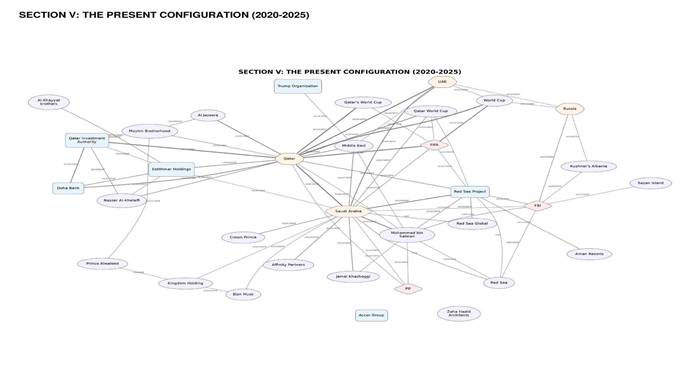
Network diagram: Section V I – The Present Configuration (2020-2025). Traces current operational relationships between Qatar, the Al-Khayyat brothers, Estithmar Holdings, Doha Bank, Nasser Al-Khelaifi, the FIFA World Cup infrastructure, Saudi Arabia’s Red Sea Project, Kushner’s Albania investments, and the Trump Organization.
Part 1: The Al-Khayyat Brothers and the 2025 Inauguration Access
On January 20, 2025, Ramez and Moutaz Al-Khayyat attended Donald Trump’s second presidential inauguration at the United States Capitol in Washington, D.C. Their presence represented not merely the attendance of two Qatari businessmen at a significant American political ceremony, but rather a data point illustrating the operational continuity of networks connecting Gulf state capital, alleged terrorism financing, and access to the highest levels of United States political power. The brothers’ attendance occurred despite active civil litigation in the London High Court alleging their systematic provision of financial support to Jabhat al-Nusra, an Al-Qaeda affiliate designated as a foreign terrorist organization by the United States government, through banking infrastructure they controlled and with the knowledge and participation of senior Qatari government officials. [6] Presidential inaugurations operate under comprehensive security protocols developed and executed by the United States Secret Service in coordination with the Federal Bureau of Investigation’s Counterterrorism Division, the State Department’s Diplomatic Security Service, and multiple intelligence community elements.
The vetting process for inaugural attendees, particularly those from foreign countries with documented connections to terrorism financing or other national security concerns, involves background checks drawing on classified intelligence reporting, law enforcement databases, financial intelligence, and information sharing arrangements with allied intelligence services, including the United Kingdom’s MI6 and MI5. The Al-Khayyats’ successful navigation of this vetting process, culminating in their physical presence at the inauguration, suggests one of several possibilities, none of which speaks favorably to U.S. counterterrorism effectiveness. First, intelligence regarding the London litigation and its underlying allegations may not have been shared between UK authorities and the U.S. agencies responsible for inaugural vetting, representing a failure of information sharing between close allies on a matter with direct counterterrorism implications.
Second, the allegations may have been shared but assessed as insufficiently credible to warrant exclusion, despite the fact that the case survived preliminary motions to dismiss and proceeded to examination of evidence and witness testimony. Third, political considerations may have overridden security protocols, with decision-makers determining that excluding prominent Qatari businessmen with connections to Qatar’s ruling family would create diplomatic complications that outweighed security concerns. Each of these scenarios represents a systemic vulnerability in how the United States assesses and manages counterterrorism risks from individuals operating at the intersection of Gulf state business networks, sovereign wealth structures, and alleged terrorism support activities.
The London case, formally filed in 2023 by eight Syrian nationals seeking damages for injuries they sustained from attacks by armed groups in Syria, alleges that the Al-Khayyats provided financial support that reached Jabhat al-Nusra operatives through a network involving Doha Bank and entities controlled through their Estithmar Holdings conglomerate. Witness testimony in the case, which has not been sealed or classified, describes a system where funds moved through accounts at Doha Bank, an institution in which Qatar Investment Authority [50] holds a majority stake and where Sheik Fahad Bin Mohammad Bin Jabor Al-Thani serves as chairman. Sheik Fahad is a member of Qatar’s ruling Al-Thani family, and his presence as chairman of the bank implicated in terrorism financing allegations illustrates the integration of alleged illicit financial flows with Qatar’s sovereign structures and ruling family oversight. [6]
The witness testimony further alleges that senior Qatari government officials possessed knowledge of these financial flows and, in some instances, participated in directing them, transforming what might otherwise be characterized as private criminal activity into state-sponsored terrorism support. The case was partially dismissed on state immunity grounds, a legal doctrine shielding governmental entities from civil liability in foreign courts, but crucially, the claims against the Al-Khayyats as individuals were permitted to proceed. This distinction is significant because it acknowledges that while Qatar as a sovereign state may enjoy immunity from civil suit in UK courts, individual Qatari citizens allegedly involved in terrorism financing remain subject to legal accountability. That distinction becomes meaningless, however, if individuals successfully evade consequences through continued access to Western political and business networks despite ongoing legal proceedings documenting their alleged activities.
Estithmar Holdings, the conglomerate through which the Al-Khayyats exercise their business interests, comprises eighty-two subsidiary companies operating across multiple sectors and jurisdictions. These subsidiaries include eight hospitals, six tourist destinations, agricultural operations, food distribution networks, real estate developments, and hospitality properties. The structure provides precisely the kind of operational complexity that facilitates financial obfuscation. Funds can move between entities within the conglomerate through management fees, consulting arrangements, loan structures, equity investments, and operational transfers that appear legitimate on their face but create layers of transactions that complicate forensic accounting efforts. The Al-Khayyats’ positions as chairman, vice chairman, and president of Estithmar Holdings give them authority to direct these financial flows while maintaining plausible business justifications for each individual transaction. This structure mirrors patterns documented in previous sections of this investigation.
Trump Organization entities created transaction layers that obscured the origins of capital from post Soviet sources. Bayrock Group moved money through multiple LLCs and offshore structures while maintaining offices in Trump Tower. Epstein’s network used modeling agencies, aircraft leasing arrangements, and foundation structures to move money and facilitate exploitation. The Rixos-Accor network creates opportunities for capital movement through hotel management contracts, franchise fees, and property development deals spanning Turkey, Qatar, Algeria, the UAE, and European jurisdictions. In each case, legitimate business operations provide cover and infrastructure for activities that would draw scrutiny if conducted directly. The Al-Khayyats’ Estithmar Holdings follows this pattern, using the inherent complexity of international conglomerate operations to create opacity regarding ultimate beneficial ownership, source of funds, and destination of disbursements.
The question of how the Al-Khayyats maintained access to U.S. political events during active litigation alleging terrorism financing connects to broader patterns of how Gulf states leverage economic relationships, sovereign wealth deployment, and intelligence cooperation to insulate their nationals from accountability. Qatar hosts Al Udeid Air Base [45], the forward headquarters of United States Central Command and the largest U.S. military facility in the Middle East. More than ten thousand American military personnel operate from Qatar, conducting air operations over Afghanistan, Iraq, Syria, and the broader region. This basing relationship creates what intelligence professionals describe as conflicting equities. On one hand, U.S. counterterrorism officials possess intelligence regarding Qatari support for extremist organizations, including Hamas, the Muslim Brotherhood, Jabhat al-Nusra, and other groups designated as foreign terrorist organizations.
On the other hand, U.S. military officials depend on Qatari cooperation to maintain basing rights essential to American military operations across the Middle East. When these equities conflict, as they do in cases like the Al-Khayyats’ inauguration attendance, diplomatic and military considerations frequently prevail over counterterrorism concerns. This dynamic is not unique to Qatar. Saudi Arabia provides the same calculation despite documented Saudi government involvement in financing Al-Qaeda prior to September 11, 2001, and despite Saudi Crown Prince Mohammed bin Salman’s ordering of journalist Jamal Khashoggi’s murder in October 2018. The UAE provides the same calculation despite documented Emirati support for armed groups in Libya, Yemen, and Sudan that have committed human rights abuses. Pakistan provides the same calculation despite harboring Osama bin Laden in Abbottabad and despite Pakistani intelligence services’ documented support for the Taliban and Lashkar-e-Taiba. In each case, the United States maintains that it confronts these issues privately through diplomatic channels while publicly maintaining relationships characterized by security cooperation, arms sales, and intelligence sharing. The result is that individuals connected to terrorism financing, human rights abuses, and other activities ostensibly contrary to American interests continue operating with minimal accountability, accessing American political events, investing in American real estate and businesses, and maintaining relationships with American political figures and intelligence community elements.
The Al-Khayyats’ January 2025 inauguration attendance occurred at a moment when these patterns were particularly visible. Trump had just won the election to a second term following a campaign in which he accepted endorsements and support from individuals and entities with documented connections to foreign intelligence services, organized crime networks, and influence operations. Jared Kushner, Trump’s son-in-law, had received two billion dollars from Saudi Arabia’s Public Investment Fund for his private equity firm Affinity Partners despite Kushner’s lack of private equity experience and despite a Saudi government assessment committee’s initial recommendation against the investment due to due diligence concerns. Trump himself maintained extensive business relationships with entities connected to the networks documented in earlier sections of this investigation.
Thomas Barrack, who chaired Trump’s 2017 inaugural committee and raised a record one hundred seven million dollars for that event, had been tried in 2022 on charges of acting as an unregistered agent of the UAE, and though acquitted, the trial evidence revealed extensive communications with UAE officials during the Trump campaign and transition in which Barrack shared nonpublic information and coordinated Trump campaign messaging to align with UAE interests. [4] [4] [31] [100] Against this backdrop, the Al-Khayyats’ attendance at Trump’s second inauguration represents continuity rather than aberration. The networks connecting Gulf state capital, Western political access, alleged terrorism financing, and business structures designed for opacity did not emerge in 2025 or even in 2016. They developed over decades through relationships built in the 1970s and 1980s, expanded in the 1990s and 2000s, consolidated in the 2010s, and persist in the present despite exposure, litigation, and occasional prosecution of individual nodes. The Al- Khayyats are not outliers operating at the system’s margins. They are examples of how the system operates, how it reproduces itself across generations, and how it continues functioning despite episodic accountability efforts that remove individual participants while leaving underlying structures intact.
Part 2: FIFA World Cup Construction Corruption and the AECOM Connection
Qatar’s successful 2010 bid to host the 2022 FIFA World Cup triggered infrastructure expenditures exceeding two hundred twenty billion dollars, making it the most expensive sporting event in human history by a margin so large as to defy meaningful comparison. The 2018 World Cup in Russia cost approximately eleven billion dollars. The 2014 World Cup in Brazil cost fifteen billion dollars. The 2010 World Cup in South Africa cost three point six billion dollars. Qatar’s expenditures were not double or triple these amounts but rather an order of magnitude larger, reflecting not simply the construction of eight stadiums but the fundamental reengineering of an entire nation’s infrastructure to accommodate a month-long tournament. This reengineering included six point five billion dollars for stadium construction, fifty billion dollars for a comprehensive metro system that did not exist prior to the World Cup bid, thirty-six billion dollars for airport expansion and new hotel construction, and tens of billions more for highways, utilities, telecommunications infrastructure, and urban development projects nominally unrelated to the World Cup but accelerated to meet the 2022 deadline.
The scale of expenditure created opportunities for corruption at every level of procurement, design, construction, and oversight. Fifteen of the twenty-two FIFA officials who voted in December 2010 to award Qatar the World Cup were subsequently fined, banned, or indicted for corruption-related offenses. This is not a case where subsequent investigation revealed one or two officials accepting bribes while the majority acted with integrity. It is a case where more than two-thirds of decision-makers were later found to have engaged in corrupt activities, suggesting that corruption was not peripheral to the decision but rather central to it. The decision to award Qatar the World Cup cannot be understood as a legitimate assessment of Qatar’s merits as a host nation that was subsequently tainted by isolated bribery. It must be understood as a decision purchased through systematic corruption of FIFA’s governance structures. The specific allegations documented in U.S. Department of Justice indictments unsealed in April 2020 provide granular detail regarding this corruption. Jack Warner, who served as FIFA Vice President and wielded substantial influence over other committee members, accepted two million dollars from Qatari officials [7] in exchange for voting for Qatar’s bid and using his influence to encourage other members to do likewise.
Julio Grondona of Argentina, Nicolás Leoz of Paraguay, and Ricardo Teixeira of Brazil received multimillion-dollar bribes routed through media companies that held broadcasting rights to international soccer tournaments. Grondona explicitly claimed he was “owed” for his support of Qatar’s bid [7], treating his vote not as a fiduciary responsibility to FIFA and international soccer but as a commodity to be sold to the highest bidder. Mohamed bin Hammam, the Qatari businessman who served as FIFA vice president and led Qatar’s bid effort, made dozens of payments to football officials across multiple continents to secure their support. These payments were not subtle gifts or gestures of goodwill but rather systematic cash transfers designed to purchase specific votes. Jack Warner accepted $2 million from Qatari officials in exchange for voting for Qatar’s bid and using his influence to direct other members’ votes. (Source: DOJ FIFA Corruption Indictments, April 2020 [7], United States v. Blatter et al., superseding indictment, ¶¶ 87-102; see also Minnesota Journal of International Law, ’What Happened in Qatar?’ (March 2023)) Grondona explicitly claimed he was ’owed’ for his support of Qatar’s bid, treating his vote not as a fiduciary responsibility to FIFA and international soccer but as a commodity to be sold. (Source: Alejandro Burzaco, cooperating witness testimony, cited in DOJ indictment [7]; BBC Sport, ’FIFA Corruption: Full List of Indicted Officials’ (2015-2020))
One particularly brazen corruption mechanism involved Al Jazeera, the Qatar-based media network owned by the Qatari Emir Sheik Hamad bin Khalifa Al-Thani, who was also the driving force behind Qatar’s World Cup bid. Al Jazeera signed broadcast rights contracts with FIFA that included clauses stating FIFA would receive an additional one hundred million dollars if Qatar won hosting rights for the 2022 World Cup. This arrangement represented a transparent conflict of interest and a violation of FIFA rules prohibiting bidding countries from offering financial incentives to FIFA in connection with hosting rights votes. The clause literally made FIFA’s financial interests directly aligned with awarding Qatar the tournament, creating a situation where FIFA officials voting for Qatar’s bid would simultaneously be voting to provide FIFA itself with a one-hundred-million-dollar payment. That such an arrangement could be proposed, documented in a written contract, and apparently accepted by FIFA officials illustrates the extent to which FIFA’s governance structures had been captured by corrupt interests. Al Jazeera’s broadcast rights contract with FIFA contained a clause providing FIFA with an additional $100 million if Qatar won hosting rights, a transparent conflict of interest and a violation of FIFA rules prohibiting bidding countries from offering financial incentives to FIFA. (Source: Garcia Report [17] on FIFA 2018/2022 World Cup Bidding (Full version leaked 2017) [17]; The Sunday Times ’FIFA Files’ investigation (2014) [27])
FIFA commissioned an investigation into corruption allegations led by Michael Garcia, a former U.S. Attorney for the Southern District of New York with extensive experience prosecuting organized crime and public corruption. Garcia produced a four-hundred-thirty-page report examining the bidding process for both the 2018 and 2022 World Cups. FIFA then published a forty-two-page summary of Garcia’s report that ostensibly cleared Qatar of wrongdoing. Garcia immediately denounced this summary as “materially incomplete” with “erroneous representations of the facts and conclusions,” language that is extraordinary for a lawyer of Garcia’s stature and experience. Garcia did not merely disagree with FIFA’s characterization of his findings or suggest that the summary lacked nuance. He stated that the summary misrepresented the facts and conclusions of his investigation, meaning that FIFA’s published account of Garcia’s work bore little relationship to what Garcia actually found and concluded. Garcia resigned from his position in protest, an action that attracted substantial media attention but ultimately accomplished nothing because FIFA controlled the full report and declined to release it. [17]
Michael Garcia immediately denounced FIFA’s published summary of his report as ’materially incomplete’ with ’erroneous representations of the facts and conclusions’, extraordinary language from a former U.S. Attorney, and resigned in protest. (Source: Michael Garcia, resignation statement, December 2014 [17]; The Sunday Times, ’FIFA’s Corruption Report ’Misrepresented Facts’, December 17, 2014) The full Garcia report was eventually leaked to and published by German media in 2017. The report’s release confirmed what Garcia’s resignation had suggested. While the report did not identify a “smoking gun” directly linking Qatari officials to vote-buying in ways that would sustain criminal prosecution, it documented extensive “testing” of FIFA rules, a euphemistic description for conduct that violated the spirit and arguably the letter of FIFA regulations while maintaining thin technical compliance that might defeat prosecution. The report documented payments, gifts, travel arrangements, business opportunities, and other benefits flowing from Qatar to FIFA officials and their family members in the years preceding the vote. Each individual transaction might be characterized as a legitimate relationship-building or a coincidental business activity unrelated to World Cup bidding. Viewed collectively, they formed a pattern of systematic cultivation of FIFA officials through financial incentives precisely timed to influence the hosting rights vote.
Alejandro Burzaco, former CEO of Argentine sports marketing firm Torneos y Competencias, pleaded guilty to bribery charges as part of the broader 2015 FIFA corruption investigation and provided detailed testimony regarding corruption in Qatar’s World Cup bid. Burzaco testified that he personally facilitated bribe payments to South American FIFA officials, including Grondona, [7] Leoz, and Teixeira, and that these officials explicitly understood the payments as compensation for voting to award Qatar the 2022 World Cup. This testimony came from a cooperating witness with direct participation in the corrupt activities, providing firsthand accounts of conversations, meetings, and payment arrangements rather than circumstantial evidence or speculation. Burzaco’s cooperation led to prosecutions and convictions of other FIFA officials, demonstrating that his information was credible enough to sustain criminal cases beyond a reasonable doubt. Despite this documented corruption, Qatar’s hosting of the World Cup proceeded without a serious threat of revocation.
FIFA conducted multiple reviews of whether Qatar should retain hosting rights in light of corruption allegations, extreme summer heat that made outdoor sporting events dangerous, insufficient existing infrastructure, concerns about treatment of migrant workers, and Qatar’s criminalization of homosexuality. Each review concluded that while problems existed, they did not warrant the extreme step of stripping Qatar of hosting rights. This conclusion reflected several factors, including the difficulty of identifying an alternative host nation on short notice, concern about potential litigation from Qatar if hosting rights were revoked, and the reality that senior FIFA officials who made the decision to uphold Qatar’s hosting rights were themselves implicated in the broader corruption that led to Qatar’s selection in the first place. Officials who participated in or knowingly tolerated the corruption that awarded Qatar the World Cup had personal interests in ensuring that the decision stood, because revocation would amount to admission that FIFA’s governance had been so thoroughly compromised as to produce an illegitimate result.
Into this environment of massive expenditure and systemic corruption, AECOM entered as a preferred contractor and consultant. AECOM is a Fortune 500 American engineering and construction management firm with annual revenue exceeding eight billion dollars and operations in more than one hundred forty countries. The firm’s scale, technical capabilities, and experience with major infrastructure projects made it a logical choice for Qatar’s World Cup-related construction. AECOM served as design consultant and construction supervision services provider for Al Wakrah Stadium, working in association with Zaha Hadid Architects. The firm served as project manager for Al-Rayyan Stadium in February 2014. AECOM provided program management services for the Hamad International Airport expansion program, including Cargo Terminal 2 and Amiri Flight Facilities, over a six-year period, with the cargo bridging facility prioritized for operational readiness ahead of the World Cup’s November 2022 start.
In 2008, years before Qatar won World Cup hosting rights, AECOM had been awarded a six-year, one hundred forty-nine-million-dollar contract to provide program management services for the New Doha Port project, a seven billion dollar development that was then the world’s largest greenfield port construction. AECOM had been deeply embedded in Qatar’s infrastructure development for more than a decade before the World Cup, giving the firm comprehensive knowledge of Qatari government contracting processes, relationships with Qatari officials and contractors, and understanding of how projects moved from design through procurement to construction in the Qatari context. AECOM’s role involved technical design review and approval, project scheduling and cost management, contractor oversight and quality assurance, health and safety protocol development, and coordination between Qatari authorities, FIFA, and construction contractors.
These responsibilities placed AECOM personnel at the center of World Cup infrastructure delivery with visibility into every major decision, expenditure, and construction activity. AECOM would have been aware of labor conditions on job sites, payment structures for workers, procurement irregularities, schedule delays, cost overruns, quality issues, and safety incidents. The firm’s project management contracts typically include provisions requiring reporting of certain categories of problems to the client, but these provisions generally cover technical issues like structural deficiencies or material failures rather than broader human rights concerns like worker exploitation or corruption in contractor selection. This structure creates a dynamic where Western professional services firms like AECOM, Dar AlHandasah, Foster + Partners, Zaha Hadid Architects, and others operate with comprehensive knowledge of problematic conditions while maintaining technical distance from direct responsibility for addressing them. AECOM’s contracts specified its obligations regarding engineering standards, quality control, and schedule management. They did not specify AECOM’s obligations regarding investigating corruption in contractor procurement, preventing wage theft from migrant workers, or ensuring that safety standards were actually implemented rather than merely documented in paper compliance systems. This allows firms like AECOM to simultaneously derive substantial revenue from projects characterized by corruption and exploitation while maintaining that they fulfilled their contractual obligations and that problems beyond their contractual scope were the client’s responsibility.
The death toll among migrant workers in Qatar between 2010 and 2022 illustrates the human cost of this structure. The Guardian [21]’s investigation, analyzing mortality data from embassies of labor-sending countries including India, Pakistan, Nepal, Bangladesh, and Sri Lanka, documented at least six thousand five hundred migrant worker deaths in Qatar during this period. [21] FIFA acknowledges only thirty-seven deaths directly linked to World Cup construction sites, a figure that excludes deaths during non-working hours even if heat-related illness developed on the job site, deaths at off-site worker accommodations, deaths from illnesses that manifested after workers left job sites but were caused by workplace conditions or exposures, and deaths during construction of infrastructure projects like the metro system or highways that supported the World Cup but were not technically part of stadium construction. The thirty-seven figure also relies on Qatar’s classification of deaths, which frequently attributes cardiac arrest, respiratory failure, or other proximate causes of death without investigating whether those deaths resulted from heat exposure, overwork, inadequate medical care, or other jobrelated factors. [21][43]
Workers experienced shifts exceeding ten hours in temperatures surpassing forty-five degrees Celsius or one hundred thirteen degrees Fahrenheit. They experienced wage theft and salary withholding as standard practice, with employers routinely delaying payment for months while workers lacked the resources to leave. They were charged fees to change jobs, creating debt bondage where workers could not escape exploitative employers without paying hundreds or thousands of dollars they did not possess. They experienced passport confiscation by employers who held workers’ identification documents to prevent them from leaving. They lived in overcrowded and unsanitary housing, often located far from job sites, requiring long commutes in non-airconditioned buses. They received inadequate medical care and safety equipment, even when performing dangerous work at heights or with heavy machinery. They faced retaliation, including deportation, when they complained about conditions or attempted to organize for better treatment. Amnesty International [42] documented these conditions in reports published from 2016 through 2022, finding labor abuses continuing [42] “on a significant scale” despite announced reforms.
Qatar introduced Workers’ Welfare Standards in 2014, establishing new protections for workers, including heat exposure limits, payment schedules, and accommodation standards. Qatar eliminated the kafala sponsorship system in 2020, allowing workers to change employers without permission from their current employer, a reform long demanded by human rights organizations. These reforms appeared significant on paper, but enforcement remained inconsistent, and penalties for violations were minimal. Employers who violated wage payment requirements faced fines that were small relative to the amounts they saved through wage theft. Employers who violated heat exposure limits faced warnings that rarely progressed to meaningful sanctions. The gap between announced reforms and actual workplace conditions illustrates a pattern common in Gulf states where governments announce policies responsive to international pressure while ensuring that enforcement mechanisms remain weak enough to avoid disrupting business practices that depend on migrant worker exploitation. [42]
Architecture firms involved in stadium design issued no public statements about labor abuses during construction despite their brands being publicly associated with the projects. Foster + Partners designed Lusail Stadium, the eighty-thousand-seat venue that hosted the World Cup final. When contacted for comment about labor conditions, a Foster + Partners spokesperson stated that the firm “made modifications and additions to the specifications in the preliminary tender documents to ensure that they adhered to stringent standards for workers’ welfare,” but acknowledged that Foster + Partners was not retained for the construction phase and therefore had no direct oversight of labor conditions during actual construction. This response typifies professional services firm approaches to human rights issues on problematic projects. Firms draft specifications requiring compliance with labor standards, include contractual language regarding worker welfare, and may conduct site visits and inspections during design development. Once construction begins, however, these firms frequently step back to advisory roles or complete their involvement entirely, eliminating their ability to enforce the standards they helped develop.
Zaha Hadid Architects designed Al Wakrah Stadium, where AECOM served as design consultant and construction supervisor. In 2014, Zaha Hadid herself was asked about migrant worker deaths at her Qatar stadium. She responded that preventing such deaths was “not my duty as an architect.” This statement provoked widespread criticism for its apparent indifference to human suffering directly connected to her work. The statement also accurately described the legal and contractual reality of architect-client relationships on international projects. Architects are retained to design buildings that meet specified performance criteria, including safety, functionality, aesthetics, and budget. They are not retained to serve as human rights monitors or labor rights enforcers. Their contracts specify their duties regarding design deliverables, not their responsibilities regarding how contractors treat workers during construction. Hadid’s statement was morally obtuse but legally accurate. The problem is not that architects failed to perform duties outside their contractual scope. The problem is that the contractual and regulatory structures governing international construction projects systematically separate technical expertise from human rights accountability, allowing exploitation to occur with the participation of firms that would never tolerate similar conditions in their home countries.
AECOM’s subsequent work on Saudi Arabia’s King Fahd International Stadium renovation, announced in 2025 as Saudi Arabia prepares to host the 2034 FIFA World Cup, illustrates that these patterns persist despite the controversies surrounding Qatar. AECOM’s announcement of its King Fahd Stadium work explicitly referenced the firm’s experience on the “2022 Qatar World Cup” as credentials supporting its selection for Saudi work. Rather than Qatar’s labor abuses and corruption creating reputational damage that reduced AECOM’s attractiveness for similar projects, AECOM marketed its Qatar experience as valuable expertise that positioned it to deliver Saudi Arabia’s World Cup infrastructure. This dynamic demonstrates that accountability mechanisms remain insufficient to alter firm behavior. Media coverage and human rights organization reporting on Qatar’s labor abuses were extensive. The number of worker deaths was widely publicized. FIFA faced protests, criticism from players and coaches, and calls for reforms.
Yet AECOM and other firms that profited from Qatar’s World Cup infrastructure experienced no meaningful business consequences. They retained their existing clients, won new contracts, and continued operating with their reputations intact among the clients and investors whose opinions matter most to their business success. The broader pattern extends beyond AECOM to the entire professional services industry. Major law firms provide legal opinions legitimizing offshore structures used for money laundering and tax evasion. Major accounting firms audit financial statements of companies while somehow failing to detect massive frauds later exposed by regulators or investigative journalists. Major consulting firms advise authoritarian governments on how to improve their international reputations without addressing the human rights abuses that damaged those reputations in the first place. In each case, firms claim they acted within professional standards, fulfilled contractual obligations, and cannot be held responsible for client misconduct that fell outside their specific scope of work. This produces a situation where Western professional services firms profit from corruption, exploitation, and human rights abuses in developing countries while maintaining that they bear no responsibility for addressing conditions they helped facilitate and from which they derive revenue.
The 2022 World Cup proceeded in November and December of that year with matches played in the eight stadiums built or renovated for the tournament. Argentina won the final at Lusail Stadium, defeating France in a penalty shootout after a three-three draw. Approximately one and a half million fans attended matches. Qatar was widely praised for its organization and logistics, particularly the compact geographic layout that allowed fans to attend multiple matches in different stadiums on the same day. Infrastructure, including the Doha Metro, performed effectively with minimal reported disruptions. Hotels accommodated the surge in visitors. The tournament was, by most objective measures, a success in terms of delivering the sporting event. This success prompted a particular kind of commentary suggesting that critics of Qatar’s World Cup bid had been proven wrong, that concerns about labor abuses had been exaggerated, and that Qatar had demonstrated that it could successfully host a major international sporting event despite initial skepticism. This commentary missed the point entirely. The question was never whether Qatar could use its financial resources to build stadiums and infrastructure capable of hosting the World Cup. With more than two hundred billion dollars in expenditure and more than a decade of preparation, almost any country could deliver the physical requirements for hosting the tournament. The question was whether that infrastructure would be built in ways consistent with basic labor rights and whether the selection process would be free from corruption. On both questions, the answer was clearly negative. The fact that the stadiums stood and the metro trains ran did not vindicate Qatar’s approach. It demonstrated that adequate financial resources can overcome human rights concerns, labor exploitation, and corrupt selection processes without meaningful accountability for those who profited from or enabled those conditions. The controversies surrounding Qatar’s World Cup bid also illuminated a wider web of hospitality magnates, political intermediaries, and transnational business operators whose relationships extended far beyond football itself, drawing attention to figures such as Fettah Tamince and the intricate network of Turkish, Gulf, and European connections through which influence, capital, and political access increasingly converged, all linked both to the Al Khayyat brothers, and to Donald Trump and his business, personal, and political ecosystem.
Part 3: The Fettah Tamince-Rixos-Accor Network and Gulf Hospitality Integration
Fettah Tamince, founder and chairman of Rixos Hotels, the Turkish luxury hospitality group that became an indispensable operational layer connecting Qatari sovereign capital, French hospitality infrastructure, and Gulf state soft power from Istanbul to Doha. Rixos properties housed and entertained delegations during the 2022 FIFA World Cup, with the brand’s expansion funded in significant part through Estithmar Holdings, the Qatari investment vehicle whose leadership includes members directly tied to the Al-Khayyat brothers.
Fettah Tamince’s Rixos Hotels represents a critical node in networks connecting Turkish capital, Qatari investment, French hospitality infrastructure, and Gulf state soft power strategies that have solidified and expanded from 2020 through 2025. The network’s evolution during this period demonstrates how business relationships formed in earlier years mature into enduring structures that facilitate continued cooperation across multiple jurisdictions and transaction types while maintaining operational flexibility to adapt to changing political relationships between the governments whose territories they operate within.
Rixos Hotels was established in 2000 by Fettah Tamince as a Turkish luxury hospitality brand initially focused on resort properties along Turkey’s Mediterranean and Aegean coasts. The brand’s growth trajectory over its first decade followed a pattern common to successful regional hospitality companies, expanding from its initial Turkish base to other markets with similar demographics and price points, including Russia, Egypt, and the UAE. By 2010, Rixos operated approximately twenty properties with eight thousand rooms, positioning it as a significant regional player but not yet a globally recognized brand with the distribution networks and loyalty program infrastructure that characterize major international hotel chains.
The transformation from a regional Turkish brand to a global hospitality network occurred through Accor Group’s staged acquisition of Rixos beginning in 2017. Accor, a French multinational hospitality company with more than five thousand hotels operating in more than one hundred countries, initially acquired fifty percent of Rixos in 2017, providing Rixos with access to Accor’s distribution networks, reservation systems, and Le Club AccorHotels loyalty program with more than one hundred million members. Accor subsequently increased its stake to seventy percent through additional capital injections that funded Rixos’s expansion into new markets and property types. This partnership provided Rixos with capabilities and market reach it could not have developed independently, while providing Accor with entry into luxury all-inclusive resort segments and geographic markets where Rixos had established presence and relationships. See also: Travel and Tour World, April 1, 2025 [75] [75]; MEED, May 5, 2014 [57].
The Accor-Rixos partnership created value through what business strategists describe as complementary capabilities. Rixos possessed expertise in high-end all-inclusive resort operations, strong relationships with Russian and Middle Eastern travelers who constitute core customer segments for luxury beach resorts, and an established presence in markets including Turkey and the UAE, where Accor was underpenetrated. Accor possessed global distribution infrastructure, sophisticated revenue management systems, procurement relationships that achieved economies of scale across thousands of properties, and brand recognition in Western European and North American markets where Rixos was unknown. The partnership allowed each entity to access the other’s strengths, accelerating growth beyond what either could have achieved independently. The Accor-Rixos partnership gives each party access to the other’s strengths: Rixos’s expertise in all-inclusive luxury resorts and strong relationships with Russian and Middle Eastern travelers; Accor’s 100+ million-member loyalty program and global distribution infrastructure. (Source: Accor Group Annual Reports 2017-2025 [47]; Hotel Investment Today, February 20, 2025 [74] [74])
What the public announcements of the Accor-Rixos partnership did not emphasize was the Qatari capital that had supported Rixos’s earlier expansion and the connections between Rixos, the Al-Khayyat brothers’ Estithmar Holdings conglomerate, and broader networks involving Nasser Al-Khelaifi, Doha Bank, and Qatar Investment Authority [50]. These connections are not documented through equity ownership disclosures or regulatory filings because the relationships operate through financing arrangements, property development partnerships, management contracts, and vendor relationships that fall below disclosure thresholds while providing the parties with operational integration and strategic coordination. Estithmar Holdings, controlled by the Al-Khayyat brothers through their positions as chairman, vice chairman, and president, provided financial support for Rixos’s expansion into multiple markets during Rixos’s growth phase before the Accor acquisition. This support took forms including debt financing for property development, equity participation in property owning special purpose vehicles, guarantees that enhanced Rixos’s borrowing capacity with commercial lenders, and participation in joint ventures where Estithmar Holdings contributed land or capital while Rixos contributed operating expertise and brand rights.
These arrangements are structured such that Estithmar Holdings does not appear as a direct shareholder of Rixos Hotels at levels requiring disclosure but nonetheless maintains ongoing economic interests in Rixos’s performance through loan repayments, profit distributions from joint ventures, and appreciation in asset values. Estithmar Holdings provided financial support for Rixos expansion through loan structures, equity participation in property-specific special purpose vehicles, and joint venture arrangements, without appearing as a direct shareholder at disclosure-triggering levels. (Source: Al-Khayyat Brothers London High Court Litigation [6]; Qatar Investment Authority [50] Public Disclosures [50]) Sheikh Suhaim Bin Abdulaziz Al-Thani serves on Estithmar Holdings’ board of directors, connecting the Al-Khayyats’ conglomerate to Qatar’s ruling Al-Thani family. Sheik Suhaim’s brother, Sheik Fahad Bin Mohammad Bin Jabor Al-Thani, chairs Doha Bank, the institution implicated in the London litigation alleging terrorism financing.
This creates a direct link between entities allegedly involved in financing Al-Qaeda affiliates and the hospitality network through which those entities integrate with Western corporate structures. Qatar Investment Authority [50], the nation’s sovereign wealth fund, holds a majority ownership position in Doha Bank, meaning that the Qatari state, through its sovereign investment arm, controls the bank that witnesses allege served as a conduit for terrorism financing. Sheik Suhaim Bin Abdulaziz Al-Thani, on Estithmar Holdings’ board, is the brother of Sheik Fahad Bin Mohammad Bin Jabor Al-Thani, who chairs Doha Bank, the institution named in terrorism financing litigation. This creates a direct link from the hospitality network to the litigation’s most sensitive allegations. (Source: Estithmar Holdings corporate filings, Qatar Financial Center; Al-Khayyat Brothers London High Court Litigation [6])
Nasser Al-Khelaifi occupies multiple roles connecting these entities. Al-Khelaifi serves on Qatar Investment Authority [50]’s board alongside ruling family members, giving him oversight of QIA’s investments, including its Doha Bank stake. Al-Khelaifi serves as chairman of Qatar Sports Investments, which owns Paris Saint-Germain Football Club. Al-Khelaifi serves as chairman of beIN Media Group, Qatar’s sports broadcasting network operating across Europe, the Middle East, North Africa, and other regions. Accor Group, which owns seventy percent of Rixos, maintains a “shirt partnership” with Paris Saint-Germain, meaning Accor’s logo appears on PSG jerseys as part of a commercial sponsorship arrangement negotiated with Al-Khelaifi in his capacity as PSG president. These overlapping relationships create situations where the same individuals occupy positions on both sides of supposedly arm’s-length commercial transactions, facilitating coordination and creating opportunities for value transfers that might not occur in truly independent negotiations.
Accor’s shirt partnership with Paris Saint-Germain, negotiated with Al-Khelaifi as PSG president, creates situations where the same individuals effectively negotiate on both sides of commercial transactions involving entities in the same network. (Source: PSG-Accor shirt partnership announcement (2019); Accor Group Annual Report 2020 [47]) Consider the Rixos-Accor partnership from this perspective. Accor negotiates its acquisition of Rixos with Rixos’s ownership, which includes or is connected to entities backed by Estithmar Holdings. Estithmar Holdings is controlled by the AlKhayyats, who allegedly financed terrorism through Doha Bank, as documented in London litigation. Doha Bank is controlled by Qatar Investment Authority [50]. Qatar Investment Authority [50] is overseen by a board including Nasser Al-Khelaifi. Al-Khelaifi also serves as president of Paris Saint-Germain. Accor simultaneously negotiates commercial sponsorship with Paris Saint-Germain, where Al-Khelaifi serves as president. Al-Khelaifi sits on boards and holds positions that give him visibility into both sides of these negotiations, creating opportunities to coordinate terms such that favorable pricing or terms in one transaction are balanced by favorable pricing or terms in another transaction, producing an overall arrangement that serves the interests of the network while appearing to involve independent commercial decisions by separate entities.
This structure provides multiple benefits. It creates legitimate business revenue streams that can support ongoing operations and generate returns for investors. It creates transaction layers and entity relationships that complicate forensic accounting efforts by investigators or regulators attempting to trace money flows. It integrates Qatari capital with Western corporate structures in ways that give both parties economic interests in maintaining the relationship, making it more difficult for Western entities to exit even if they later develop concerns about their partners’ activities. It provides cover for capital movements, as funds flowing between entities can be characterized as normal course business transactions rather than investments or transfers that might require additional scrutiny. It creates employment and business relationships that build personal loyalties and social networks beyond formal corporate structures, as executives working together on hotel development projects develop professional relationships and friendships that make them reluctant to report concerns or cooperate with investigations of their business partners.
Accor’s expansion in Algeria from 2020 through 2025 illustrates how this network operates in practice. Algeria, a North African nation with a population of forty-four million and significant natural gas reserves, has experienced limited foreign direct investment compared to regional peers due to currency controls, bureaucratic obstacles, corruption, and political instability. The country operates a foreign exchange regime that restricts currency movements, making it difficult for international companies to repatriate profits. The government maintains ownership restrictions on foreign investment in certain sectors and imposes local content requirements that complicate operations. Corruption is endemic, with Algeria ranking in the bottom third of countries assessed by Transparency International [40]’s Corruption Perceptions Index. Former President Abdelaziz Bouteflika and associates were convicted of corruption charges following mass protests in 2019 that forced Bouteflika from office after twenty years in power. The business environment is characterized by opacity regarding ownership structures, informal payments to facilitate licenses and permits, and political risk where government decisions can arbitrarily alter contract terms or seize assets. [40]
Accor operates multiple five-star properties in Algeria despite that country’s endemic corruption, currency controls, and limited tourist demand that would not ordinarily attract aggressive luxury hospitality expansion. (Source: Transparency International [40], Corruption Perceptions Index 2023 [40]; THP News, September 11, 2024 [76] [76]) The most durable influence vectors have been financial relationships, Gulf sovereign capital embedded in U.S. financial institutions, technology companies, real estate markets, and campaign infrastructure, which create dependencies that conventional counterintelligence frameworks are not designed to address. (Source: Carnegie Endowment for International Peace [44], Gulf States Influence Operations Studies [44]; Transparency International [40], Corruption Perceptions Index 2023 [40]) Despite these challenges, Accor operates multiple five-star properties in Algeria, including Sofitel Algiers, Pullman Algiers, Novotel Algiers, and Ibis Algiers. Accor announced plans for additional Algerian properties in 2023 through 2025 despite the country’s economic challenges and the fact that Algeria’s GDP per capita and tourist arrival numbers do not suggest robust demand for luxury hotel rooms. When AccorHotels opened the Novotel and Ibis Setif properties in October 2017, company co-founder Gérard Pélisson stated that “this new opening is a testament to the trust that your country, Algeria, has placed in us. Our partnership is primarily driven by the willingness of two major groups to jointly create wealth in a country as ambitious as Algeria.” Steven Daines, CEO of AccorHotels for Africa and the Middle East, added that AccorHotels was “the leading international hotel operator in Algeria with a network of 10 hotels ranging from the luxury to economy segments.”
These statements emphasize partnership, trust, and ambition while avoiding discussion of the commercial rationale for investing in a country with Algeria’s economic profile. The explanation becomes clearer when examining the Al-Khayyat brothers’ parallel investments in Algeria during the same period. Estithmar Holdings established healthcare operations in Algeria, including hospital management contracts at facilities in Algiers and Oran. The conglomerate made agricultural investments in Algerian farming operations and food distribution networks. It conducted real estate developments in Algiers and other cities. These investments occurred from 2018 through 2022, overlapping substantially with the period covered by the London litigation’s allegations regarding Syria financing, which span from 2011 through 2019 but include witness testimony suggesting continuation of financial flows beyond the formal end date of the allegations. The parallel timing of Accor’s Algeria expansion and the Al-Khayyats’ Algeria investments is consistent with the coordinated deployment of capital from related entities into a jurisdiction offering specific money laundering advantages.
Algeria’s currency controls and limited financial transparency make it an attractive destination for parking capital that originates from illicit sources. Investments in healthcare, hospitality, agriculture, and real estate are sectors that generate cash flow to justify ongoing presence while offering opportunities to inflate costs, attribute profits to intangible factors like brand value or management expertise, and move money through complex ownership structures. The Rixos brand, now seventy percent owned by Accor, also entered North African markets with backing from the integrated Qatar-Turkey-Accor network, with properties in locations that appear selected for strategic rather than purely commercial reasons. The Al-Khayyat brothers’ Algeria healthcare operations deserve particular attention because they mirror patterns documented in other contexts where medical facilities serve as vehicles for financial crimes. Hospitals generate substantial revenue, employ large numbers of workers, maintain complex supply chains involving expensive equipment and pharmaceuticals, and operate under regulatory frameworks that often involve government payment systems. These characteristics create multiple opportunities for financial manipulation. Healthcare facilities can inflate patient counts to justify revenue that actually originates from other sources. They can manipulate procurement processes to overpay for equipment and supplies, with vendors rebating the overcharges to owners through side agreements. They can employ workers who exist only on paper, with their salaries actually going to owners or being used to compensate individuals who provide services unrelated to healthcare. They can attribute profits to management fees, consulting arrangements, licensing of intellectual property, or other intangible services that are difficult for auditors or investigators to verify.
Estithmar Holdings’ hospital operations in Algeria involve management contracts rather than direct ownership, a structure that provides additional opacity. Under management contract arrangements, a separate entity owns the hospital facility and employs the medical staff, while Estithmar provides management services in exchange for fees calculated as percentages of revenue or profit. This structure allows Estithmar to extract value from the operations without appearing as the owner in public records. It creates contractual relationships involving management fees, performance bonuses, termination payments, and other financial flows that can be structured to move money while maintaining plausible business justifications for each payment. It positions Estithmar to make operational decisions regarding procurement, staffing, and financial management while limiting its legal liability as a non-owner service provider. The investigation into how these networks operate encounters substantial obstacles because the entities are established in jurisdictions with weak transparency requirements and enforcement. Algeria does not maintain public beneficial ownership registries that would reveal who ultimately owns and controls Algerian corporations.
Algeria’s anti-money laundering enforcement is limited, with few prosecutions despite obvious opportunities for financial crimes. Turkish corporate disclosure requirements provide minimal transparency regarding the ownership of private companies like Rixos. Qatari corporate structures are similarly opaque unless entities are publicly traded on the Qatar Stock Exchange, which most of these entities are not. French corporate law requires more disclosure, but Accor’s public filings regarding its Rixos acquisition provide only high-level information about purchase price, strategic rationale, and expected financial contributions, not detailed information about financing sources, side agreements, or relationships between Rixos and entities like Estithmar Holdings. This jurisdictional arbitrage, where networks structure their operations to exploit the least demanding regulatory environment applicable to any particular transaction or entity, represents a fundamental challenge to investigation and accountability. Money laundering investigations depend on tracing funds from source through intermediaries to the ultimate destination, identifying patterns of activity that reveal the purpose of transactions, and building cases demonstrating that entities knowingly facilitated illicit financial flows. Each of these investigative steps becomes more difficult when funds move across multiple jurisdictions with different legal systems, different disclosure requirements, different levels of regulatory enforcement, and different degrees of cooperation with foreign investigators.
Networks like the Rixos-Accor-Estithmar structure exploit these difficulties by ensuring that no single jurisdiction contains sufficient information to understand the full scope of their operations. Western financial intelligence units track suspicious financial activity through mechanisms including currency transaction reports, suspicious activity reports filed by banks, wire transfer records, and information sharing among members of the Financial Action Task Force [41]. These mechanisms work reasonably well for detecting unsophisticated criminals who move money directly through the banking system using their own names or obvious shell company structures. They work less well against networks that move money through legitimate business operations, use multiple layers of entities in different jurisdictions, maintain operations over years or decades that establish track records of normal business activity, and involve individuals who hold senior government positions or ruling family status that makes financial institutions hesitant to file suspicious activity reports. The Al-Khayyat brothers, operating through Estithmar Holdings with eighty-two subsidiary companies spanning multiple countries and business sectors, with connections to Qatar’s ruling family through Sheik Suhaim’s board position, and with ongoing operations generating millions of dollars in annual legitimate business revenue, present exactly the kind of target against which these systems struggle.
The Rixos brand’s continued expansion into Saudi Arabia despite the 2017-2021 Qatar-Saudi blockade illustrates another aspect of how these networks operate. During the blockade period, Saudi Arabia, the UAE, Bahrain, and Egypt severed diplomatic relations with Qatar and imposed a comprehensive blockade, including closed borders, prohibited air traffic, severed trade relationships, and demands that Qatar close Al Jazeera, expel Turkish military presence, reduce Iran ties, and pay reparations for alleged terrorism financing. The blockade represented the most serious rupture in Gulf Cooperation Council relationships since the organization’s establishment in 1981. Business relationships between Saudi entities and Qatari entities were supposed to cease during the blockade period as part of the comprehensive severing of ties. Yet the Rixos brand, backed by Qatari capital through Estithmar Holdings and integrated with Accor Group, continued operating in both Saudi Arabia and Qatar during the blockade.
Rixos properties in Saudi Arabia maintained their franchise agreements, continued using the Rixos brand and reservation systems, and continued generating franchise fees and management payments that flowed through the network. This operational continuity despite political rupture demonstrates that business networks at this level operate with substantial independence from governmental decisions. While governments may announce blockades, sever diplomatic relations, and prohibit official cooperation, private sector entities maintain relationships through structures that technically comply with restrictions while maintaining operational integration. A Saudi property might technically be operated by a Saudi entity under license from a Turkish brand owned by a French company, with no Qatari entity directly receiving payments, even as the economic benefits of those operations ultimately flow to entities connected to Qatari capital and Qatari ruling family members.
The January 2021 Al-Ula Declaration ended the Gulf blockade and restored diplomatic relations between Qatar and its Gulf neighbors. The agreement did not address any of the underlying disputes regarding Al Jazeera, Hamas support, Muslim Brotherhood ties, or Turkey relations. The Al-Ula Declaration of January 2021 ended the blockade without Qatar making meaningful concessions on any of the original thirteen demands. Saudi Arabia had achieved nothing strategically while demonstrating the limits of economic coercion against a target with sufficient natural resource wealth. (Source: Al-Ula Declaration text (January 5, 2021); Carnegie Endowment analysis, ’Gulf Reconciliation: What It Means and What It Doesn’t’ (January 2021)) Qatar made no meaningful concessions on the issues that Saudi Arabia, UAE, Bahrain, and Egypt had identified as justifications for the blockade. The agreement merely restored the status quo ante, with all parties agreeing to move past the dispute. This outcome suggests that the blockade itself was more theater than substantive policy change, and that the business networks connecting these countries operated throughout with the understanding that the political dispute would eventually be resolved without requiring fundamental changes to their operations.
The three-and-a-half-year blockade/boycott (depending on which side one asks), from this perspective, was an episode within ongoing relationships rather than a rupture requiring permanent restructuring. The business networks connecting Qatar and its Gulf neighbors operated throughout the blockade period with the understanding that the political dispute would eventually be resolved. Rixos properties, backed by Qatari-linked capital, continued operating in Saudi Arabia throughout. (Source: Accor Group Annual Reports 2017-2021 [47]; Financial Times, ’Gulf Blockade Fails to Halt Qatar Business Dealings,’ 2019) The Accor Group’s 2024-2025 expansion announcements reinforce this assessment. Accor announced during this period that sixty percent of its planned openings would be in the Middle East, Africa, and Asia-Pacific regions, with particular focus on Gulf states including Saudi Arabia, the UAE, and Qatar. The company signed contracts for additional properties in Algeria despite that country’s economic challenges. Accor expanded its Rixos operations into additional markets, including Croatia, Montenegro, Albania, and Azerbaijan. This expansion occurred in an environment where hospitality industry analysts questioned the commercial rationale for aggressive development in markets with limited tourist demand and significant political risk.
Accor’s explanation emphasized long-term growth potential, partnership with local developers who were providing capital and assuming risk, and strategic positioning to capture anticipated tourism growth as Gulf states implement economic diversification plans under initiatives like Saudi Arabia’s Vision 2030. These explanations are plausible as far as they go, but they do not address why Accor would expand so aggressively in markets like Algeria, where most international hotel chains maintain minimal presence. The better explanation is that Accor’s expansion serves multiple purposes, including market development, revenue generation from franchise fees and management contracts, and facilitation of capital deployment by partners, including entities connected to the networks documented in this investigation. Hotel development projects provide vehicles for deploying capital, creating business activity that justifies ongoing relationships, and moving money between jurisdictions through property acquisitions, development financing, franchise fees, and management payments. Accor benefits from expansion that increases its footprint and revenue. Partners like Rixos and entities providing development capital benefit from mechanisms for parking capital and conducting transactions that serve purposes beyond simply operating hotels.
This pattern recurs throughout the investigation’s documentation. Real estate projects serve purposes beyond providing places to live or work. Modeling agencies serve purposes beyond connecting models with legitimate fashion and commercial photography assignments. Professional services firms serve purposes beyond providing technical expertise to clients. In each case, the nominal business purpose is real and the entities do operate legitimate businesses. But those legitimate operations also provide infrastructure, relationships, and transaction capabilities that facilitate activities that would be impossible without that cover. The Rixos-Accor network operates real hotels that employ real staff and accommodate real guests. It also provides mechanisms for Qatari capital, including capital connected to the AlKhayyat brothers, and to entities allegedly involved in terrorism financing, to integrate with Western corporate structures and operate across multiple jurisdictions while maintaining opacity regarding ultimate beneficial ownership and sources of funds. The networks orbiting Fettah Tamince likewise reflected the growing convergence of luxury development, political patronage, and regional power projection that came to define many of the Gulf’s flagship commercial ventures, dynamics that would emerge with even greater visibility through the activities of the Al Khayyat brothers and their connections to Saudi Arabia’s ambitious Red Sea Project.

The branding materials for Red Sea Global, the Saudi government-owned development company created to oversee MBS’s flagship Vision 2030 tourism project a $5 billion, 28,000-kilometer luxury resort development along Saudi Arabia’s western coastline.
Part 4: Saudi Arabia’s Red Sea Global Project and Continued Western Firm Involvement
Saudi Arabia’s Red Sea Project, officially launched in July 2017 as part of Crown Prince Mohammed bin Salman’s Vision 2030 economic diversification initiative, represents a luxury tourism development spanning twenty-eight thousand square kilometers of Saudi Arabia’s western coast along the Red Sea between the cities of Umluj and Al Wajh. The project’s scope includes ninety hotels with eight thousand rooms representing global luxury brands and local boutique properties, twenty-two islands among an archipelago that has remained largely undeveloped due to Saudi government restrictions on tourism, residential developments including luxury villas and mixed-use communities, an international airport designed to accommodate one million visitors annually, marina facilities accommodating luxury yachts, golf courses, entertainment venues, nature reserves, and supporting infrastructure including roads, utilities, and telecommunications networks.
The project is being developed by Red Sea Global, a Saudi government-owned development company, with a completion timeline extending from 2022 through 2030 and a total investment exceeding five billion dollars through initial project phases, with potential expansion to ten billion dollars for complete buildout. The Red Sea Project’s significance extends beyond its physical scope or financial investment to its symbolic importance as a demonstration of Saudi Arabia’s transformation under Crown Prince Mohammed bin Salman from a conservative Islamic monarchy to a modernized tourist destination. The project represents MBS’s effort to diversify the Saudi economy away from oil dependence by developing tourism, entertainment, and technology sectors while creating employment opportunities for young Saudis in industries beyond government bureaucracy and state-owned oil companies. The project also demonstrates Saudi Arabia’s willingness to relax social restrictions that previously limited tourism, including allowing women to move freely without male guardians, permitting consumption of alcohol in designated areas, and accepting Western standards of dress and behavior in tourist zones while maintaining more conservative norms in other areas of the country.
Western firms involved in the Red Sea Project include AECOM serving as master planning and project management consultant, Foster + Partners providing architecture for multiple resort properties, Arup conducting engineering and infrastructure design, and various hotel management companies, including Accor Group, operating properties under multiple brand flags, including Raffles, Fairmont, and Sofitel. These firms’ involvement provides the Red Sea Project with technical expertise, international credibility, and access to global luxury tourism markets. AECOM’s role as master planner gives it responsibility for overall site planning, including the location of hotels and resorts, transportation infrastructure connecting different development areas, environmental assessments, and coordination of multiple architects and engineers working on different project components. Foster + Partners’ role involves detailed architectural design for specific resort properties, establishing design standards and aesthetic themes for different areas of the project, and coordination with Red Sea Global on how individual buildings integrate with the landscape and environmental features. Arup’s engineering work involves structural design, mechanical and electrical systems, water management in an arid environment, renewable energy integration, and infrastructure resilience planning to address extreme heat, wind, and occasional flooding from Red Sea storm surges.
The Red Sea Project’s relationship to networks documented in earlier sections of this investigation operates through several channels. First, AECOM’s master planning role follows directly from its Qatar World Cup work, demonstrating that firms’ involvement in projects characterized by labor abuses and corruption does not damage their reputations among Gulf state clients but rather enhances their credentials as firms with relevant experience and proven ability to navigate political and operational challenges in the region. AECOM explicitly marketed its Qatar World Cup experience when announcing its Red Sea Project engagement, stating in press releases that the firm was “leveraging our expertise from major international events like the 2022 Qatar World Cup” to deliver Saudi Arabia’s tourism infrastructure.
This framing treats Qatar’s World Cup, despite its well-documented labor abuses and corruption, as a success story and valuable credential rather than as a cautionary tale or source of reputational damage. AECOM explicitly marketed its Qatar World Cup experience as credentials for its Saudi Red Sea Project engagement, stating it was ’leveraging expertise from major international events like the 2022 Qatar World Cup’, treating an operation with documented mass worker deaths as a career highlight. (Source: AECOM press release, Red Sea Project engagement announcement, 2023 [46]; SaudiGulf Projects, ’AECOM Awarded Consultancy Services Contract for King Fahd International Stadium,’ May 19, 2025 [77] [77]) AECOM is leveraging expertise from major international events like the 2022 Qatar World Cup to deliver Saudi Arabia tourism infrastructure. (Source: AECOM press release, Red Sea Project engagement, 2023 [46]; SaudiGulf Projects, May 19, 2025 [77])
Second, Accor Group’s Red Sea Project participation continues the company’s Gulf expansion strategy that integrates with the Rixos network and entities connected to Qatari capital, including Estithmar Holdings. Accor announced multiple Red Sea Project properties under its Raffles, Fairmont, and Sofitel brands, representing approximately five hundred rooms across three hotels in the project’s initial phase. These properties will operate under management contracts where Red Sea Global or property-specific special purpose vehicles own the physical assets while Accor provides operating expertise, brand standards, reservation systems, and marketing in exchange for management fees calculated as percentages of revenue and profit. This structure mirrors the pattern documented in the Rixos-Accor relationship and the Algeria hotel developments, where management contract structures provide opacity regarding ownership while creating ongoing financial relationships that facilitate capital movement through fees, reimbursements, and profit distributions.
Third, the Red Sea Project occurred in the context of Crown Prince Mohammed bin Salman’s broader consolidation of power through mechanisms including the November 2017 Ritz-Carlton purge documented in Section IV. The timing is significant because the Red Sea Project was formally announced in July 2017, four months before the purge, meaning that planning and initial contracts were being developed during the same period when MBS was preparing to detain and extract billions of dollars from princes, ministers, and businessmen who represented potential rivals or obstacles to his authority. The purge generated approximately one hundred six billion dollars according to Saudi government claims, providing capital theoretically available for Vision 2030 projects, including the Red Sea development. However, the purge also created profound uncertainty about property rights and investment security in Saudi Arabia by demonstrating that wealth provided no protection against arbitrary detention and forced asset transfers if the Crown Prince determined that an individual posed a threat or possessed assets he wished to seize. The Red Sea Project was announced four months before the November 2017 Ritz-Carlton purge, a forced extraction of 06 billion from detained princes and businessmen that provided capital theoretically available for Vision 2030 but obtained through coercion. (Source: Bloomberg, January 30, 2018; Wall Street Journal, November 11, 2017)
Western firms working on the Red Sea Project operate with full knowledge of this context. They know that the Saudi government can seize assets, detain partners without formal charges, extract forced “settlements” through physical and psychological coercion, and revise contracts based on political calculations rather than commercial disputes. They know that Saudi Arabia maintains a kafala sponsorship system that human rights organizations describe as enabling forced labor, with workers’ visas tied to specific employers in ways that prevent workers from leaving even exploitative employment. They know that Saudi Arabia’s courts provide limited due process and that judicial outcomes are influenced by political considerations and parties’ relationships with ruling family members. Despite this knowledge, firms like AECOM, Foster + Partners, Arup, and Accor participate in the Red Sea Project with apparent confidence that they can manage these risks through careful contract drafting, relationship management with Saudi officials, and acceptance that Saudi investment capital and project scale compensate for governance and human rights concerns.
Western firms, including AECOM, Foster and Partners, Arup, and Accor, participate in the Red Sea Project with full knowledge of the kafala system, enabling forced labor and the weak enforcement of Saudi labor standards. (Source: Amnesty International [42], Qatar labor series [42]; Human Rights Watch [43] Qatar Reports [43]; U.S. Intelligence Community Assessment on Khashoggi, February 2021) This calculus reflects a broader dynamic where Western professional services firms and hospitality companies separate their business decisions from ethical considerations about client behavior, governance standards, and human rights conditions. These firms maintain that their role is to provide technical services to clients, not to evaluate whether clients’ broader activities or governance systems align with Western norms. They argue that their participation in projects like the Red Sea development provides a positive influence by introducing international standards, creating employment, and demonstrating alternative approaches to development that may gradually influence client behavior.
They contend that refusing to work with imperfect clients would eliminate most international opportunities and that progress requires engagement rather than boycotts. These arguments have surface plausibility but ultimately amount to rationalization of participation in projects that generate revenue for firms while providing legitimacy to governments with documented human rights abuses and governance failures. The “positive influence” argument assumes that Western firms’ presence creates meaningful leverage to address problematic practices, but there is minimal evidence supporting this assumption. AECOM’s participation in Qatar’s World Cup did not prevent thousands of migrant worker deaths. Architecture firms’ involvement in Qatar stadium design did not lead to meaningful improvements in labor conditions beyond paper reforms that were weakly enforced. Accor’s hotel operations in Gulf states have not prompted those governments to improve worker protections, women’s rights, or LGBTQ rights. To the extend Mohammed bin Salman undertook such reforms at home, it was arguably in spite of the Western consultants, who were more concerned about pleasing their patrons, not because of them. The pattern suggests that Western firms adapt to client norms rather than influencing clients to adopt Western standards. Indeed, as Mohammed bin Salman’s visibility is diminishing and his reforms appear to be backsliding, judging by the reports of the young Saudis arrested for complaining about the failures of Saudization and other economic grievances on social media, the same Western consultants who fled in faux outrage and out of alleged abundance of caution over reputational risk in the aftermath of Khashoggi’s demise, have no issue continuing to work with the resurgent old elite networks in Saudi Arabia, just as they had no problems providing their expertise for decades prior to the arguably manufactured outrage campaigns over accusations against the Crown Prince.
The Red Sea Project’s environmental dimensions add additional complexity to this assessment. The development is occurring in ecologically sensitive areas, including coral reefs, mangrove forests, and habitats for endangered species. Red Sea Global has announced environmental protection measures, including restrictions on development footprint, waste management systems, renewable energy use, and ecological monitoring. However, the fundamental reality is that developing twenty-eight thousand square kilometers of largely pristine coastline for luxury tourism will cause substantial environmental damage regardless of mitigation measures. The project involves clearing land for roads and buildings, dredging for marinas, constructing airport runways, installing utilities, generating waste from construction and operations, producing light and noise pollution affecting wildlife, and creating boat traffic that threatens marine ecosystems.
These impacts are inherent to tourism development at this scale and cannot be eliminated through even the most sophisticated environmental management. Red Sea Global has announced environmental protection measures, but the fundamental reality is that developing 28,000 square kilometers of largely pristine coastline will cause substantial environmental damage regardless of mitigation efforts. (Source: Amnesty International [42]; Human Rights Watch [43]; 41 environmental organizations’ letter to Albanian PM Rama, January 2025 (analogous to Gulf environmental concerns)) Red Sea Global’s environmental marketing emphasizes renewable energy, describing plans for solar arrays providing project power, but this framing is misleading because it focuses on operational energy while ignoring embodied energy in construction materials, particularly concrete and steel, whose production generates massive carbon emissions.
The project’s climate marketing also ignores that luxury tourism itself is carbon-intensive due to air travel by international visitors, resort operations including air conditioning in extreme heat, water desalination in an arid environment, and energy-intensive amenities including golf course irrigation and swimming pool heating. The project is fundamentally incompatible with climate sustainability, regardless of renewable energy adoption for resort operations. The involvement of firms like Foster + Partners and Arup, which emphasize their sustainability credentials in marketing materials and describe their commitment to addressing climate change, appears particularly cynical in this context. These firms design buildings and infrastructure that worsen climate problems while marketing themselves as sustainability leaders. They work on projects that consume enormous resources while claiming commitment to environmental stewardship. This is not hypocrisy in the sense of secretly opposing values they publicly espouse.
Rather, it reflects professional cultures where sustainability is treated as a technical optimization problem, how to reduce the carbon footprint of a luxury resort development by ten or twenty percent, rather than as a fundamental question about whether such developments should proceed at all. Migrant labor concerns at the Red Sea Project follow predictable patterns documented in Qatar and other Gulf mega-projects. The Red Sea development relies extensively on migrant workers from South Asia and East Africa employed by construction contractors from Turkey, China, India, and other countries. These workers experience conditions similar to those documented in Qatar, including extreme heat exposure, long working hours, inadequate housing, wage theft, passport confiscation, and limited ability to change employers or leave Saudi Arabia, even when facing exploitation.
Red Sea Global announced labor standards and monitoring systems intended to prevent such abuses, but enforcement transparency remains limited, and workers continue reporting violations with minimal consequences for employers. Human Rights Watch [43] and other organizations have documented systematic abuses in Saudi Arabia’s construction sector, including on high-profile Vision 2030 projects that receive more scrutiny than typical private development. If abuses occur on showcase projects with international attention and involvement of Western firms, conditions on lower-profile projects with less oversight are almost certainly worse. The pattern suggests that announced labor standards serve primarily as public relations responses to external pressure rather than as operational priorities with senior management commitment and resources necessary for effective implementation. Western firms involved in these projects include language in their contracts regarding labor standards compliance, but generally lack enforcement mechanisms or incentives to actively monitor conditions and suspend work when contractors violate standards.
Accor Group’s Saudi expansion announcements from 2020 through 2025 illustrated the company’s strategic commitment to Gulf markets despite governance and human rights concerns. In addition to Red Sea Project properties, Accor announced hotels in Riyadh, Jeddah, Al-Khobar, and other Saudi cities representing approximately two thousand rooms across multiple brands. This expansion occurred alongside Accor’s Qatar presence, including properties supporting the 2022 World Cup, UAE operations in Dubai and Abu Dhabi, and Algeria operations documented earlier. The geographic pattern demonstrates systematic development across Gulf Cooperation Council countries and North African markets rather than selective presence in particular countries, suggesting that Accor views the broader region as strategically important regardless of individual country conditions. The expansion also occurred despite ongoing investigations of Saudi officials for human rights abuse. Interestingly enough the media campaigns attacking the Crown Prince Mohammed bin Salman’s over the circumstances of the Washington Post columnist Jamal Khashoggi’s murder in October 2018, affected the Crown Prince and his personal initiatives, but not this expansion of operations. Worth noting that although U.S. intelligence community assessment concluded with high confidence that MBS approved the operation that resulted in Khashoggi’s killing at the Saudi consulate in Istanbul, his body’s dismemberment, and disposal of his remains, this assessment was made at a very early stage of the investigation, and was largely based on “most likely” scenarios of optics. This assessment became public in February 2021 following the Biden administration’s release of a declassified intelligence report. Despite the seeming public outrage over this story, the assessment was never re-examined at a later date. Alternative versions were never addressed. Evidence supporting these claims was never revealed. Still, despite this dubious but public confirmation that established at least Some Saudi responsibility for murdering a U.S. resident who was a contributing columnist for the Washington Post, Western firms, including Accor, continued pursuing Saudi business with minimal apparent hesitation or concern about reputational association with a government led by an individual who supposedly ordered a journalist’s murder.
“We assess that Saudi Arabia’s Crown Prince Muhammad bin Salman approved an operation in Istanbul, Turkey to capture or kill Saudi journalist Jamal Khashoggi.” (Source: Office of the Director of National Intelligence, Declassified Assessment of Saudi Government’s Role in the Killing of Jamal Khashoggi (February 26, 2021)) The CIA assessed with high confidence that MBS approved the operation and that MBS had ‘previous operations targeting dissidents for surveillance, kidnapping, rendition, and killing,’ establishing Khashoggi’s murder as consistent with a documented pattern. (Source: ODNI Declassified Assessment (February 26, 2021); Senate Intelligence Committee classified annex, portions leaked to media (2019)) See also: New York Times, November 29, 2018; Jamal Khashoggi, Washington Post column archive (2017-2018) Once again, worth nothing, that evidence of any of these sensational claims was never introduced. Therefore, the soundness of these claims could never have been evaluated by anyone. What is also true is that no independent media investigation of claims around Khashoggi’s death was ever conducted. Many of the claims made initially later fell apart; lawsuits were dismissed; many questions lingered about the operation, the way it was tracked, and the potential for external or internal sabotage or intervention. What matters for the purposes for this report, is that curiously, a Qatar-linked company operating in KSA in the aftermath of this tremendous scandal drew no condemnation nor public pressure to ends its work on the projects. Why was Accor treated so differently from American and other companies forced out by the noise of public opinion?
Let’s revert back to the ownership, which is Turkish. It is none other than Turkish intelligence that surveilled the Saudi consulate where Khashoggi was murdered; it is none other than Turkey that remained the only sources for the claims surrounding the circumstances of Khashoggi’s death; Khashoggi’s fiance/wife at the time was Turkish and linked to the Muslim Brotherhood circles in Turkey as was Khashoggi himself, and Turkey stood most to benefit from this incident both in terms of undermining Saudi influence in the region more broadly, minimizing MBS’s reach to counter religious and political extremism, and gaining concessions in Syria, which remained a field of rivalry between the two countries. Worth nothing that the Qatari-Syrian Al Khayyat brothers who were once fixers for the Assad regime, later reemerged as power brokers for the ex-HTS leader Ahmed Al Sharaa, whose rise to power in Syria was backed by Turkey. The musicians changed, but the music stays the same. This seemingly paradoxical set of circumstances points to the fact that the power players like Fettah Tamince, reportedly close to Erdogan, far from being exposed by operating in post-Khashoggi Saudi Arabia, benefited from the dearth of Western competition and from bypassing competitive bidding processes in the aftermath of the reputational damage from the Khashoggi affair. Turkey had every reason to play up Jamal Khashoggi’s death, to presents only the version of the evidence most favorable to its interest, and to suppress anything that would have exonerated MBS and therefore diminished the opportunities for high level Turkish operators to establish their foothold in Saudi Arabia.
This dynamic illustrates a fundamental asymmetry in how corporate reputational concerns operate. Western and international companies dedicate substantial resources to managing reputations in their home markets, responding rapidly to negative press coverage, employee criticism, or consumer boycott threats. The same companies demonstrate remarkable indifference to reputational concerns arising from their operations in non-Western markets or relationships with governments that commit human rights abuses – if there is a clear and visible gain, or an arrangement that shields them from reputational exposure. This asymmetry likely reflects rational calculation about which reputational damage matters to firm performance. Western consumers’ awareness of and reactions to firm activities in Gulf states is limited, with most customers booking hotels or purchasing services without investigating whether the firm operates properties in Saudi Arabia or whether those properties meet Western labor standards.
Western employees generally support international expansion as a source of career opportunities and firm growth. Western investors focus on financial performance rather than human rights standards in firm operations outside highly visible contexts like South African apartheid or Burma’s military dictatorship, which attracted sustained activist attention. The result is that firms face minimal accountability for participating in projects that would be unthinkable in Western contexts. No major Western firm would propose developing twenty-eight thousand square kilometers of coastal California for luxury resorts using migrant labor working in extreme heat with minimal worker protections, knowing that project financing came partly from forced asset seizures, and that the governor had ordered a journalist’s murder two years earlier. Yet this factual description applies precisely to the Red Sea Project, and Western firms compete for contracts to participate. The difference is not that Gulf governments hide their problematic practices while Western governments are transparent. The human rights issues, governance failures, and corruption in Gulf states are well documented and widely known.
The difference is that Western firms calculate that participation in Gulf projects with problematic clients will not damage their reputations in ways that matter to their business performance, so they proceed with minimal hesitation. At the same time, the handling of the project is yet another illustration of how elite networks in Saudi Arabia bypass the Crown Prince’s interests and will. It is hard to imagine that MBS would have personally approved an engagement with a company linked to Qatar and Turkey, especially after the role of the governments of these two countries in amplifying reputational attacks against him. The fact that they were simultaneously able to undercut MBS’s public persona and yet benefit from projects linked to him is once again explained by the fact that his involvement at least post-Khashoggi with many of such projects was symbolic at best or else never was meant to be anything more than a gesture of legitimacy. Indeed, the same elite networks who sought to circumvent accountability in other circumstances sought to coopt major investment projects such as the Red Sea Project precisely because under normal circumstances and had the Crown Prince been actively engaged, neither the means of implementation nor engagement with dubious actors would have gotten approval. But Turkish realtors are not the only ones actively engaged in questionable tourism and real estate schemes. Fettace Tamince’s contact from the Trump real estate ecosystem eventually took on a similar project operating by the same playbook in another part of the world after years of discussions.
An architectural rendering of Jared Kushner’s proposed Sazan Island resort development off the Albanian coast, a $1.4 billion project, awarded strategic investor status by the Albanian government on January 15, 2025, five days before Trump’s inauguration. Sazan Island had been classified as a military territory for decades, controlling access to the Otranto Strait between the Adriatic and Ionian Seas. Sazan Island controls access to the Otranto Strait between the Adriatic and Ionian Seas, a NATO-sensitive maritime chokepoint. Its declassification from military territory and transfer to the son-in-law of the incoming U.S. president occurred through presidential decree with no parliamentary consultation. (Source: The Guardian [21], July 2025 [31] [100]; Bloomberg, March 2024 [54] [54])
Part 5: Albania, Jared Kushner, and Trump-Era Balkan Investments
Albania emerged from 2020 through 2025 as a focal point for overlapping networks connecting Trump family associates, Gulf capital, Russian influence, and Balkan corruption, demonstrating how individuals operating at the intersection of business and politics exploit weak governance environments to conduct transactions that would face greater scrutiny in countries with stronger institutions. Multiple independent investigations by Albanian investigative journalists, international corruption researchers, and U.S. law enforcement documented how Albania’s government, led by Prime Minister Edi Rama since 2013, became a nexus for money laundering, influence operations, and strategic positioning by actors seeking to profit from proximity to Trump administration officials and prepare for Trump’s potential return to power. Jared Kushner’s Albania investments began with exploratory visits in 2021, accompanied by Ivanka Trump and Nasser Al-Khelaifi, creating a visually documented connection between Trump family business interests and the Qatar-linked networks documented throughout this investigation. The six-day yacht trip along Albania’s coast in summer 2021 involved visits to multiple potential development sites, including Cape Rodon, Sazan Island, Porto Palermo, Qeparo, Sazani, Butrint, and Leusa. Albanian media extensively covered the visit, publishing photographs of Kushner, Trump, and Al-Khelaifi touring locations and meeting with Albanian officials, including Prime Minister Rama.
The visits were not clandestine or disguised but rather conducted with the apparent expectation that the Albanian government would welcome high-profile American investors regardless of potential conflicts between Kushner’s business development and his recent government service. [30] Kushner, accompanied by Ivanka Trump and Nasser Al-Khelaifi, toured Albanian coastal sites in a six-day yacht trip in summer 2021. Albanian media published photographs of the group at multiple development sites. (Source: Balkan Insight, January 2025 [30] [30]; Albanian Times, January 20, 2025 [73] [73])
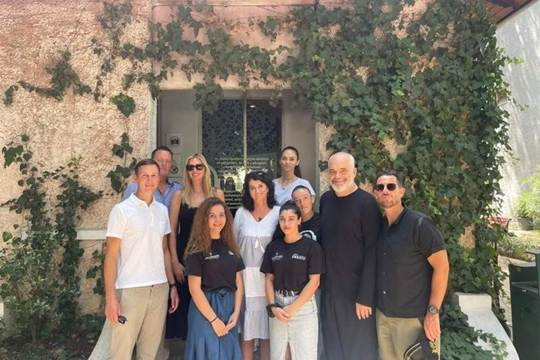
Jared Kushner and Ivanka Trump with Albanian Prime Minister Edi Rama (second from right) and members of the local delegation during their 2021 coastal survey of Albania.
The visit, which included Nasser Al-Khelaifi and covered sites from Cape Rodon to Sazan Island, preceded Kushner’s formal development proposals and the Albanian government’s grant of strategic investor status to Kushner’s entity five days before Donald Trump’s January 2025 inauguration. Source: Albanian media / public record.
Kushner returned to Albania in 2023, accompanied by Richard Grenell, who served as Acting Director of National Intelligence from February through May 2020, giving him access to the full scope of U.S. intelligence community collection and analysis during his tenure. Grenell’s post-government involvement in Kushner’s Albania business development creates questions about whether he provided Kushner with insights derived from intelligence access, whether his involvement was intended to provide political credibility to transactions with the Albanian government, and whether his participation reflected ongoing intelligence community relationships that continued beyond his formal government tenure. No evidence has emerged indicating Grenell misused classified information or violated post-government employment restrictions, but his presence during Kushner’s Albania site visits suggests that he viewed his relationship with Kushner and his association with the Trump administration as assets in business development contexts.
In March 2024, Kushner announced through his investment firm Affinity Partners a proposal to develop Sazan Island, Albania’s largest island at five square kilometers, into a luxury resort under the Aman brand, which represents the highest tier of ultra-luxury hospitality. Sazan Island possesses strategic importance beyond its tourism potential due to its location controlling access to the Otranto Strait between the Adriatic and Ionian Seas. The island served as a military base under Fascist Italy following World War I and continued as an Albanian naval base through the communist period under Enver Hoxha’s dictatorship and subsequent governments. The island remained restricted military territory until December 2024, when Albanian President Bajram Begaj issued a decree removing Sazan from the list of national military assets. This decree, removing military status from strategic territory to facilitate its sale to Trump’s son-in-law, occurred five weeks before Trump’s January 2025 inauguration and three weeks before final government approval of Kushner’s project.
The timing sequence is significant. Kushner first visited Albania in 2021, shortly after leaving his position as senior advisor to President Trump in January 2021. He developed the Sazan Island proposal through 2022 and 2023 while Trump campaigned for president again following his January 2021 departure from office and indictment in multiple criminal cases during 2023. Albania’s government advanced the project through regulatory approval processes during 2024 as Trump’s electoral prospects improved through the primary campaign and general election. The island’s military status was removed in December 2024 after Trump won the November election, but before his inauguration. Final approval designating Kushner’s entity as a strategic investor occurred on January 15, 2025, five days before Trump’s inauguration. This timeline demonstrates that the Albanian government facilitated the transaction with the apparent expectation that approving Trump’s son-in-law’s investment in strategic military territory would create goodwill with the incoming administration. [30]
The island’s military status was removed by Albanian presidential decree in December 2024, five weeks before Trump’s inauguration. Final approval of Kushner’s strategic investor designation occurred on January 15, 2025, five days before the inauguration. (Source: Albanian Times, January 20, 2025 [73] [73]; Jacobin, July 2025 [32]) The Albanian government’s decision-making process raises additional questions about how Kushner secured access to strategic military territory in a NATO member country. The decision to declassify Sazan Island and make it available for private development required a presidential decree, prime ministerial approval, parliamentary notification, and ministry coordination across defense, tourism, environment, and investment agencies. Each of these governmental actions involved officials who understood that they were facilitating the sale of strategic military territory to the son-in-law of the incoming U.S. president. The process was not hidden or disguised but rather conducted openly with the apparent assessment that transparency regarding the relationship between Kushner and Trump enhanced rather than undermined the project’s political appeal to Albanian decisionmakers.
The strategic investor designation granted to Kushner’s Atlantic Incubation Partners LLC provides the project with substantial benefits under Albanian law, including accelerated permitting procedures, assistance from government agencies in obtaining required approvals, consolidation of state-owned properties needed for the development, exemptions from certain taxes and fees, and 10-year validity of approvals that typically might require periodic renewal. The designation requires investment exceeding specific monetary thresholds and creation of minimum numbers of jobs, criteria that Kushner’s project satisfied based on announced plans for one point four billion euros in investment and one thousand jobs during development and operational phases. However, the strategic investor designation is discretionary, meaning the Albanian government can deny applications even when formal criteria are satisfied. Granting such a designation to Trump’s son-in-law for the development of strategic military territory represents a political decision that calculated the benefits of the relationship with the Trump family outweighed concerns about sovereignty, security, or the appearance of corruption.
International media coverage of the Sazan Island transaction raised exactly these concerns. The Guardian [21]’s reporting emphasized the environmental implications of developing the pristine coastline prized for its biodiversity. The New York Times highlighted Albanian opposition voices questioning whether the government courted Kushner to curry favor with Trump, noting Prime Minister Rama’s forceful denials while documenting that the timeline and terms strongly suggested political motivation. Balkan Insight documented that negotiations about the sale of Sazan Island were kept secret from Albanian parliamentarians and residents, who learned of the transaction through media reporting rather than government transparency. Jacobin published investigative reporting featuring interviews with Albanian environmental activists and tour operators who described arriving at Sazan Island hours after Kushner and Trump’s latest visit to find a military escort preventing local boats from approaching, illustrating how Albanian security services prioritized the Trump family’s desires over Albanian citizens’ access to what had previously been public territory. The criticism did not slow the project’s advancement. Following final approval in January 2025, the Albanian government created a state-owned company, Albanian State Development & Real Estate, registered at the National Business Center, with the explicit purpose of representing the state as a partner in the Sazan Island resort development.
This structure makes the Albanian government a direct business partner with Kushner’s entity, sharing in project profits and losses while presumably providing additional governmental support and protection for the investment. The arrangement creates obvious conflicts where the Albanian government as regulatory authority and the Albanian government as business partner are the same entity, eliminating meaningful separation between development interests and regulatory oversight. Kushner’s parallel proposal to develop the Zvernec area near Vlora, planning several resorts with approximately ten thousand hotel rooms and villas, faced stronger opposition due to Zvernec’s location within the environmentally protected Narte-Zvernec area. The Albanian government amended the law on protected areas in 2024 to give the government decision-making power over development within such areas despite their protected status, paving legal groundwork for approving Kushner’s Zvernec project. The law amendment occurred as Kushner’s proposals were being evaluated, raising questions about whether the legal changes were designed specifically to facilitate his projects or represented broader policy shifts that coincidentally benefited Kushner. The timing and specificity of the changes suggest the former, meaning Albanian parliament amended environmental protection laws to accommodate Trump’s son-in-law’s development proposals.
Forty-one environmental organizations from twenty-eight countries sent a letter to Prime Minister Rama and Environment Minister Sofjan Jaupaj in January 2025 calling for the immediate suspension of decisions advancing the Sazan Island project, citing threats to valuable biodiversity. The letter documented that Sazan Island area is prized for its flora, including subtropical ferns, maritime pines, oaks, rosemary, and other species, its avian populations, its marine ecosystems, including coral formations, and its relative lack of development compared to other Mediterranean coastal areas. Local ornithologists warned of tremendous ecological and economic costs from development that would introduce boat traffic, construction runoff, light pollution, noise disturbance, and human presence to areas that currently support nesting and migratory bird populations. These environmental concerns were dismissed by Kushner’s team and Albanian officials using language emphasizing that the project would adhere to environmental regulations and include sustainability measures, without addressing the fundamental incompatibility of luxury resort development with preservation of pristine ecological areas. Forty-one environmental organizations from 28 countries wrote to Albanian authorities in January 2025, demanding suspension of the Sazan Island project, citing threats to subtropical flora, coral formations, and marine ecosystems. (Source: Open letter of environmental organizations, January 2025; The Guardian [21], July 2025 [31] [100])
The involvement of Nick Muzin, whose lobbying activities on behalf of Qatar were documented in Section IV, illustrates how influence networks operate across apparently unrelated geographic areas and policy issues. Muzin’s Stonington Strategies represented Albania’s opposition Democratic Party through funding provided by a Scottish shell company that was itself financed by a Moscow-based businessman. Muzin simultaneously represented the Qatari government during the Gulf Crisis period, receiving three hundred thousand dollars monthly for lobbying, media relations, and organizing visits to Doha by American influencers. His dual representation of Albania’s opposition party (while that party was out of power but maintaining relationships that could be valuable if political circumstances changed) and the Qatari government (during a period when Qatar sought to maintain U.S. relationships despite the blockade) illustrates how lobbyists build portfolios of clients across different regions whose issues rarely intersect, but whose combined retainers provide substantial revenue streams while creating opportunities for information sharing and coordination that may not be apparent to any individual client.
Muzin’s Albania work involved attempting to influence U.S. policy toward Albania and shape American perceptions of the Rama government and its opposition. His Qatar work involved attempting to influence U.S. policy toward the Gulf Crisis and shape American perceptions of Qatar versus Saudi Arabia and the UAE. The fact that one lobbyist simultaneously worked both issues suggests that clients in both contexts valued his access to American policymakers, media, and influencers more than any specific expertise in Albanian politics or Gulf affairs. This pattern, where lobbyists and influence operatives work across unrelated issues based on access rather than expertise, creates structural corruption in policymaking because it concentrates influence with individuals who may be advocating positions for multiple clients with conflicting interests while presenting themselves as independent analysts or concerned voices. The Charles McGonigal case provides the most disturbing element of Albania-related corruption because it involved the compromise of an FBI Special Agent in Charge of Counterintelligence for the New York office, giving him oversight of sensitive espionage investigations at precisely the moment when FBI was investigating Trump campaign ties to Russia and handling Charles McGonigal, former FBI Special Agent in Charge of Counterintelligence for the New York office, pled guilty to concealing foreign payments from Albanian businessman Agron Neza and to working for sanctioned Russian oligarch Oleg Deripaska. He was sentenced to 78 months. (Source: U.S. v. Charles McGonigal, Case 23-cr-00032 (S.D.N.Y. 2023-2024) [5] [5]; Washington Post, 2023)
Counterintelligence matters related to the 2016 election. McGonigal was charged in January 2023 with concealing foreign payments and making false statements to the FBI regarding his relationship with Agron Neza, a former Albanian intelligence officer turned businessman. McGonigal accepted at least two hundred twenty-five thousand dollars from Neza from 2017 through 2018 while failing to disclose these payments as required by FBI regulations applicable to all personnel, particularly those holding security clearances and handling sensitive intelligence. The indictment and subsequent trial evidence documented that McGonigal made multiple trips to Albania, met with Prime Minister Edi Rama, warned Albanian officials against awarding oil exploration contracts to Russian-tied entities (aligned with Neza’s business interests in competing for those contracts), and allegedly encouraged FBI investigation of a U.S. lobbyist working for Rama’s political rivals (though this allegation was disputed and not ultimately proven). McGonigal also participated in business meetings regarding Albanian real estate investments and discussions of how Neza’s business interests could benefit from McGonigal’s government position and contacts. After leaving the FBI in 2018, McGonigal continued his relationship with Neza and subsequently worked for Russian oligarch Oleg Deripaska in violation of U.S. sanctions, leading to additional criminal charges.
McGonigal pleaded guilty to concealing foreign payments and to sanctions violations in separate cases brought by the Southern District of New York and the District of Columbia. He was sentenced to seventy-eight months in federal prison (but set to be released early under Trump). His conviction represents the successful prosecution of a senior FBI official for corruption, but it raises profound questions about how he maintained his position for years while accepting foreign payments and pursuing business interests that conflicted with his counterintelligence responsibilities. FBI’s internal security systems, which include financial disclosure requirements, periodic polygraph examinations, and monitoring of agent activities, failed to detect McGonigal’s corrupt relationship with Neza until after his retirement. This failure occurred in the New York counterintelligence division, which handles some of the FBI’s most sensitive espionage investigations and maintains responsibility for monitoring foreign intelligence services operating in the New York area, including at the United Nations. McGonigal’s post-FBI employment as Chief Security Officer for Vladislav Doronin’s Aman Resorts adds another layer to the Albania story because Aman is the ultra-luxury hotel brand that Kushner proposed using for the Sazan Island resort.
Doronin, a Russian billionaire with extensive Putin connections who moved Aman’s headquarters to Moscow, employed McGonigal to oversee security for a global hospitality operation that required him to maintain relationships with security services and intelligence agencies in countries where Aman properties operated. The same Aman brand proposed for Sazan Island is the brand whose parent company employed convicted felon Charles McGonigal as Chief Security Officer, reflecting a pattern where the same individuals and entities recur across apparently unrelated transactions. (Source: The Week, July 2, 2025 [77]; U.S. v. McGonigal [5]) McGonigal’s intelligence community experience and contacts would have been valuable to Doronin for purposes including threat assessment, security planning, and relationship management with foreign governments whose cooperation was necessary for high-end hospitality operations serving wealthy international clientele, including oligarchs, royalty, and political figures who might attract hostile intelligence attention.
The coincidence that Kushner’s Albania resort will operate under the Aman brand and that a former FBI counterintelligence chief convicted of corruption and sanctions violations related to Russia worked for the Aman corporate parent may be precisely that, a coincidence reflecting Aman’s small market of ultra-luxury hospitality brands suitable for trophy resort developments. Or it may illustrate how networks at this level operate, where the same individuals, brands, and entities recur across different transactions in different regions because the pool of participants in ultra-luxury hospitality influences operations and corrupt relationships with government officials is relatively small. The investigation cannot determine which explanation is correct based on available information, but the pattern is consistent with network persistence documented throughout this investigation, where the same entities and relationships recur in contexts that appear unrelated until examined in detail. Richard Grenell’s role in Kushner’s Albania activities deserves additional scrutiny because his intelligence community position creates particular concerns about post-government employment and the use of access to information for private benefit.
Grenell served as Acting Director of National Intelligence for three months in 2020, a relatively brief tenure but one that gave him access to Presidential Daily Briefings, finished intelligence assessments from all intelligence community agencies, raw intelligence reporting from sensitive sources and methods, and discussions of intelligence gaps, collection priorities, and analytical uncertainties at the highest classification levels. DNI position gave Grenell visibility into which countries and targets were subject to intense intelligence community focus, what collection methods were producing valuable information, where the intelligence community had limited visibility, and what issues were of the highest priority for policymakers. Post-government restrictions on senior intelligence officials are intended to prevent exactly the kind of exploitation of knowledge, relationships, and access that would occur if former officials immediately engaged in business activities that could benefit from their former positions.
Grenell’s participation in Kushner’s Albania site visits in 2023, two years after leaving government, likely complied with legal requirements regarding postgovernment employment cooling-off periods. But compliance with legal minimums does not address the ethical and national security concerns arising when a former DNI involves himself in business development in a small Balkan country with documented corruption issues, Russian influence, and organized crime presence. Ethics experts and former government officials noted that the transaction raised serious conflict of interest concerns that no existing law directly prohibited, illustrating a structural gap in post-government employment restrictions for senior White House officials. (Source: Citizens for Responsibility and Ethics in Washington (CREW), analysis of Kushner PIF investment; Congressional Research Service analysis of post-government employment restrictions (2022))
Grenell’s presence during Kushner’s Albania trips provided political credibility to the projects by associating them with a former senior Trump administration official whose reputation includes strong anti-corruption rhetoric and NATO alliance management. Albanian officials meeting with Kushner and Grenell would understand that Grenell’s participation signaled broader Trump administration interest in Albania and suggested that facilitating Kushner’s investments might benefit Albania’s relationship with a potential second Trump presidency. This dynamic creates influence operations risks even in the absence of explicit quid pro quo discussions. Albanian officials might grant favorable treatment to Kushner’s projects based on assumptions about Trump family gratitude without any Trump family member explicitly promising policy changes in exchange for business considerations. The appearance of a transactional relationship serves to influence purposes regardless of whether formal agreements exist.
Albania’s governance context during the Rama government period provides essential background for understanding why entities like Kushner’s Affinity Partners viewed the country as an attractive investment destination despite significant political and economic risks. Albania has attracted nearly twelve million visitors annually in recent years, approximately four times its domestic population of three million, representing substantial tourism growth compared to previous decades when communist-era isolation and postcommunist instability limited international visitors. Tourism investment has flowed into Albania primarily from diaspora Albanians sending remittances and investing in hospitality properties, as well as from Turkish, UAE, and other foreign investors seeking to capitalize on Albania’s relative underdevelopment compared to neighboring Greece, Croatia, and Italy.
This investment flow has produced hotel development and beach privatization that local environmental activists describe as destroying unspoiled coastline while generating profits for developers and minimal benefits for local communities. Transparency International [40] ranks Albania in the bottom third of countries assessed for corruption, reflecting endemic problems including bribery in government procurement, political influence over judicial decisions, organized crime infiltration of government institutions, and weak enforcement of laws against corruption. Former President Bouteflika faced corruption charges, as did multiple ministers and senior officials, though prosecutions often reflected political considerations rather than consistent rule of law application.
The European Union has delayed Albania’s membership accession partly due to governance and rule-of-law concerns, conditioning membership on reforms including judicial independence, anti-corruption measures, and organized crime reduction. Albania’s progress on these reforms has been uneven, with laws enacted to satisfy EU requirements but implementation remaining weak due to political interference, insufficient resources, and resistance from interests that benefit from status quo corruption. Albanian criminal networks operate extensively in drug trafficking, with the Balkan route through Albania serving as a major conduit for heroin from Afghanistan and cocaine from South America into European markets. These networks maintain connections to government officials who provide protection in exchange for payoffs, creating state capture dynamics where organized crime and government institutions are mutually dependent.
The United States designated former Albanian officials and businessmen under the Global Magnitsky Act authorities for corruption, imposing visa bans and asset freezes on individuals involved in bribery, embezzlement, and misappropriation of state resources. These designations reflected the U.S. government’s assessment that corruption in Albania reached levels warranting targeted sanctions against specific individuals while maintaining the overall bilateral relationship with the Albanian government. The sanctions demonstrated that the U.S. government possessed intelligence regarding corrupt activities by senior Albanian figures but lacked leverage to compel broader reform because Albania’s NATO membership, Kosovo support, and general alignment with Western foreign policy created competing equities that complicated the ability to apply more aggressive pressure. Into this environment, Kushner brought his Affinity Partners fund, which holds three point one billion dollars in assets according to Bloomberg reporting, with approximately two billion dollars coming from Saudi Arabia’s Public Investment Fund as documented previously. The Saudi backing of Kushner’s investment vehicle created immediate concerns about conflict of interest given Trump’s close relationship with Saudi Crown Prince Mohammed bin Salman, but these concerns generated no formal investigations or enforcement actions because the investment occurred after Kushner left government and because no laws prohibit former officials from accepting foreign government money for private business ventures so long as they do not explicitly condition foreign investment on past or future official actions.
The broader pattern emerging from Kushner’s Albania investments, Grenell’s participation, McGonigal’s corruption conviction, Muzin’s lobbying activities, and Al-Khelaifi’s presence during initial site visits demonstrates how networks operating at the intersection of business, politics, and intelligence create systemic vulnerabilities that episodic prosecutions do not adequately address. McGonigal’s conviction removed one corrupt FBI official but did not address how he maintained his position for years while engaging in corrupt activities. Kushner’s Albania projects face environmental and sovereignty criticism but proceed with government blessing. Grenell’s participation creates appearance problems but likely violates no laws. Al-Khelaifi’s connection to Kushner during Albania visits creates additional data points connecting Trump networks to Qatar-linked entities, but produces no investigative action because the connection is not in itself illegal.
The result is a situation where individual actions that might each be technically legal or face insufficient evidence for prosecution combine to create patterns of behavior that undermine governance, facilitate corruption, and create intelligence and counterintelligence vulnerabilities. This is the fundamental challenge that conventional law enforcement and intelligence community oversight mechanisms struggle to address. They are designed to identify and prosecute discrete criminal acts or to collect intelligence on specific foreign threats. They are not designed to address complex networks that operate across business, politics, and intelligence domains through relationships that blur lines between official and private conduct, between corruption and legitimate business, and between domestic and foreign influence operations. The controversies surrounding Kushner’s Albania venture also underscored a broader pattern in which high profile development initiatives became increasingly vulnerable to opaque financing structures, politically connected intermediaries, and speculative opportunism, pressures that would similarly complicate Saudi Arabia’s Vision 2030 as layers of contractors, fixers, and entrenched business interests began reshaping portions of the project around their own priorities rather than its original strategic objectives.
Vision 2030 Rhetoric Versus Corrupt Implementation Through Contractor Selection
Crown Prince Mohammed bin Salman launched Vision 2030 on April 25, 2016, promising a fundamental transformation of Saudi Arabia’s economy and society away from oil dependency and corruption that had characterized previous decades of governance. Speaking to Bloomberg Businessweek journalists that same day, Mohammed bin Salman declared with apparent conviction that Saudi Arabia was not waiting until 2030 to begin reforms but would start immediately, that the kingdom possessed all necessary criteria to rank among the top fifteen countries globally, and that the only question remaining was how long the transformation would require to complete. He positioned Vision 2030 explicitly as breaking from corruption and dysfunction. Mohammed bin Salman declared in his April 2016 Bloomberg interview that Saudi Arabia was not waiting until 2030 to begin reforms and would start immediately. Six years later, the flagship reforms remained incomplete, and the networks they were designed to displace remained operational. (Source: MBS Bloomberg interview, April 25, 2016; Karen Elliott House, On Saudi Arabia (2012), pp. 201-225 [90]) plaguing previous Saudi development efforts, stating in a March 2018 interview with CBS [105]’s 60 Minutes program that corruption now faced zero tolerance in Saudi Arabia, that there were no red lines protecting anyone from anti-corruption investigations regardless of their position or family connections, and that accountability would apply consistently across Saudi society.
The Red Sea Project, announced July 31, 2017, represented Vision 2030’s most visible tourism development component. The initiative involved a five billion dollar investment spanning 28,000 square kilometers along Saudi Arabia’s pristine western coastline, with Red Sea Global created as a dedicated government entity managing project implementation. The announced plans included ninety hotels totaling 8,000 rooms providing luxury accommodations, development of twenty-two islands for resort properties, an international airport with capacity for one million annual visitors, and targeted completion by 2030, coinciding with the broader Vision 2030 timeline. John Pagano, appointed as CEO of Red Sea Global to oversee this flagship development, stated at the project announcement that the Red Sea Project demonstrated the Crown Prince’s genuine commitment to diversifying the Saudi economy beyond oil revenues, creating substantial employment opportunities for Saudi nationals who faced high unemployment, particularly among youth demographics, and showcasing the Kingdom as an emerging global tourism destination capable of competing with established markets. Yet the actual implementation of the Red Sea Project through contractor selections, procurement decisions, and partnership agreements systematically contradicted Mohammed bin Salman’s stated anti-corruption principles by choosing precisely those firms and individuals whose documented records demonstrated corruption, systematic labor exploitation, and influence peddling networks that Vision 2030’s rhetoric ostensibly rejected as incompatible with Saudi Arabia’s transformation into a modern economy operating according to international governance standards. The gap between announced sustainability commitments and actual implementation choices reveals how corrupt advisory networks captured Mohammed bin Salman’s genuine reform intent and converted it into infrastructure perpetuating exactly those practices that Vision 2030 claimed to eliminate.
AECOM’s Direct Pipeline from Qatar Worker Deaths to the Saudi Red Sea Project AECOM, the American multinational engineering and construction management corporation with fourteen billion dollars in annual revenue and operations across more than 150 countries, secured the critically important master planning contract for the Red Sea Project despite the firm’s central role in Qatar’s 2022 FIFA World Cup infrastructure development that resulted in documented deaths of over 6,500 migrant workers, according to an investigation by The Guardian [21] newspaper. AECOM’s Qatar involvement spanned multiple years and numerous high-profile venues, positioning firm personnel at the absolute center of decision-making processes affecting worker welfare, safety conditions, payment practices, and labor rights protections. AECOM served as design consultant for Al Wakrah Stadium between 2013 and 2016, collaborating with Zaha Hadid Architects on one of the tournament’s most architecturally distinctive venues featuring design inspired by traditional dhow boats. The firm was appointed in February 2014 as project manager for Al-Rayyan Stadium, providing comprehensive oversight of construction activities, contractor coordination, schedule management, and quality assurance throughout a multi-year development process. AECOM also managed a six-year program management contract for Hamad International Airport expansion, with work specifically prioritizing cargo facilities required for the November 2022 World Cup logistics, handling an enormous influx of equipment, materials, and supplies.
Additionally, AECOM served as program manager for New Doha Port development under a 149 million dollar contract awarded in 2008 for a seven billion dollar project representing the world’s largest greenfield port development at the time of contract signing. The Guardian [21]’s comprehensive investigation analyzing official embassy mortality data from major labor sending countries, including India, Pakistan, Nepal, Bangladesh, and Sri Lanka, documented over 6,500 migrant worker deaths occurring in Qatar between 2010 and 2022 during a period encompassing World Cup infrastructure construction. FIFA acknowledged only thirty-seven deaths as directly linked to World Cup construction sites through its narrow definitional criteria, systematically excluding deaths occurring during nonworking hours even when heat-related illness initially developed while laboring on job sites, deaths at off-site worker accommodations despite connection to workplace conditions, illnesses manifesting symptoms after workers left construction sites but clearly caused by extreme heat exposure and overwork, and deaths on infrastructure projects supporting World Cup like roads and hotels but not technically classified as stadium construction. At least 6,500 migrant workers from South Asian countries died in Qatar between 2010 and 2022, according to data obtained from embassies of labor-sending countries. FIFA acknowledges only 37 deaths directly linked to World Cup construction sites. (Source: The Guardian [21], ’Revealed: 6,500 Migrant Workers Have Died in Qatar Since World Cup Awarded,’ February 23, 2021 [20] [101]; Amnesty International [42], ’The Ugly Side of the Beautiful Game’ [42]; Human Rights Watch [43], Qatar Labor Rights Reports (2010-2025) [43])
Amnesty International [42]’s sustained reporting on Qatar labor conditions between 2016 and 2022 found that violations continued occurring on a significant scale throughout the World Cup preparation period despite the Qatari government’s highly publicized announcements of labor law reforms and enhanced enforcement mechanisms. The organization’s detailed documentation based on hundreds of worker interviews, site visits to construction locations and housing facilities, review of employment contracts and payment records, and coordination with worker advocacy organizations revealed systematic patterns including workers laboring ten or more hours daily in temperatures exceeding 45 degrees Celsius without adequate rest periods or hydration, wage theft and salary withholding as standard practice where employers routinely delayed payments for months while workers lacked financial resources to leave Qatar or return home, charging workers substantial fees to change employers despite nominal reforms abolishing kafala sponsorship system thereby creating debt bondage, passport confiscation by employers preventing workers from departing even when facing dangerous conditions or serious contract violations, overcrowded and unsanitary housing accommodations failing basic health and safety standards, inadequate medical care when workers suffered heat-related illness or workplace injuries, and systematic retaliation including immediate deportation and blacklisting from future Gulf employment when workers complained about conditions or attempted to organize collective action.
AECOM’s contractual responsibilities positioned the firm’s personnel at the absolute center of Qatar’s infrastructure delivery with comprehensive visibility into every major decision affecting project implementation, financial expenditure, construction activity sequence, labor deployment, and safety protocol execution. The firm’s obligations explicitly included technical design review and approval of construction methods ensuring structural integrity, project scheduling and timeline management establishing completion deadlines that created pressure for rapid construction potentially encouraging corner-cutting on safety and worker welfare, cost management and budget oversight providing incentives to minimize expenditures including those protecting workers, contractor performance monitoring theoretically including oversight of labor practices and working conditions, quality assurance and compliance verification, and health and safety protocol development that should have prevented or at minimum substantially reduced worker deaths from preventable causes.
Given this comprehensive oversight role, AECOM either was directly aware of labor exploitation including workers dying from heat stress while laboring outdoors in extreme temperatures, wage theft where contractors systematically withheld salary payments for extended periods, passport confiscation preventing workers from leaving despite dangerous conditions, overcrowded housing facilities lacking adequate sanitation, insufficient medical care for workplace injuries and heat illness, and retaliation against workers who complained, or alternatively AECOM’s oversight was so profoundly negligent and incompetent that firm failed to detect massive abuses occurring throughout projects under its direct supervision despite contractual obligations requiring attention to worker welfare and safety conditions. Either scenario of direct awareness coupled with inaction, accepting worker deaths as an unavoidable cost of rapid development, or negligent failure to detect obvious and widespread abuses that any competent oversight would have identified, should have completely disqualified AECOM from subsequent selection for projects claiming to prioritize worker welfare and sustainable development practices. Yet rather than Qatar’s labor abuse record creating reputational damage that reduced AECOM’s attractiveness for similar large-scale Gulf infrastructure projects, the firm actively marketed its Qatar experience as a valuable credential, qualifying it for additional work.
In AECOM’s January 2025 announcement that it had been selected for the King Fahd International Stadium renovation project in Saudi Arabia ahead of the kingdom’s hosting of the 2034 FIFA World Cup, the company’s press release explicitly stated that AECOM’s expertise from major international events like the 2022 Qatar World Cup positioned it to deliver world-class infrastructure for Saudi Arabia. This remarkable statement treats systematic labor exploitation resulting in over 6,500 documented worker deaths as expertise and relevant experience rather than disqualifying history requiring accountability. The framing reveals AECOM’s corporate assessment that Gulf client countries view Qatar’s World Cup delivery, despite massive human cost, as successful project execution, demonstrating the firm’s valuable capabilities rather than a cautionary example of development approach requiring fundamental reform before the firm could claim commitment to worker welfare.
The Trump-Richard Attias-Doronin Network: Corruption Camouflaged as Luxury Development
The Red Sea Project’s hospitality component reveals direct connections between Trump family business interests and individuals whose backgrounds exemplify precisely the corruption that Mohammed bin Salman claimed Vision 2030 would eliminate. Aman Resorts, the ultra-luxury hospitality brand operating over fifty properties globally with nightly room rates starting at $1,500 and extending to tens of thousands for premium suites, secured development rights for multiple Red Sea Project properties. The Aman selection represented a choice of a globally recognized luxury brand capable of attracting ultra-wealthy international tourists whose spending would validate the Red Sea Project’s positioning as a world-class destination competing with established luxury markets. However, Aman Resorts is controlled by Vladislav Doronin, a Russian billionaire with extensive Putin connections, who relocated Aman’s corporate headquarters to Moscow. Craig Unger’s investigative book American Kompromat documents Doronin’s deep integration into Russian power structures, characterizing him as representative of new generation of Russian oligarchs who maintain simultaneous operations across Moscow, Western capitals, and offshore jurisdictions, using luxury real estate developments and hospitality properties as vehicles for capital movement, relationship cultivation with Western business and political elites, and preservation of wealth outside Russian government’s direct control while maintaining necessary accommodations with Kremlin to protect Russian-based operations and personal security.
Doronin’s employment decisions for Aman’s senior leadership revealed either catastrophic judgment failures or deliberate comfort with corruption networks. From 2018 until his arrest in January 2023, Doronin employed Charles McGonigal as Aman Resorts’ Chief Security Officer. McGonigal’s background made him an extraordinarily valuable hire for any organization requiring sophisticated security expertise and intelligence community connections. He had served as FBI Special Agent in Charge of Counterintelligence Division for New York Field Office, one of FBI’s most sensitive positions involving oversight of investigations into foreign intelligence services’ operations against United States, protection of classified information and intelligence sources, coordination with CIA and other intelligence community partners on joint operations, and development of strategies countering espionage, foreign influence operations, and efforts by hostile governments to penetrate American institutions.
McGonigal’s subsequent criminal convictions on two separate federal charges revealed systematic corruption occurring while he held this extraordinarily sensitive counterintelligence position and continuing after his departure from government service. First, McGonigal pleaded guilty in August 2023 to concealing $225,000 in payments received from Agron Neza, a former Albanian intelligence officer who transitioned to business activities following Albania’s post-communist transition. These payments occurred during 2017 and 2018 while McGonigal actively served in FBI counterintelligence leadership, directly violating FBI financial disclosure requirements specifically designed to prevent foreign payments creating conflicts of interest, potential compromise of FBI officials through financial dependencies, and foreign influence over counterintelligence operations protecting American national security. McGonigal’s deliberate concealment of these payments demonstrated a conscious effort to hide foreign financial relationships from FBI oversight mechanisms that should have detected the payments and triggered an immediate investigation into whether a foreign actor sought to influence or compromise a senior counterintelligence official.
Second, McGonigal pleaded guilty in September 2023 to a separate charge of violating United States sanctions by providing services to Russian oligarch Oleg Deripaska after McGonigal’s retirement from the FBI in 2018. Deripaska faced US Treasury Department sanctions designating him as a Russian oligarch with close Putin ties whose business empire served Russian government interests and who warranted economic restrictions preventing American individuals and entities from engaging in business relationships with him or his controlled entities. McGonigal’s willingness to work for a sanctioned Russian oligarch immediately after retiring from a senior FBI counterintelligence position demonstrated a pattern where his government career culminated in exactly the type of corrupt foreign relationship that his FBI role explicitly required detecting and preventing in others. The conviction revealed McGonigal understood sanctions violations risked federal prosecution, yet proceeded with the Deripaska relationship regardless, suggesting either confidence he would avoid detection or an assessment that substantial financial compensation justified significant legal risks.
McGonigal received a combined sentence of 78 months in federal prison across both convictions, with 50 months for concealing foreign payments and 28 months for sanctions violations to run consecutively. [5] The successful prosecution represented the Justice Department’s accountability for senior FBI officials’ corruption but also demonstrated profound penetration of United States law enforcement leadership by precisely those foreign influence networks that counterintelligence operations exist to detect and neutralize. The fact that Doronin’s Aman Resorts employed McGonigal as Chief Security Officer, presumably valuing combination of his FBI counterintelligence experience, technical expertise in security operations, and continued relationships within intelligence community and law enforcement even after government service departure, and that this same Aman organization controlled by Putin-connected Russian oligarch employing convicted corrupt former FBI official received development rights for multiple luxury properties at Saudi Arabia’s flagship Red Sea tourism project, creates obvious governance concerns about partnership selection criteria and due diligence processes that Mohammed bin Salman’s advisors either implemented inadequately or deliberately avoided to maintain relationship with prestigious luxury brand. Richard Attias, the Moroccan-born French events executive and nation-branding consultant who founded and chairs Richard Attias & Associates, serves as a critical connector linking the Trump Organization, Aman Resorts, Doronin, and the Saudi Red Sea Project through overlapping business relationships spanning multiple continents and decades. [71]
Born in 1959 in Fes into a Moroccan Jewish family, trained as a civil engineer in Toulouse with a mathematics and physics master’s from Paris University, Attias spent a decade as Executive Chairman of Publicis Events Worldwide, a position whose significance extends beyond his events production work: Publicis’s subsidiary Qorvis Communications became Saudi Arabia’s primary Washington lobbying firm after 9/11, spending more than fourteen million dollars in a six-month period alone to rehabilitate the Kingdom’s image following revelations that 15 of the 19 hijackers were Saudi nationals. His relationship with the Saudi government began in this same era, when SAGIA, the Saudi Arabian General Investment Authority, retained Publicis Events to organize the Global Competitiveness Forum in Riyadh, an engagement Attias later described as the foundation of a two-decade relationship with the House of Saud. He produced 16 editions of the World Economic Forum in Davos as executive producer from 1992 through 2008, co-founded the Clinton Global Initiative, and served as a special adviser to the Emirate of Dubai on nation-branding strategy.
He married Cecilia Ciganer-Albeniz in 2008, the former First Lady of France and ex-wife of President Nicolas Sarkozy, a union that substantially deepened his access to European political elites and French government corridors. In 2017, at the invitation of the Saudi ruling family and acting in close coordination with Yasir Al-Rumayyan, Attias created the Future Investment Initiative, positioning PIF at the center of global capital conversations. In 2018, PIF’s investment arm Sanabil acquired a 49 percent stake in his firm, later increasing that ownership to 75 percent, while Attias was simultaneously appointed CEO of the FII Institute and, in 2024, Special Adviser to PIF itself. [72] The structure means Attias is not merely a consultant to PIF but a partner whose commercial interests are substantially owned by the fund he helps promote.
His career simultaneously spans Qatari soft-power infrastructure, producing the Doha GOALS Forum under the patronage of Emir Sheikh Hamad, and Saudi Vision 2030 promotion, positioning him at the intersection of two sovereign wealth ecosystems that are formal rivals. Attias maintained extensively documented business relationships with the Trump Organization dating to at least the 2000s period when Trump pursued Middle East development opportunities, including proposed Trump-branded towers in Dubai, Abu Dhabi, and other Gulf locations. Most of these projects failed to materialize beyond preliminary discussions and feasibility studies, but the engagement established Trump’s sustained interest in licensing his brand for Middle East real estate developments and created a network of regional consultants and intermediaries including Attias who positioned themselves as essential facilitators for navigating Gulf business environments. [46] Investigative reporting by Israeli newspaper Haaretz documented Attias’s role across multiple networks, characterizing him as operating at the intersection of Israeli business networks providing connections throughout the Middle East where an Israeli passport otherwise restricts direct access.
The Russian capital is seeking investment opportunities in Gulf countries and providing financing for development projects requiring international funding sources, and American political connections through the Trump relationship, creating access to individuals and networks that non-American consultants struggle to cultivate independently. The Haaretz investigation positioned Attias as a quintessential intermediary whose value derives not from technical expertise in hospitality development or project management but rather from the claimed ability to navigate complex relationships between property developers, government officials controlling permits and regulatory approvals, international financing sources, and luxury brand operators seeking to minimize risks while maximizing returns through licensing arrangements requiring minimal capital investment.
Attias’s relationship with Aman Resorts and Vladislav Doronin involved facilitating Aman’s expansion into Middle East markets, where the luxury hospitality brand sought to establish properties, capitalizing on the Gulf region’s growing ultra-wealthy tourist demographic but lacking established regional relationships, regulatory knowledge, and understanding of Gulf business practices that typically require informal connections and personal relationships more than formal procurement processes and merit-based contractor selections. Attias’s value proposition to Aman derived from the claimed ability to identify suitable development sites, negotiate favorable terms with property owners and government entities, secure necessary regulatory approvals and operating licenses, and manage relationships with local partners whose cooperation proved essential for successful market entry. Attias’s consulting role with Red Sea Project involved advising Red Sea Global management on hospitality components of massive development, recruiting international investors and luxury hospitality operators interested in participating in Saudi Arabia’s flagship tourism initiative, and facilitating relationships between Red Sea Global’s Saudi leadership and potential international partners, including Aman Resorts.
The consulting engagement created a direct pipeline between Mohammed bin Salman’s signature tourism project and networks encompassing Trump family business interests through Attias’s Trump Organization relationships spanning decades, Russian oligarchs maintaining Putin connections through Doronin’s background and Aman ownership structure, and convicted FBI counterintelligence officials who had betrayed their responsibilities through corrupt foreign relationships and subsequently worked for entities involved in Red Sea Project implementation. Each of these connections individually raises substantial governance concerns about who Saudi Arabia selected as partners for Vision 2030 implementation and whether due diligence processes functioned adequately. Trump Organization’s documented history of business relationships with organized crime figures across multiple decades, acceptance of Russian capital through property purchases by individuals later convicted of money laundering, and licensing arrangements with developers whose financing sources remained opaque despite journalistic investigations created serious questions about whether the Trump brand represented luxury and quality, or rather association with corruption networks operating internationally.
Doronin’s Putin connections and decision to relocate Aman headquarters to Moscow created obvious concerns about whether the Russian government maintained visibility into or potential influence over Aman’s international operations that could affect the Red Sea Project through intelligence collection, pressure on Doronin to advance Russian interests through business relationships, or exploitation of Aman’s partnerships for purposes beyond hospitality operations. McGonigal’s employment by Aman while Red Sea Project consulting occurred created additional questions about whether convicted corrupt FBI counterintelligence official leveraged continued relationships within intelligence community and law enforcement to benefit Aman’s business interests through information access or influence, whether his extensive background conducting counterintelligence investigations provided expertise that Aman valued for protecting operations against foreign intelligence services, or whether his demonstrated willingness to engage in corrupt relationships with foreign actors including Albanians and Russians made him particularly attractive to entities like Aman whose ownership structure and international operations involved navigating relationships with governments and individuals subject to intelligence collection and law enforcement scrutiny.
Collectively, these Trump-Richard Attias-Doronin-McGonigal connections demonstrate a systematic pattern where advisors responsible for Red Sea Project contractor selection approved partnerships with entities and individuals whose backgrounds exemplify precisely the corruption, foreign influence operations, and compromised relationships that Vision 2030 ostensibly rejected as incompatible with Saudi Arabia’s transformation into a modern economy operating according to international governance standards and transparency principles. The approvals suggest advisors either actively prioritized these problematic relationships because they provided access to capital, luxury brand recognition, and international networks that Mohammed bin Salman valued despite governance concerns, or failed to identify obvious concerns through due diligence processes that should have surfaced readily available information about partners’ backgrounds through basic internet searches and minimal investigation, or identified serious concerns but presented them to Mohammed bin Salman (if they were presented at all) in ways that systematically minimized significance while emphasizing benefits of maintaining relationships over costs of adhering to stated anti-corruption principles.
Foster + Partners, a prestigious British architecture firm, designed Lusail Stadium, serving as an 80,000-seat final venue for the Qatar World Cup. The firm issued no public statements acknowledging or addressing labor abuses occurring on projects bearing its name, despite the Foster + Partners brand being publicly and prominently associated with Qatar’s World Cup infrastructure. When questioned by journalists about worker welfare, Foster + Partners stated it had made modifications to design specifications intended to ensure stringent workers’ welfare standards, but acknowledged not being retained for the construction phase, thereby eliminating any oversight role over actual labor conditions during the building process when worker deaths occurred. This response positioned the firm as concerned about welfare issues but lacking authority or responsibility for construction practices, thereby avoiding accountability for outcomes on projects the firm designed. When questioned specifically about migrant worker deaths on her Qatar projects before her death in 2016, architect Zaha Hadid responded with a statement revealing professional detachment from human consequences of construction: “I have nothing to do with the workers. I think that’s an issue the government should pick up. Hopefully, these things will be resolved.” Asked directly about her responsibility as architect for worker welfare on projects she designed, Hadid stated bluntly: “It’s not my duty as an architect to look at it.”
This response, while morally obtuse and revealing callous indifference to preventable deaths, represents a legally accurate description of standard architect-client contractual relationships on international projects, where design professionals provide drawings and technical specifications but typically lack contractual authority over labor practices, hiring decisions, or working conditions during actual construction implementation. These same firms, including AECOM, Foster + Partners, and other international consultants with documented Qatar records, proceeded directly to Saudi Red Sea Project contracts, creating disturbing continuity of exploitation infrastructure and professional networks while Mohammed bin Salman publicly proclaimed that Saudi Arabia does not tolerate corruption at any level, citing royal decrees dating to founding king Abdulaziz establishing the principle that anyone proven guilty of corruption will face punishment. The gap between rhetoric emphasizing zero tolerance for corruption and actual practice, selecting firms whose recent projects involved systematic labor exploitation resulting in thousands of preventable deaths, reveals how completely corrupt advisory networks captured Mohammed bin Salman’s genuine reform intentions and converted them into mechanisms perpetuating precisely those abusive practices that Vision 2030 claimed to reject.
The Ritz-Carlton Purge: Asset Seizure or Anti-Corruption Reform?
The fundamental contradiction between Mohammed bin Salman’s anti-corruption rhetoric and what appeared to be the governance practices in place became starkest during the November 4 and 5, 2017, Ritz-Carlton purge, when Saudi authorities detained over 200 princes, ministers, businessmen, and senior officials at the Ritz-Carlton hotel in Riyadh, claiming the mass detention represented a comprehensive anti-corruption crackdown targeting elite wrongdoing. Saudi Attorney General Saud al-Mojeb announced the detentions through an official statement declaring that this represented a significant step in combating corruption at the highest levels of Saudi society, that the Kingdom would no longer tolerate corruption in any form, regardless of perpetrators’ positions or family connections, and that all those responsible for corrupt practices would face accountability through legal processes. MBS extracted approximately $106 billion in settlements from the detained princes and businessmen, an amount unprecedented in any anti-corruption operation globally. The figure raises questions about whether this represented a genuine recovery of stolen assets or a forced wealth transfer to consolidate state financial power. (Source: Saudi Attorney General statement, January 30, 2018 [96]; Bloomberg, ’Saudi Arabia Says It’s Recovered $106 Billion From Corruption Crackdown,’ January 30, 2018 [97])
Among those detained was Prince Alwaleed bin Talal, Saudi Arabia’s wealthiest businessman with a Forbes- estimated fortune of seventeen billion dollars accumulated through Kingdom Holding Company’s strategic investments, including major stakes in Citigroup bank, Twitter social media platform, Four Seasons luxury hotel chain, and Kingdom Holding real estate properties spanning multiple continents. Alwaleed remained detained for 83 days from early November 2017 until his release on January 27, 2018, which came only after he reportedly reached a settlement agreement transferring approximately six billion dollars in combined cash payments and asset transfers to the Saudi government. Among those detained: Prince Alwaleed bin Talal, then Saudi Arabia’s wealthiest individual with stakes in Citigroup, Twitter, and global luxury real estate; Waleed Ibrahim, head of Saudi media conglomerate MBC; and Bakr bin Laden, chairman of the Saudi Binladin Group construction empire. (Source: Financial Times, ’Saudi Arabia’s Anti-Corruption Purge: Who Has Been Detained?’ November 5, 2017; Wall Street Journal, November 4, 2017 [99])
Saudi government officials never filed any formal criminal corruption charges against Alwaleed despite nearly three months of detention. No trial occurred where evidence could be presented and contested. No public documentation was provided explaining what specific corrupt acts justified detention or how the settlement amount was calculated. The forced settlement involved asset transfers whose exact terms remain undisclosed even years later, though Alwaleed’s ownership stake in Kingdom Holding Company declined from 95 percent before Ritz detention to 78 percent following his release, clearly suggesting that the Saudi government extracted a substantial equity position as the price for ending the indefinite detention. Alwaleed described his detention experience to Bloomberg Television journalists following his release, stating that while there was no physical torture involving beatings or violence, there was definitely psychological torture through the interrogation methods employed. He characterized the interrogation as “tough, very, very tough,” emphasizing the intensive pressure applied to force a settlement agreement. When explaining what Saudi authorities wanted from him, Alwaleed stated bluntly that they wanted assets and they wanted cash, confirming that detention served wealth extraction purposes rather than legitimate criminal prosecution, establishing guilt through evidence.
When asked what he had learned from the entire experience, Alwaleed provided an extraordinarily revealing response: I learned that in Saudi Arabia, at the end of the day, the government is more powerful than any individual. This admission is critically important for understanding actual power dynamics in Saudi Arabia despite Vision 2030 rhetoric about the rule of law and consistent application of anti-corruption standards. Alwaleed explicitly acknowledges that detention was fundamentally about demonstrating government power and extracting desired assets, not about prosecuting corruption through legal processes where evidence determines outcomes. The purge demonstrated that even enormous personal wealth accumulated over decades provides absolutely no protection against arbitrary detention when the system determines that the individual poses a political threat or simply possesses assets that the government wants to seize. However, there is another telling admission in Alwaleed’s comments, and that is, if someone like Mohammed bin Salman, an empowered reformer, decides to take on the government, he too, may soon find himself outnumbered and outgunned by the concerted efforts of the system to preserve itself and to resist changes at any cost. Mohammed bin Salman may have wanted this episode to play out differently, specifically with full accountability to all involved for all their transgression, with the defanging of the nepotistic, corrupt, or ideologically captured individuals, business entities, and institutions, but that is not how it played out.
The Atlantic magazine’s comprehensive reporting on Ritz-Carlton detention process documented the systematic violations of due process and legal norms, describing how detainees were held completely incommunicado without contact with family members or lawyers, denied access to legal counsel during interrogations despite this being fundamental right in any system claiming to operate according to rule of law, and subjected to enormous pressure to sign over substantial portions of their wealth in exchange for eventual freedom. Some detainees alleged experiencing physical abuse, including beatings and being forced into stress positions, though the Saudi government denied these allegations. The investigative reporting concluded that the entire process bore absolutely no resemblance to due process under any recognized legal system, representing instead extrajudicial asset seizure camouflaged with anti-corruption rhetoric. And at the end, the worst offenders were in fact the ones ultimately in charged of that process. No wonder that they went on to sabotage, block, or hijack other reforms, initiatives, and policies that Mohammed bin Salman was trying to build on from what he thought to be the ashes of the past.
Western firms including AECOM, Foster + Partners, Accor Group, and numerous other international companies pursuing Saudi contracts operate with full knowledge that Saudi government possesses demonstrated capacity to seize assets without filing formal criminal charges, detain business partners indefinitely without meaningful legal process or judicial review, extract forced settlements through psychological and potentially physical coercion without any connection to proven wrongdoing, and unilaterally revise contractual terms based on political calculations rather than commercial disputes or legal obligations. Despite this clearly demonstrated risk to property rights, contractual security, and personal safety, these international firms continued aggressively pursuing Saudi contracts worth billions of dollars, apparently calculating that access to Saudi investment capital and participation in massive infrastructure projects compensates adequately for severe governance deficiencies and human rights concerns that would disqualify most other potential client countries from receiving such enthusiastic Western business engagement.
PART 2: PRINCE ALWALEED’S STRATEGIC RECAPTURE OF INFLUENCE THROUGH ELON MUSK]
Muslim Brotherhood Funding History and Extremism Network Connections Prince Alwaleed’s detention and forced six-billion-dollar settlement did not permanently end his business operations or eliminate his political influence, as Mohammed bin Salman’s anticorruption rhetoric suggested would occur for those proven guilty of corruption. Instead, the Ritz experience forced Alwaleed to adopt more strategically sophisticated and indirect mechanisms for exercising power and advancing interests while avoiding direct confrontation with the Crown Prince that could trigger renewed detention. Alwaleed’s documented record before Ritz detention included extensive financial support for entities and causes promoting Islamist ideology that directly contradicts Mohammed bin Salman’s stated Vision 2030 commitment to combating extremism and promoting moderate Islamic interpretation open to the world’s diverse religions and traditions. In 2002, Prince Alwaleed offered a ten-million-dollar donation to New York City for September 11 terrorist attack recovery assistance.
However, Mayor Rudy Giuliani publicly rejected the donation after Alwaleed issued an accompanying statement suggesting that the United States foreign policy positions in the Middle East had contributed to creating conditions enabling terrorist attacks. Alwaleed’s statement declared that at times like these, Americans must address some of the underlying issues that led to such criminal attacks, and that he believed the government of the United States should re-examine its policies in the Middle East and adopt a more balanced stance toward the Palestinian cause rather than the perceived one-sided support for Israel. Mayor Giuliani responded forcefully that there is no moral equivalent for terrorist attacks murdering thousands of innocent civilians, that Alwaleed’s statements were not only factually wrong but actually part of the problem enabling terrorism, and that New York City would not accept donations accompanied by suggestions that American policy bore responsibility for terrorist violence. The public exchange revealed Alwaleed’s consistent willingness to use philanthropic gestures as a platform for advancing political positions aligned with Islamist grievance narratives holding United States policies rather than terrorist ideology responsible for violence against American civilians.
More significantly for assessing Alwaleed’s ideological alignments and financial support networks, his Kingdom Foundation donated five hundred thousand dollars to the Council on American-Islamic Relations in 2002. CAIR was subsequently named as an unindicted coconspirator in United States v. Holy Land [102] Foundation criminal trial, which resulted in convictions of multiple defendants for systematically funneling twelve million dollars to the Hamas terrorist organization through ostensibly charitable fundraising operations. FBI documentation introduced as evidence at the Holy Land Foundation trial included internal organizational charts and strategy documents showing that CAIR’s founding was directly connected to the Muslim Brotherhood’s United States network infrastructure and Hamas financial support operations designed to appear as legitimate charitable and civil rights advocacy while actually advancing the Islamist political agenda and providing material support to designated terrorist organizations. FBI officially severed all formal institutional ties with CAIR in 2009 based on evidence revealed through the Holy Land Foundation prosecution.
Then-FBI Director Robert Mueller [103] explained the decision to Congressional committees, stating that until the FBI could definitively resolve whether a continuing connection exists between CAIR’s current organizational leadership and Hamas terrorist infrastructure, the FBI would not maintain an official relationship with CAIR or treat the organization as a legitimate civil rights advocacy group worthy of law enforcement partnership. This represents an extraordinary repudiation from the FBI, which typically seeks cooperative relationships with community organizations, indicating that evidence of CAIR’s Hamas connections was sufficiently strong that the FBI could not risk association even for community outreach purposes.
Beyond the CAIR donation, Alwaleed provided twenty million dollars to Harvard University specifically for establishing the Middle East Studies center and a separate twenty million dollar donation to Georgetown University’s Center for Muslim-Christian Understanding, which was subsequently renamed the Prince Alwaleed bin Talal Center for Muslim-Christian Understanding in recognition of his financial contribution. Critics, including prominent terrorism analyst Steven Emerson [104], argued in Congressional testimony that these massive donations to prestigious universities influenced academic institutions toward producing scholarship and educational programming sympathetic to Islamist political perspectives and systematically critical of United States counterterrorism policies, essentially purchasing ideological influence over how future American leaders would understand Middle East conflicts and political Islam. These funding patterns spanning CAIR donation, post-September 11 political messaging, and university center establishment reveal a consistent record of Alwaleed supporting ideological infrastructure advancing narratives fundamentally incompatible with Mohammed bin Salman’s Vision 2030 rhetoric about Saudi Arabia promoting moderate Islam, combating extremism, and destroying extremist thoughts immediately rather than wasting decades fighting ideological battles.
Mohammed bin Salman told CBS [105] 60 Minutes in March 2018 that Saudis were simply reverting to what they had followed historically before the 1979 Iranian revolution triggered regional extremism competition, specifically moderate Islam open to the world and all religions. He emphasized that 70 percent of the Saudi population is under age 30, and that honestly, we won’t waste 30 years of our lives combating extremist thoughts, but rather we will destroy them now and immediately. Yet despite this forceful anti-extremism rhetoric, Mohammed bin Salman released Alwaleed from Ritz-Carlton detention and allowed him to resume business operations despite Alwaleed’s extensively documented record of financially supporting precisely those extremist ideological networks that the Crown Prince claimed to oppose as incompatible with Saudi modernization. This fundamental contradiction demonstrates that as far as the majority of the Saudi establishment was concerned, Mohammed bin Salman’s anti-extremism commitments serve primarily public relations purposes, satisfying international audiences seeking evidence of Saudi reform, while actual practices under their immediate control accommodated continued extremism support and ideological financing when doing so served political relationships or economic interests. Over time, the more Mohammed bin Salman had tried to assert his counterextremism posture with more consistency, the more pushback he received. The Al Ula agreement, which he reportedly argued against, ultimately opened the doors to a far more open reintegration of Qatar into the Saudi business, policy, and academic circles, allowing the flow of money from Doha to come in far more directly. It was also arguably the beginning of the end for the efforts to bring Saudi Arabia closer to Israel. It was not only that MBS became a less visible public presence after the conclusion of this reintegration process, but that his policies too were soon overshadowed by other concerns. As the gatekeepers of the old Saudi policy establishment such as Turki al-Faisal once more retook the public stage in the months prior and after the signing of the agreement, the official language towards Israel in Saudi Foreign Ministry statements and other communiques started reverting back first to a more guarded, and then increasingly, towards a more hostile tone. The more Saudi Arabia integrated with Qatar, Turkey, and eventually even normalization with Iran, the less remained of Mohammed bin Salman’s efforts towards warmer relations with Israel.
Twitter/X Acquisition: Alwaleed’s Transformation from Opponent to Musk’s Partner
In early 2022, Prince Alwaleed played a surprisingly pivotal role despite publicly opposing Musk’s takeover offer during the initial announcement phase. On April 14, 2022, Alwaleed posted a tweet stating that he did not believe the proposed offer by Elon Musk at $54.20 per share came close to Twitter’s intrinsic value given its growth prospects, and that, being one of Twitter’s largest and longest-term shareholders, both Kingdom Holding Company and he personally rejected this offer as inadequate compensation for surrendering their equity position. Elon Musk responded with a sarcastic tweet apparently designed to embarrass Alwaleed by highlighting Saudi Arabia’s poor record on freedom of speech and press freedom. Musk wrote that Alwaleed’s position was interesting and posed just two questions: How much of Twitter does the Kingdom own directly and indirectly, and what are the Kingdom’s views on journalistic freedom of speech?
The pointed exchange appeared adversarial and suggested Alwaleed would actively oppose the acquisition attempt, potentially marshaling other shareholders to reject Musk’s offer as inadequate. Yet by May 5, 2022, barely three weeks after publicly rejecting the offer and enduring Musk’s sarcastic questioning about Saudi commitment to free speech, Alwaleed executed a complete reversal of position. He announced that Kingdom Holding would roll its existing Twitter equity stake valued at approximately $1.9 billion into Musk’s acquisition structure, thereby making Alwaleed the second-largest shareholder in privatized Twitter behind only Musk himself. Kingdom Holding’s official statement declared that this investment decision allows Kingdom to maintain its position as one of Twitter’s largest shareholders while supporting Elon Musk’s vision for the platform’s future development.
This dramatic reversal from rejection to partnership within a three-week period is remarkable and demands an explanation that official statements never provided. Alwaleed shifted from characterizing the offer price as inadequate and incompatible with Twitter’s intrinsic value based on growth prospects, to enthusiastically rolling his entire stake into the acquisition at the same price he had just rejected as insufficient. No explanation was offered for the radically changed assessment of Twitter’s intrinsic value or growth prospects that supposedly justified rejection. The timing suggests Alwaleed recognized a strategic opportunity to gain substantial influence over a critically important global communications platform through a partnership arrangement with Musk, an influence he could never obtain through opposition that might have succeeded in blocking the acquisition but would have left him as a minority shareholder in a publicly traded company where his voice carried limited weight.
Twitter’s October 2022 acquisition completion filing with the Securities and Exchange Commission listed major shareholders in the post-transaction ownership structure. Elon Musk controlled approximately 79 percent of the privatized company through a combination of cash investment and rolled equity from his previous Twitter stake. Prince Alwaleed bin Talal and Kingdom Holding held a $1.89 billion stake representing approximately 4.4 percent ownership, making him the definitively second-largest shareholder. Qatar Investment Authority [50] held approximately 3.8 percent through a similar rollover of its existing position. Various other institutional and individual investors held stakes under 3 percent each. This post-acquisition ownership structure means that Saudi and Qatari sovereign wealth entities combined control approximately 8 percent of Twitter/X, with Alwaleed personally holding the second-largest individual ownership stake behind only Musk. Given Alwaleed’s extensively documented Muslim Brotherhood funding history through CAIR donation and ideological support through university center financing, combined with Qatar Investment Authority [50]’s documented relationships with entities alleged throughout this investigation to support extremism and terrorism financing, this concentration of Gulf sovereign and royal family ownership in major United States social media platform creates obvious and severe policy concerns about foreign influence over American communications infrastructure and content moderation decisions affecting hundreds of millions of global users including senior U.S. government officials, military personnel, and elected representatives.
Following Elon Musk’s acquisition of Twitter in October 2022, the platform underwent dramatic policy transformations affecting content moderation practices, handling of previously suspended extremist accounts, verification systems distinguishing authentic from fake accounts, and algorithmic amplification determining which content reaches large audiences. These sweeping changes occurred while Prince Alwaleed held the second largest ownership stake in a privatized company, creating legitimate questions about whether his presence as a major shareholder influenced policy decisions that systematically weakened constraints on extremist content and hate speech. Musk conducted a so-called general amnesty poll in late November 2022, asking Twitter users whether accounts suspended for violations, including hate speech, harassment, deliberate misinformation, and promotion of extremist ideologies, should be reinstated to the platform.
Following poll results showing majority support for reinstatement among those users who participated, Musk ordered the restoration of approximately 62,000 previously suspended accounts. The reinstated accounts included Andrew Anglin, founder of the neo-Nazi Daily Stormer website, who was reinstated in December 2022 despite his site being internationally recognized as the primary hub for white supremacist content and violent extremist recruitment. Richard Spencer, a prominent white nationalist and organizer of the 2017 Charlottesville Unite the Right rally, where a participant murdered a counter-protester, was reinstated in November 2022. Multiple accounts associated with the QAnon conspiracy theory network, which the FBI had identified as a domestic terrorism threat, regained platform access. Numerous accounts previously suspended for systematically spreading COVID-19 medical misinformation that endangered public health received reinstatement despite their documented records of promoting dangerous falsehoods.
Musk framed mass reinstatements as vindicating free speech principles and correcting previous management’s excessive censorship, but provided absolutely no coherent explanation for why hate speech explicitly advocating violence against minorities, systematic harassment campaigns targeting individuals with threats, and deliberate medical misinformation endangering public health warranted platform protection rather than continued exclusion based on Terms of Service violations. The Anti-Defamation League’s systematic monitoring documented that measurable hate speech on the platform increased 105 percent during the week immediately following reinstatements, demonstrating a direct causal connection between allowing extremists back onto the platform and a surge in hateful content targeting vulnerable communities.
Network Contagion Research Institute conducted a detailed analysis of reinstated accounts’ behavioral patterns, finding that these accounts showed a 4.5 times increase in toxic content production during the first month following reinstatement compared to baseline rates documented before their original suspensions. This dramatic increase in violating content suggests that suspensions had been serving a meaningful deterrent effect that removal eliminated, essentially signaling to bad actors that previous consequences no longer applied and thereby encouraging them to resume and intensify precisely those behaviors that had justified suspension. The verification system changes represented additional degradation of information quality on the platform. Musk replaced Twitter’s established verification system, where blue checkmarks indicated that accounts genuinely belonged to public figures, journalists, government officials, and legitimate organizations whose identities had been authenticated, with a paid subscription model where literally anyone could purchase a verification badge for eight dollars a month, regardless of their actual identity or legitimate claim to public recognition.
This change completely eliminated meaningful distinction between authentic accounts operated by who they claim and impersonator accounts created by bad actors, thereby creating substantial opportunities for impersonation of government officials making false policy announcements, journalists spreading fabricated news stories, and organizations issuing fraudulent statements, while simultaneously enabling amplification of misinformation through verified-appearing accounts that casual users might mistake for legitimate authoritative sources, and making it systematically more difficult for ordinary platform users to distinguish genuinely authoritative information sources from sophisticated bad actors exploiting verification system’s credibility markers.
Musk implemented massive cuts to Twitter’s trust and safety team, reducing staffing from approximately 2,000 employees responsible for content moderation, user safety, and terms of service enforcement down to fewer than 400 employees attempting to perform the same functions with a roughly 80 percent reduction in available personnel. Yoel Roth, who had served as Head of Trust and Safety before resigning in December 2022, provided a public statement explaining that a substantial reduction in content moderation capacity has made Twitter fundamentally unable to address harassment at scale, respond adequately to child safety issues requiring rapid intervention, or detect and counter coordinated inauthentic behavior, including bot networks and influence operations, at anywhere near the levels that previous staffing had enabled. The European Commission threatened Twitter with substantial fines under the Digital Services Act for systematic failure to adequately address illegal content as required by European Union regulations protecting users.
Stanford Internet Observatory research revealed that reports of child sexual abuse material to the National Center for Missing and Exploited Children decreased 75 percent year-over-year following moderation team cuts, strongly suggesting catastrophic failures in detection and removal systems rather than an actual reduction in CSAM presence on the platform. This represents a profound child safety crisis where known mechanisms for protecting children from predatory content collapsed due to deliberate staffing and system changes. Musk altered Twitter’s core recommendation algorithm to boost engagement metrics over content quality or accuracy, prioritizing posts generating reactions regardless of whether those reactions stemmed from valuable information or outrageous misinformation.
Multiple academic studies documented how algorithmic changes systematically amplified sensational and divisive content while reducing the reach of measured factual reporting. MIT Media Lab analysis found that false information spread six times faster than accurate information on post-Musk Twitter compared to three times faster pre-acquisition, representing a doubling in misinformation’s competitive advantage over truth. University of Washington researchers documented that political misinformation reached 40 percent more users during the first 24 hours following the algorithm modification compared to identical content shared under the previous algorithmic approach. NewsGuard monitoring revealed conspiracy theories about election integrity, vaccine safety, and climate science received increases exceeding 200 percent in reach and engagement following algorithmic prioritization of engagement over accuracy.
These systematic changes toward reduced moderation, reinstated extremists, degraded verification, depleted safety teams, and engagement-maximizing algorithms collectively align with interests that benefit from platform instability, unconstrained misinformation spread, and the elimination of content moderation protecting vulnerable users. Alwaleed’s extensively documented history of Muslim Brotherhood funding through CAIR donation and ideological support financing suggests his interests align with at least some categories of extremist content that Musk’s policy changes enabled to flourish. The mechanism creating this alignment need not involve Alwaleed directly ordering specific policy changes or maintaining operational control over content decisions.
Rather, his mere presence as a major shareholder holding the second-largest stake creates a structural situation where Musk’s proclaimed libertarian commitment to free speech absolutism, regardless of consequences, serves Alwaleed’s interests in systematically reducing constraints on precisely those categories of extremist ideological content that serve the Muslim Brotherhood narrative objectives. United States Government Contracts Creating National Security Exposure Prince Alwaleed’s substantial influence over Elon Musk extends far beyond Twitter/X ownership into domains with direct national security implications through Musk’s companies holding billions of dollars in United States government contracts, while Musk simultaneously maintains significant business relationships with Alwaleed.
This creates an extraordinary situation where an individual with documented financial dependence on a Saudi prince who has funded Muslim Brotherhood-linked organizations controls companies that are critical to United States space operations, military communications infrastructure, and advanced technology development essential to American national security. SpaceX, Musk’s aerospace manufacturer and space transportation company, holds multiple massive contracts with NASA and the Department of Defense, representing core components of the United States civil and military space programs. The NASA Commercial Crew Program contract, which enables SpaceX to transport American astronauts to the International Space Station using the Dragon spacecraft, totals 3.1 billion dollars across multiple missions. NASA’s Artemis program, which aims to return American astronauts to the lunar surface for the first time since Apollo missions ended in 1972, awarded SpaceX a $2.9 billion contract for developing the Human Landing System that will transport crew from lunar orbit to the moon’s surface. The United States Space Force, the newest branch of the American military focused on space-based operations and defense, has awarded SpaceX approximately 1.8 billion dollars through multiple contracts for launching classified and unclassified satellites essential to military communications, reconnaissance, and early warning systems. Department of Defense continues providing SpaceX with contracts exceeding 70 million dollars for Starlink satellite internet service supporting military operations globally, with ongoing expansions as military becomes increasingly dependent on commercial satellite communications.
Tesla, Musk’s electric vehicle and clean energy company, similarly maintains substantial government relationships through General Services Administration vehicle procurement contracts totaling over 200 million dollars for federal government fleet purchases, representing a significant portion of the federal transition toward electric vehicles. While Tesla repaid the controversial 465-million-dollar Department of Energy loan guarantee from 2010, the loan was critical to the company’s survival during a period when bankruptcy appeared imminent, demonstrating ongoing government support enabling Musk’s business empire expansion. A comprehensive analysis by the Los Angeles Times documented that Musk’s various companies received approximately 8.5 billion dollars in federal contracts, subsidies, and loan guarantees between 2015 and 2023.
This enormous government financial support creates situation where individual maintaining documented business relationships with Prince Alwaleed, who holds second-largest Twitter ownership stake and whose Kingdom Holding has invested in multiple Musk ventures, controls companies that are absolutely critical to United States space exploration, military satellite communications, and technology infrastructure that American national security depends upon. The Starlink satellite internet system, which SpaceX operates with over 5,000 satellites providing global coverage, became critically important to Ukrainian military operations following Russia’s February 2022 invasion when traditional communications infrastructure was destroyed or compromised. However, Elon Musk unilaterally disabled Starlink service during Ukrainian military offensive operations in Crimea during 2022, effectively vetoing military operations of a United States ally without consulting the American government despite Starlink’s importance to Ukrainian military communications. Walter Isaacson’s authorized biography of Musk documents this decision in detail, revealing that Musk personally ordered Starlink deactivation to prevent what he characterized as Ukrainian use of technology for offensive operations rather than defensive purposes.
When questioned about essentially making independent foreign policy decisions affecting active military conflict involving a United States ally, Musk stated that SpaceX is not a weapons company and that if the Ukrainian government wants to purchase Starlink terminals for military use, they need to make that request formally through appropriate channels. This framing deliberately ignores the established reality that the Ukrainian military had been using Starlink with apparent Musk approval for many months before he suddenly imposed restrictions, and that Musk’s unilateral decision to disable service during active military operations constituted an extraordinary foreign policy intervention by a private individual, overriding what the United States government and its allies had determined served their strategic interests. The incident demonstrates that Musk views himself as possessing independent authority to make consequential geopolitical decisions affecting military operations based on his personal judgment, regardless of what the United States government or allied nations assess as serving their security interests.
Saudi and Qatari sovereign wealth investment in Musk’s various enterprises creates obvious and acute questions about conflicts of interest and potential foreign influence over critical American infrastructure. Can Musk maintain genuine independence from major investors, including Prince Alwaleed, when making business decisions that might affect those investors’ interests or the interests of countries they represent? Does Alwaleed’s second-largest Twitter ownership stake create influence over Musk’s decisions about content moderation policies affecting Middle East-related topics, particularly the moderation of content critical of Saudi Arabia, the promotion of Islamist ideologies, or the discussion of Saudi human rights record? Do Gulf sovereign wealth investments create leverage over Musk personally or over his companies that hold critical United States government contracts involving classified military systems and sensitive space operations?
These questions become particularly acute given Prince Alwaleed’s extensively documented Muslim Brotherhood funding history through CAIR donations and demonstrated commitment to promoting Islamist ideological perspectives through massive university donations. Committee on Foreign Investment in the United States, the interagency body that reviews foreign investments for national security concerns and possesses authority to block or unwind transactions threatening American interests, operates under a regulatory framework where CFIUS authority applies primarily to acquisitions that provide foreign entities with control over American companies rather than minority investments creating influence without formal control. Alwaleed’s 4.4 percent Twitter ownership stake and similar minority stakes in other Musk business ventures may fall below CFIUS review thresholds despite representing obvious potential for influence over an individual who controls companies essential to the United States national security. The regulatory gap reveals fundamental vulnerability where foreign actors, including individuals with documented extremism support records, can acquire substantial influence over American technology platforms and defense contractors through minority investments that avoid triggering national security reviews, thereby creating dependencies and potential leverage that could affect decisions involving classified information, military operations, and critical infrastructure without ever reaching the level of formal control that existing regulations were designed to prevent.
The China Connection
Worth noting is that despite Donald Trump’s repeated warnings about strategic rivalry with China, and calls for decoupling, he and his network maintain active business interests in that country.
Alwaleed’s China exposure, for example, formed part of a wider network of China facing financial and political relationships surrounding figures connected to Trump, Kushner, Richard Attias, Erik Prince, and the Al Khayyat brothers. Through Kingdom Holding, Alwaleed placed Saudi private capital into major Chinese growth sectors, including a roughly $250 million investment in JD.com, while his broader portfolio extended into Chinese finance, hospitality, entertainment, and consumer technology platforms through holdings connected to Citigroup, Four Seasons, Fairmont, Raffles, Swissôtel, Mövenpick, and Disney linked assets in Hong Kong and Shanghai. Kingdom Holding’s Asia allocation also included exposure to companies such as Alibaba, Baidu, and Deezer, embedding Saudi elite capital into China’s expanding digital and consumer economy.
The Al Khayyat brothers likewise expanded deep commercial relationships with China through construction materials, infrastructure supply chains, industrial manufacturing partnerships, logistics, and procurement channels tied to Saudi mega projects and Red Sea development initiatives, integrating Chinese firms into major Gulf construction and hospitality ecosystems. Kushner Companies simultaneously pursued Chinese financing for major U.S. real estate developments, including EB-5 linked investment tied to projects such as Trump Bay Street and 1 Journal Square, while Jared Kushner maintained direct engagement with Chinese officials during the Trump transition and early administration period.
Richard Attias operated within the elite conference and investment circuit linking Gulf sovereign capital, Western political networks, and Asian technology and finance interests through high profile forums backed by Saudi and Emirati institutions. Trump’s business exposure to China included trademark expansion, manufacturing dependencies, and branding interests, while Erik Prince positioned Frontier Services Group in Hong Kong as a logistics and security platform integrated into Belt and Road commercial corridors across Asia and Africa. Together, these overlapping relationships embedded Gulf capital, politically connected real estate finance, sovereign investment channels, private security infrastructure, industrial procurement systems, and post-2016 influence networks deeply into the Chinese commercial sphere.
TRUMP ADMINISTRATION INTEGRATION AND POLICY CORRUPTION
Donald Trump’s Decades of Saudi Business Relationships
Donald Trump’s relationship with Saudi Arabia spans multiple decades of business dealings that preceded and shaped his presidency’s dramatic policy alignment with Saudi interests, regardless of human rights concerns or American strategic considerations. In 1991, during Trump’s severe financial crisis, when his casino and real estate empire faced potential bankruptcy and creditors were demanding payment on hundreds of millions in personal guarantees, Trump sold his yacht, Trump Princess, a 282-foot vessel he had purchased from arms dealer Adnan Khashoggi, to Prince Alwaleed bin Talal for approximately 30 million dollars. This sale provided Trump with desperately needed cash during a period when his business empire was collapsing, and he faced personal financial ruin. Alwaleed subsequently purchased luxury apartments in Trump’s Plaza Hotel and maintained various business relationships with Trump throughout the 1990s, establishing a decades-long financial connection that would later shape Trump’s approach to Saudi Arabia as president.
Trump’s decision to make Saudi Arabia his first foreign visit as president, traveling to Riyadh on May 20 and 21, 2017, represented highly unusual choice that signaled clear prioritization of Saudi relationship over traditional allies including United Kingdom and major European partners that American presidents typically visit first. The timing of this presidential visit is particularly significant as it occurred only weeks before Red Sea Project’s public announcement on July 31, 2017, strongly suggesting coordination between Saudi Arabia’s Vision 2030 initiatives and Trump administration’s positioning to support Saudi development projects that would create opportunities for American contractors and business interests with Trump connections.
During Riyadh visit, Trump signed arms sale agreements totaling announced value of 110 billion dollars, though actual implemented contracts proved substantially smaller than initial announcements suggested. Trump delivered speech at Arab Islamic American Summit emphasizing that United States was not in Middle East to lecture partners about governance or impose American values, stating explicitly that “We are not here to lecture. We are not here to tell other people how to live, what to do, who to be, or how to worship. Instead, we are here to offer partnership based on shared interests and values to pursue a better future for us all.” This framing represented dramatic departure from previous American presidents’ emphasis on promoting democracy and human rights, essentially announcing that Trump administration would not allow human rights concerns to constrain business relationships or arms sales to authoritarian governments
Jamal Khashoggi Murder and Trump’s Defense of Saudi Arabia
The October 2, 2018, murder of journalist Jamal Khashoggi at the Saudi consulate in Istanbul represented the ultimate test of whether Trump would prioritize human rights and accountability over Saudi business relationships and political alliance. Khashoggi, a Virginia resident and Washington Post columnist and a former Saudi intelligence operative with links to the Muslim Brotherhood, critical of Mohammed bin Salman’s governance and linked to Qatar Investment Authority [50]’s anti-Crown Prince propaganda copy-and-paste pay-to-play operations via the Washington Post, was lured to the Saudi consulate under the pretext of obtaining documents for his upcoming marriage, where a Saudi assassination team murdered and dismembered him. Turkish intelligence provided audio recordings to the United States documenting murder, while a CIA assessment conducted at an early stage concluded, allegedly with high confidence, that Mohammed bin Salman personally ordered the operation [11], given Saudi Arabia’s authoritarian structure, where operations of this sensitivity targeting prominent critics with an international profile require royal family authorization. The problem with all of that, of course, was that 1. No one, whether in Congress or elsewhere, was ever privy to the full report 2. There was no follow-up report. 3. Mohammed bin Salman did not necessarily have the level of authority that was ascribed to him, and 4. Mohammed bin Salman had every reason to want to see Jamal Khashoggi arrested and questioned, given that Khashoggi was once an assistant to Turki Al-Faisal, when he was an Ambassador to London, and was also at one point briefly funded by Alwaleed bin Talal, another of MBS’s nemesis. On the other hand, removing Khashoggi before he could talk, and simultaneously framing the Crown Prince for murder, very much aligned with the agendas of the networks looking to undercut the reform agenda and to preserve their own power.
Despite the CIA’s alleged early conclusion that the Crown Prince ordered Khashoggi’s murder, Trump publicly defended Saudi Arabia and refused to impose meaningful consequences. Trump’s initial response to questions about Saudi responsibility included a statement, “maybe he did, and maybe he didn’t,” regarding Mohammed bin Salman’s involvement, framing as uncertain what the intelligence community had assessed with high confidence. That said, it is unclear who exactly had worked on that report. It is also clear that even if the evidence pointed to exactly the opposite conclusion, that MBS, despite initial optics, likely would not have ordered an operation that would have pointed directly to him, and certainly would not have approved an assassination inside a Saudi diplomatic facility inside an unfriendly country (at that time, Saudi Arabia and Turkey were at odds over various foreign policy matters), rather than clearing MBS at an early stage and putting an end to a media campaign that followed, Trump did only just enough to preserve a working relationship with Saudi Arabia but not nearly enough to preserve MBS’s political position or reputation.
Trump subsequently issued an official written statement defending the relationship with Saudi Arabia. (as a country) that included memorable phrasing: “The world is a very dangerous place!” Trump’s November 2018 statement declared that the United States intended to remain a steadfast partner of Saudi Arabia regardless of the Khashoggi murder, that arms sales and cooperation on Iran policy were too important to jeopardize over a journalist’s death, and that even if the Crown Prince had knowledge of the murder, the American relationship is with the Kingdom of Saudi Arabia as a whole rather than any individual. All of that fell far from a vigorous defense of the Crown Prince personally. Seven years later, when the damage from the Khashoggi affair had died down, and Mohammed bin Salman paid a second visit to the White House, Trump finally acknowledged that he did not believe MBS was responsible for Khashoggi’s demise.
The top beneficiaries from this sequence of events were the very networks Trump and his associates had worked with for years before Mohammed bin Salman was born. Trump’s response to the Khashoggi murder was to side publicly with MBS, stating in November 2018: ‘Maybe he did, and maybe he didn’t’, citing weapons sales and oil prices as reasons to maintain the relationship. (Source: Donald Trump, White House statement, ‘America First!’ November 20, 2018; Washington Post, November 20, 2018) Jared Kushner reportedly advocated within the administration for protecting MBS from accountability following the Khashoggi murder and maintained his personal relationship with the Crown Prince throughout the controversy. (Source: Bob Woodward, Rage (2020), pp. 218-226; New York Times, ‘Kushner and Mohammed bin Salman: The Bromance That Shaped U.S. Policy,’ November 29, 2018) This extraordinary statement outraged both sides of the debate: For those who viewed Khashoggi as a journalist, rather than a political operative, and a US resident, it indicated that Trump administration would not allow even brutal murder of American resident and prominent journalist to affect arms sales or political alliance with Saudi Arabia, establishing precedent that Saudi government could quite literally get away with murder without facing serious American consequences so long as business relationships and arms purchases continued. And those who believed that Khashoggi was neither innocent nor murdered by MBS were aghast that Trump would not question the inconsistencies in the stories, much less push for a transparent investigation that cast a shadow of aspersions for years to come. For both sides, the position directly contradicted American intelligence assessment, abandoned any pretense of promoting human rights or accountability, and demonstrated that Trump viewed the Saudi relationship through a purely transactional lens where financial considerations outweighed all other concerns, including the murder of an American resident.
Clearly, if the US intelligence was wrong or even deceptive on this matter, that too should have been clarified and investigated rather than allowing an early assessment to linger on without a clear resolution. And if some in the intelligence community erroneously rely on biased or faulty sources or deliberately mislead the President and Congress about the true course of events, that in itself was a scandal that demanded an investigation, and that may have contributed to other failed intelligence assessments years down the line. Ultimately, neither Trump nor Kushner never took any action to put an end to the media campaigns attacking MBS personally, even as they continued to reap the benefits of continuing a relationship with Saudi Arabia. The fact that Kushner never publicly defended Mohammed bin Salman in the end undercuts the reports alleging his close personal friendship with the Crown Prince. Indeed, if anything, Kushner who was arguably underqualified for the sort of business he was doing with Saudi Arabia, was one of the people who benefited the most from MBS being distanced from the PIF and sidelined from arguments against his involvement or policies (such as the Al-Ula agreement).
Jared Kushner’s Two Billion Dollar Saudi Capture
Perhaps the most blatant example of Saudi Arabia’s successful capture of the Trump family through financial mechanisms came through Jared Kushner’s Affinity Partners receiving two billion dollars from Saudi Arabia’s Public Investment Fund in 2022, approximately 18 months after Kushner departed his White House position as senior advisor handling Middle East policy. The investment’s timing created an obvious appearance of delayed payment for services rendered during Kushner’s government tenure, when he supposedly maintained a close relationship with Mohammed bin Salman and certainly was a visible and frequent visitor to Saudi Arabia, advocated for continued American engagement with KSA after the Khashoggi murder, and allegedly shaped Middle East policies favorable to Saudi interests, including arms sales approval and a limited response to Yemen war civilian casualties. At the end, however, Kushner’s and Trump’s push for the Al Ula agreement may have benefited some in KSA far more than others. Who, if not the ant-MBS factions, would stand to gain the most from bringing Qatar back into the fold after all the damage Doha propagandists did to MBS’s reputation around the world?
Critically, PIF’s internal investment committee, chaired by Yasir Al-Rumayyan and responsible for evaluating proposed investments against established criteria, including manager track record and fee reasonableness, initially recommended against the two-billion-dollar Kushner investment. Committee’s professional assessment cited Affinity Partners’ complete lack of investment track record since Kushner had never previously managed institutional capital, characterized due diligence results on Kushner and his proposed fund as unsatisfactory, identified proposed 1.25 percent annual management fee amounting to 25 million dollars yearly regardless of fund performance as excessive relative to industry standards, and found investment strategy unclear with insufficient detail about how Kushner intended to generate returns justifying massive capital commitment.
Despite the investment committee’s comprehensive negative recommendation based on standard professional criteria, according to the anonymous sources, allegedly from the Saudi official circles, Mohammed bin Salman personally intervened to overrule the committee’s assessment and directly ordered PIF to make a two-billion-dollar investment in Kushner’s fund. This extraordinary override of professional investment judgment by political leadership would have normally demonstrated purposes beyond commercial returns, functioning as relationship maintenance with the Trump family during the period when Trump might return to the presidency, and Kushner’s continued influence over Republican Middle East policy remained valuable to Saudi interests. In retrospect, it is very unlike that MBS authorized this expenditure, and he certainly would have no reason to expose himself to further reputational risk by doing so openly. It is far more likely than not that he had no part in such a decision, but that government sources deliberately leaked what they knew to be a stamp of approval for the unsuspecting Western audiences unfamiliar with the opaqueness of the Saudi system, while simultaneously undercutting faith in the sincerity of the Crown Prince’s reform efforts. The investment structure guarantees Kushner 25 million dollars annually in management fees regardless of whether Affinity Partners generates any investment returns, creating a permanent income stream dependent on continued Saudi favor and thereby establishing financial dependency that could influence Kushner’s future policy positions regarding Saudi Arabia.
2024 Presidential Campaign and Second Term Saudi Alignment
Trump’s 2024 presidential campaign featured explicit acknowledgment of how business relationships shaped his Saudi Arabia policy positions. At the October 2023 campaign rally, Trump stated without apparent embarrassment: “Saudi Arabia, and I get along great with all of them. They buy apartments from me. They spent 40 million dollars, 50 million dollars. Am I supposed to dislike them? I like them very much.” This statement represented an extraordinary admission that Trump’s policy positions toward foreign governments are directly influenced by whether that government or its nationals purchase Trump-branded properties, explicitly acknowledging that personal business profits shape official policy rather than American national interests. In a December 2023 interview, Trump declared: We will have the best relationship with Saudi Arabia we’ve ever had in the history of our country. They’re going to invest in the United States like never before. Mohammed bin Salman is a strong leader who gets things done, and we’re going to work together on many important projects. Notably absent from Trump’s characterization of future relationship was either any mention of people-to-people engagement, push for increasing institutional transparency, and meritocracy, praise for modernizing and liberalizing reforms, or concerns regarding the Houthis in Yemen, questions about the role of Islamists in trying to subvert reforms, or concerns about the beneficiaries of the Khashoggi murder and campaigns. The framing positioned the relationship purely in terms of Saudi investment in the United States and cooperation on unspecified projects, suggesting the second Trump term would continue and intensify the transactional approach, prioritizing business deals over supporting human security and reformist allies who share a more open-minded vision of Saudi Arabia and the Middle East or of broader American strategic interests.
Trump’s January 20, 2025, presidential inauguration included attendance by Al-Khayyat brothers despite their involvement in active London litigation where Syrian nationals allege the brothers facilitated terrorism financing supporting Al-Nusra operations that caused plaintiffs severe harm. The Al-Khayyat brothers’ presence at the presidential inauguration demonstrates either catastrophic failure of Secret Service and State Department vetting processes that should have identified individuals subject to terrorism financing allegations in allied nations’ courts, political override of security concerns to accommodate individuals with valuable Saudi connections, or threshold gaps in existing vetting systems that allow individuals not yet convicted of terrorism-related offenses to receive inauguration access despite pending serious allegations.
The Blavatnik-PIF Streaming Convergence: Russian Capital Meets Gulf Sovereign Wealth.
See also: Accor Group Annual Reports 2017-2025 [47]; ODNI Declassified Assessment on Khashoggi (2021) The February 2025 announcement that PIF’s sports investment arm SURJ had acquired a minority stake in DAZN, the global sports streaming platform majority-owned by Ukrainian-born billionaire Leonard Blavatnik through his Access Industries holding company, closed a loop that this investigation’s structural analysis had anticipated. [66] Blavatnik’s trajectory tracks the post-Soviet capital integration thread documented across the preceding sections. Born in Odessa in 1957, he emigrated to the United States in 1978, earned a computer science degree from Columbia and an MBA from Harvard, and in 1986 founded Access Industries, the private investment vehicle that would become his primary operating entity. His initial fortune was built in the same post-Soviet privatization window that produced the oligarch class documented throughout this report: Access partnered with Viktor Vekselberg and Mikhail Fridman’s Alfa Group to acquire TNK, a West Siberian oil joint venture that BP eventually purchased a fifty percent stake in for nearly seven billion dollars. When TNK-BP was sold to Rosneft, the Russian state oil company, in 2013, Blavatnik received approximately 6.86 billion dollars from the transaction. [67]
This capital was then redeployed into Western media, entertainment, and technology assets, including Warner Music Group, acquired for 3.3 billion dollars in 2011 and listed on the Nasdaq in 2020 at a 13.3 billion dollar valuation, and DAZN, the sports streaming platform he has controlled since 2014, and which streams more than 90,000 live events annually across Europe, the Americas, and Asia. The PIF investment in DAZN, reported at more than one billion dollars through SURJ Sports Investment, is not merely a financial transaction. [46] [68] It connects PIF’s expanding sports infrastructure empire, which already encompasses LIV Golf, Newcastle United, and extensive live event rights across boxing, Formula E, and other properties, to a streaming distribution network controlled by a figure whose initial wealth derives directly from the post-Soviet privatization environment that spawned the Russian capital integration thread this report has traced from Trump Tower through Bayrock to the present.
Blavatnik himself received a British knighthood in 2017 for services to philanthropy and has cultivated a reputation as a disinterested cultural benefactor through the Blavatnik School of Government at Oxford and various arts endowments. The structure of his fortune, however, connects the Russian state’s energy sector to Western content infrastructure in ways that the DAZN-PIF deal makes explicit: Saudi sovereign capital now holds a stake in a streaming platform built on proceeds from a sale to Rosneft, the arm of the Russian state. The continuity of Russian and Gulf sovereign interests through these financial relationships, persisting from the 1990s privatization era through the 2025 streaming deal, is precisely the structural pattern this investigation’s analytical framework was designed to surface. [46]
What makes the DAZN-PIF transaction analytically significant beyond its headline numbers is the nature of what PIF is actually acquiring. DAZN is not simply a sports broadcaster. It holds exclusive or near-exclusive live streaming rights to Serie A, the Bundesliga, the Champions League in multiple markets, La Liga, Premier League rights in selected territories, and boxing’s most lucrative pay-per-view properties. It has a significant positioning in Japan’s sports market, in which NTT Docomo, one of Japan’s largest telecoms, holds a minority stake. Through the acquisition of Foxtel in Australia in 2024, Blavatnik added a major English-language cable and streaming subscriber base to the platform. When PIF, through SURJ Sports Investment, invests more than one billion dollars and establishes a regional joint venture, it is not buying passive exposure to a streaming startup.
It is embedding itself into the distribution infrastructure through which hundreds of millions of viewers in Europe, Asia, and the Americas consume live sport. The implications for Saudi Arabia’s soft power agenda, which has deployed LIV Golf, the PIF’s acquisition of Newcastle United, the procurement of boxing’s most prominent heavyweight champions to fight in Riyadh, and Formula E rights to project a modernizing image internationally, are direct. A sovereign wealth fund that controls the production of premium sporting events and simultaneously holds a stake in the platform delivering those events to global audiences has achieved a degree of vertical integration in sports media that no Gulf state has previously managed.
Blavatnik’s personal trajectory through this transaction also merits scrutiny that his philanthropic reputation has largely foreclosed in Western coverage. His knighthood, awarded in 2017 for services to philanthropy, the same year he was donating to the Blavatnik School of Government at Oxford, whose faculty produces policy papers on democratic governance and institutional integrity, arrived at a moment when the origin of the capital underwriting those donations remained poorly examined in British public discourse. The fortune that endowed Oxford came substantially from the AAR consortium’s sale of TNK-BP to Rosneft. Rosneft, at the time of that sale, was already the subject of Western concern about its role as an instrument of Russian state power; Igor Sechin, its CEO, had been a close Putin associate since the St. Petersburg years and would later be sanctioned by the United States and European Union.
The transaction that transferred Blavatnik’s Russian oil stake into cash, and that cash into Warner Music and DAZN, was approved and structured in a period when Western governments were actively debating the extent to which Russian state-adjacent capital should be permitted to flow freely into Western assets. Blavatnik navigated that period without sanction, maintaining dual US-UK citizenship and cultivating relationships with institutions on both sides of the Atlantic who benefited from his largesse. The Viktor Vekselberg connection is worth examining separately. Vekselberg, Blavatnik’s longtime business partner from their Moscow State University days and a co-founder of the AAR consortium that controlled TNK, was sanctioned by the US Treasury in April 2018 under the Countering America’s Adversaries Through Sanctions Act. Vekselberg’s Renova Group was simultaneously invested in several of the same sectors as Access Industries. His yacht was boarded by federal agents [18] [102] at a New York pier in 2018, and his assets in the United States were frozen. Blavatnik, who had exited his Russian oil holdings through the Rosneft sale before Vekselberg’s sanctioning, avoided this outcome.
The question of whether the timing of Blavatnik’s divestiture from Russian assets reflected advance awareness of the sanctions trajectory or simply prudent portfolio management is unanswerable from public sources. What is answerable is that his capital, now residing in Western media and entertainment assets including the world’s second-largest music rights library and a global sports streaming platform, has been laundered of its Russian origin in the sense that most Western counterparties engage with Warner Music Group and DAZN as ordinary commercial entities rather than as assets whose foundation capital moved through the same post-Soviet privatization ecosystem that produced Deripaska, Abramovich, and the figures the West subsequently sanctioned. [18] [102] Len Blavatnik’s Access Industries, which holds significant stakes in Warner Music, DAZN, and other media properties, has served as a bridge between post-Soviet capital and Western entertainment and media infrastructure, with documented connections extending through Gulf sovereign wealth relationships. (Source: Forbes profile, Len Blavatnik, 2019; New York Times, ‘The Unlikely Partners Behind Warner Music,’ 2018) It should could come as no surprise that DAZN also plays an equally active role in Qatar.
The PIF-DAZN deal therefore completes a circuit. Capital that originated in Soviet state assets, was privatized into oligarch hands in the 1990s, was sold to Rosneft in 2013 (where Turki Al-Faisal, and others from his circle reportedly have accumulated significant personal investments), was redeployed into Western entertainment infrastructure through the 2010s, is now partially owned by Saudi sovereign wealth, a fund whose own expansion was predicated on assets extracted through the Ritz-Carlton purge, whose governance the preceding sections have documented as captured by Al-Rumayyan’s network rather than directed by MBS’s reform agenda. The transaction is legal at every step. It will generate no enforcement action. But it is, in structural terms, precisely the kind of relationship that this investigation’s analytical framework exists to make visible: the convergence of post-Soviet capital, Gulf sovereign wealth, and Western media infrastructure in a deal that no single regulatory jurisdiction is positioned to evaluate in full. The convergence of Russian oligarch capital with Gulf sovereign wealth in U.S. technology, media, and financial institutions creates layered influence networks that conventional counterintelligence frameworks are not designed to detect or disrupt. (Source: Carnegie Endowment for International Peace [44], Gulf States Influence Operations Studies [44]; Senate Intelligence Committee, Report on Russian Active Measures, Vol. 5 (2020) [12] [11])
Network Integration and Systematic Corruption Infrastructure

Network diagram: Conclusion, Vision 2030 as Corruption Infrastructure Rather Than Reform. Synthesizes the persistent structural connections between Mohammed bin Salman, the Muslim Brotherhood financing network, Qatar, the UAE, Thomas Barrack, Estithmar Holdings, FIFA, and Western regulatory bodies
The integration of Trump family business interests, Saudi sovereign wealth deployment, Kushner’s two-billion-dollar capture, and Alwaleed’s Twitter/X ownership while funding the Muslim Brotherhood creates a comprehensive corruption network where multiple vectors of influence converge. Trump maintains decades of personal financial relationships with Saudi royals who have purchased his properties during financial crises and continue providing revenue through hotel stays and property investments. Kushner depends on a 25 million dollar annual income from the Saudi PIF regardless of investment performance, creating permanent financial dependency on continued Saudi favor. Alwaleed controls the second-largest Twitter/X stake, giving him influence over content moderation affecting the discussion of Saudi human rights record, Islamist ideology, and Middle East conflicts. These relationships are not independent or coincidental but rather represent deliberately constructed influence infrastructure where Saudi Arabia and affiliated actors, including Alwaleed, have systematically created dependencies that constrain American policy options and enable corruption of decisionmaking processes. The Al-Khayyat inauguration attendance despite terrorism financing allegations, occurring simultaneously with Kushner receiving guaranteed Saudi income and Alwaleed controlling a major Twitter stake, reveals a pattern where multiple influence vectors operate simultaneously to ensure Saudi interests receive priority consideration regardless of American national security concerns, human rights violations, or democratic governance principles.
The Systematic Betrayal of Mohammed bin Salman’s Reform Aspirations
The comprehensive evidence presented throughout this investigation demonstrates that the Red Sea Project and broader Vision 2030 implementation systematically betrayed Mohammed bin Salman’s stated anti-corruption and modernization principles through contractor selections, partnership agreements, and governance decisions that perpetuated precisely those corrupt practices and extremist support networks that reform rhetoric claimed to eliminate. Rather than representing Saudi Arabia’s transformation into a transparent economy operating according to international governance standards, Vision 2030’s actual implementation created infrastructure enabling continued corruption while providing a public relations narrative satisfying international observers seeking evidence of Saudi progress.
AECOM’s selection for Red Sea Project master planning, despite the firm’s central role in Qatar World Cup infrastructure, resulting in over 6,500 migrant worker deaths, exemplifies how corrupt advisory networks captured Saudi institutions and undercut Mohammed bin Salman’s genuine reform intent. The decision to hire firms responsible for systematic labor exploitation directly contradicted Red Sea Project’s stated worker welfare commitments, revealing that sustainability rhetoric served marketing purposes while actual implementation prioritized relationships with established contractors possessing technical capabilities regardless of their human rights records. AECOM’s subsequent characterization of Qatar experience as valuable expertise qualifying the firm for additional Gulf projects demonstrates that accountability mechanisms were insufficient to create business consequences for deadly exploitation, instead allowing firms to profit continuously from patterns of abuse. Another possible conclusion is that the entire process could have been deliberately hijacked and mismanaged to diminish Mohammed bin Salman’s influence and to benefit groups that advanced their own interests while using the Crown Prince’s chairmanship as a cover.
The Trump-Richard Attias-Doronin-McGonigal network’s involvement in the Red Sea Project through Aman Resorts development rights created a direct pipeline between Mohammed bin Salman’s signature tourism initiative and corruption networks spanning Russian oligarchs with Putin connections, convicted FBI counterintelligence officials who betrayed their responsibilities through foreign payments and sanctions violations, and Trump Organization relationships that influenced presidential policy toward Saudi Arabia. Each connection individually raises severe governance concerns. Collectively, they demonstrate a systematic pattern where advisors approved partnerships with entities whose backgrounds exemplify precisely the corruption and foreign influence that Vision 2030 ostensibly rejected. Prince Alwaleed bin Talal’s trajectory from Ritz-Carlton detention through Twitter/X partnership with Elon Musk represents ultimate evidence that Mohammed bin Salman became captive of corrupt networks rather than successfully constraining them through reform.
Alwaleed’s extensive Muslim Brotherhood funding record through CAIR donations and university center financing demonstrates ideological support for extremism that directly contradicts Mohammed bin Salman’s Vision 2030 commitment to combating extremist thoughts immediately. Yet Mohammed bin Salman released Alwaleed from detention despite this record, allowed him to resume business operations without meaningful restrictions, and apparently raised no objections to Alwaleed’s Twitter/X partnership that gave Muslim Brotherhood founder the second-largest ownership stake in a major United States communications platform. Alwaleed’s Twitter/X influence during the period when Musk systematically dismantled content moderation, reinstated 62,000 suspended accounts, including neo-Nazis and QAnon promoters, eliminated trust and safety staffing by 80 percent, and modified algorithms to amplify misinformation, creating an environment that benefited extremist content spread.
Whether Alwaleed directly ordered these policy changes or merely benefited from structural alignment where Musk’s actions served his interests, the outcome enables precisely those extremist ideological narratives that Alwaleed’s Muslim Brotherhood funding history suggests he supports. The national security implications extend beyond content moderation to Musk’s 8.5 billion dollars in United States government contracts, while maintaining business relationships with Alwaleed, creating dependencies where a foreign actor with an extremist support record possesses potential influence over individuals controlling companies critical to American space operations and military communications.
Trump administration’s integration into this corruption network through decades of Trump family business relationships with Saudi royals, Kushner’s two billion dollar PIF investment overriding professional committee recommendation, Trump’s explicit acknowledgment that Saudi property purchases influence his policy positions, and Al-Khayyat brothers’ inauguration attendance despite terrorism financing allegations reveals systematic construction of influence infrastructure ensuring Saudi interests receive priority regardless of American national security, human rights, or democratic governance concerns. The corruption operates through multiple simultaneous vectors, including direct business profits, guaranteed annual payments creating financial dependencies, media platform ownership affecting public discourse, and personal relationships cultivated over decades.
Vision 2030 functions not as a reform program transforming Saudi Arabia into a transparent modern economy but rather as a sophisticated public relations narrative justifying Western engagement while obscuring continued corruption, extremism support, and authoritarian practices. Mohammed bin Salman’s genuine early reform intent was systematically captured by advisory networks who converted his anti-corruption rhetoric into mechanisms perpetuating corruption, his anti-extremism commitments into accommodation of Muslim Brotherhood funding, and his governance modernization into power consolidation through asset seizure without due process. The Red Sea Project exemplifies this betrayal, where announced sustainability and worker welfare commitments became cover for hiring firms responsible for thousands of worker deaths and partnering with corruption networks spanning Russian oligarchs, convicted American officials, and Trump family business interests.
The implications extend far beyond Saudi Arabia to fundamental questions about whether concentrated authoritarian power can implement genuine reform absent institutional checks preventing advisory capture, whether Western governments and firms bear responsibility for enabling corruption through continued engagement despite obvious governance failures, and whether corruption networks operating across national boundaries can be effectively constrained when they successfully capture both foreign leaders like Mohammed bin Salman and American political figures including Trump family members. The evidence presented demonstrates that, in the absence of meaningful accountability mechanisms, including an independent judiciary, a free press investigating misconduct, and democratic institutions enabling citizen oversight, even leaders with apparent genuine reform intent become instruments of precisely those corrupt systems they initially sought to constrain.
Part 6: Network Persistence, Current Operations, and Structural Resilience
The networks documented across this investigation’s five sections spanning 1970s through 2025 did not dissolve following major exposures including Epstein’s death, Maxwell’s conviction, Trump’s 2021 departure from office, revelations of FIFA corruption, or ongoing litigation against entities like the Al-Khayyat brothers. Instead, these networks demonstrated resilience through structural characteristics that allow them to persist despite the removal of individual participants, adaptation through entity restructuring that maintains operational capabilities while modifying surface appearances, and regeneration through the recruitment of new participants who replace those lost to prosecution, death, or retirement. Understanding network persistence requires examining specific operational indicators demonstrating continued activity, analyzing structural features that create resilience, and assessing why accountability mechanisms repeatedly fail to dismantle networks despite exposure and episodic prosecution. See also: Sarah Kendzior, Hiding in Plain Sight (2020), Chapter 8; Craig Unger, House of Trump, House of Putin (2018), Epilogue
Current operational indicators from 2025 include the Al-Khayyat brothers’ attendance at Trump’s January inauguration, despite active London litigation alleging terrorism financing, Estithmar Holdings’ continued operations across eighty-two subsidiary companies conducting business in healthcare, hospitality, agriculture, and real estate across multiple countries, and the absence of evidence that the Qatari government has discontinued relationships with the AlKhayyats or imposed restrictions on their business activities despite the allegations. The brothers’ inauguration attendance specifically demonstrates maintained access to U.S. political networks at the highest level during ongoing legal proceedings that would typically trigger counterterrorism scrutiny and security restrictions. This access suggests either intelligence community failures, an assessment that allegations lack sufficient credibility, or political decisions overriding security protocols, none of which reflect favorably on counterterrorism systems’ effectiveness.
Nasser Al-Khelaifi maintains all his significant positions as of 2025, including president of Paris Saint-Germain, chairman of beIN Media Group, and member of Qatar Investment Authority [50] board, despite French investigation into Tayeb Benabderrahmane torture allegations. Qatar sentenced Benabderrahmane to death in absentia in May 2023 for allegedly sharing information about Al-Khelaifi with French authorities, treating the victim of alleged torture as a criminal for cooperating with the investigation. UN Working Group on Arbitrary Detention [16] found in July 2025 that Benabderrahmane’s Qatar detention was arbitrary [16] and violated due process, providing international validation of claims that Qatar imprisoned and tortured an individual to prevent exposure of Al-Khelaifi’s alleged involvement in World Cup corruption. Despite these findings and the ongoing French investigation, Al-Khelaifi continues operating without apparent restriction, attending international events, negotiating commercial contracts, and maintaining a prominent public profile. [16]
This continuation illustrates how individuals in Al-Khelaifi’s position benefit from multiple layers of protection, including sovereign immunity claims when conducting activities arguably connected to government duties, political value to Qatar, making the government committed to protecting him, wealth enabling sophisticated legal defense, and relationships with powerful commercial entities, including Accor Group, through PSG sponsorships that create business interests in maintaining Al-Khelaifi’s position. French investigation has proceeded slowly with no indications of imminent charges despite allegations dating to 2020 events, suggesting investigative obstacles including Qatari government non-cooperation, difficulty accessing witnesses and evidence located in Qatar, and political considerations regarding France’s broader relationship with Qatar affecting prosecutor and judicial decision-making.
Fettah Tamince’s Rixos Hotels continues expansion with Accor’s backing despite all the network connections documented in previous sections. Properties operate across Turkey, the UAE, Saudi Arabia, Egypt, Albania, Croatia, Switzerland, and other markets, providing hospitality services to actual guests while also maintaining the network infrastructure connecting the Turkish capital, Qatari backing through Estithmar Holdings, and French integration through Accor ownership. The network has not contracted or hibernated following exposure of Qatar World Cup corruption or other controversies, but rather continues expanding, announcing new properties and entering new markets based on announced plans, suggesting confidence that past controversies will not significantly impact future operations.
AECOM continues work on Gulf mega-projects following Qatar World Cup, including Saudi Arabia’s Red Sea Project, King Fahd International Stadium renovation, and additional infrastructure developments in the UAE and Qatar. The firm maintains its position as the preferred Western contractor for Gulf state projects despite documented labor rights controversies associated with its Qatar work. AECOM’s continued Gulf engagement demonstrates that professional services firm reputations among Gulf clients are not damaged by association with labor abuses or corruption but rather potentially enhanced by demonstrating the ability to navigate complex environments and manage relationships with government officials. AECOM markets its Qatar experience as credential supporting its qualifications for additional Gulf work, treating past controversies as irrelevant to future contracting decisions.
Thomas Barrack, acquitted in November 2022 on charges of acting as an unregistered agent of the UAE, continued operating through his DigitalBridge investment firm following Colony Capital’s transformation until being appointed under Trump 2.0 as the Ambassador to Turkey, and a Special Envoy to Syria. Increasingly, he has expanded his portfolio to Lebanon, and reportedly, is now eyeing Iraq, which, if it happens, would make Barrack one of the most powerful foreign policy actors in the Trump administration, accumulating unprecedent regional power in the hands of one official – and potentially benefiting the interests of Barrack’s and Trump’s Qatar, Russian, Turkish, Lebanese, and Syrian networks. While criminal charges were not sustained, trial evidence revealed extensive communications with UAE officials during the Trump campaign and transition, where Barrack shared nonpublic information and coordinated messaging. These communications, while insufficient for criminal conviction beyond a reasonable doubt, demonstrated relationship patterns consistent with influence operations, even if prosecutors could not prove specific elements required for conviction under foreign agent statutes. Barrack’s true loyalties in the region, however, were revealed when Barrack publicly urged the Trump administration to use the Khashoggi murder to force UAE and KSA to the table and to resolve the crisis with Qatar (presumably to the benefit of the latter). Barrack not only maintains Gulf relationships developed over decades, but frequently echoes the Turkish and Qatari policies on Syria, including his push in support of the ex-HTS new president of Syria Ahmed Al-Sharaa, and his line that called for curtailing Kurdish and Druze autonomy in Syria, suggesting that acquittal restored his ability to operate without criminal justice system constraints while relationships built through years of interaction not only remained intact but proved to be even more mutually beneficial over time. [4] [4] Erik Prince continues operating from a UAE base, where he relocated in 2010 amid legal pressure on Blackwater following multiple incidents, including Nisour Square and Iraqi civilian death allegations. Prince provides security consulting and training services to Gulf governments through various entities that succeed the Blackwater corporate structure while maintaining operational continuity. His testimony to Congress regarding the January 2017 Seychelles meeting was contradicted by documentary evidence collected by the Mueller investigation, but Prince faced no perjury charges despite apparent false statements under oath. This lack of prosecution despite evidence of material misstatement to Congress demonstrates how individuals with intelligence community connections and represented by sophisticated counsel can evade accountability even when evidence of wrongdoing appears strong.
George Nader is serving a ten-year federal sentence for child sex offenses separate from Epstein network charges but related to the same pattern of exploitation documented across this investigation. Nader’s cooperation with the Mueller investigation regarding the UAE-Russia back channel attempts provided prosecutors with information about influence operations and relationships between Gulf states, Trump campaign officials, and Russian entities, but this cooperation did not prevent his subsequent prosecution for child exploitation when additional evidence emerged. Nader’s case illustrates that cooperation agreements with prosecutors provide protection only for disclosed criminal conduct, not for concealed criminal activity that later comes to light. Intelligence regarding Nader’s access to multiple governments during his conviction period remains classified, suggesting that counterintelligence implications of his activities continue to concern the intelligence community even after his incarceration. George Nader serves a ten-year federal sentence for child sex offenses. His cooperation with the Mueller investigation regarding UAE-Russia back-channel attempts provided valuable information, but did not prevent his prosecution when additional evidence of exploitation emerged. (Source: United States v. George Nader (E.D. Va. 2019); Mueller Report (2019) [11] Vol. I, pp. 147-162) Many questions remain of how he ended up in the limelight of the US intelligence and the State Department during the Iran-Contra scandal and how he was then able to turn these relationships to his advantage to advance an active presence through multiple administrations in varying roles until he was finally caught.
Prince Alwaleed bin Talal, released from Ritz-Carlton detention in January 2018 after a reported six-billion-dollar settlement, continues as Kingdom Holding chairman but with a reduced stake of seventy-eight percent versus ninety-five percent pre-detention, suggesting that the Saudi government used the purge to extract both cash and equity stakes in major Saudi business empires. Alwaleed maintains significant investment positions in Citigroup, Twitter, Kingdom Holding properties, and various other holdings, but his relationship with Crown Prince Mohammed bin Salman fundamentally changed from one where wealth provided security to one where wealth makes him a target for future seizure if political circumstances make that expedient. Still, as the role of Alwaleed’s backers such as Turki Al-Faisal is resurging, Alwaleed’s continued operations demonstrate that Gulf business elites can survive even dramatic government action but must do so with awareness that no amount of wealth or international connections provides reliable protection against arbitrary state action should they ultimately outlive their usefulness. The Al-Khayyats’ Algeria operations continue through Estithmar Holdings subsidiaries, conducting healthcare contracts, agricultural investments, and real estate developments. These operations function in an environment of limited financial transparency where the Algerian government maintains opacity regarding corporate ownership and foreign exchange controls that complicate efforts to trace money flows. The Algeria investments’ timeline overlaps with the period covered by London litigation terrorism financing allegations and continues beyond that period, suggesting operational continuity rather than cessation following exposure. The integration of Al-Khayyat Algeria operations with Accor Group’s parallel Algeria expansion through hotel properties creates network infrastructure connecting entities allegedly involved in terrorism financing with mainstream Western corporate structures conducting ordinary business operations. The Al Khayyats have reportedly reverted to their roles as trusted fixers under Al Sharaa, who is in dire need of experienced political operatives as he struggles to cobble together a coalition of diverse and often fraught and mutually hostile interests.
Network persistence reflects several structural characteristics that create resilience against disruption. First, networks maintain operational redundancy where multiple entities can perform similar functions, meaning the removal of one entity does not eliminate network capability. Networks maintain operational redundancy where multiple entities can perform similar functions, meaning the removal of one participant does not eliminate network capability. (Source: Congressional Research Service, ’Money Laundering and Terrorist Financing: Issues for Congress,’ 2023 [65]; FATF, Money Laundering and Terrorist Financing Reports [41]) When Epstein died, his exploitation network’s infrastructure transferred to other modeling agencies, offshore accounts, and facilitators who continued operating without Epstein’s personal involvement. When the FBI arrested specific FIFA officials, other officials continued executing similar corruption patterns until FIFA’s overall governance structures were reformed, which, even following the scandal, remain vulnerable to future corruption. When one Al-Khayyat entity faces litigation, the other eighty-one Estithmar Holdings subsidiaries continue functioning, maintaining revenue generation and business relationships. Second, networks operate across multiple jurisdictions with different legal systems, enforcement capabilities, and political priorities, allowing activities to shift to more permissive environments when scrutiny increases in particular locations.
When U.S. prosecutors investigated FIFA, corruption activity that previously occurred through American financial system intermediaries shifted to other jurisdictions with weaker enforcement. When Western governments increased scrutiny of Gulf state terrorism financing, financial flows that previously moved directly to extremist organizations moved through additional intermediaries in countries with weak anti-money laundering enforcement. When one country’s regulators investigate suspicious transactions, networks redirect activities through jurisdictions where their relationships with local authorities provide protection or advance warning. Third, networks maintain entity structures that create liability barriers and obscure beneficial ownership, preventing investigators from easily connecting activities across different entities. Corporate veils shield beneficial owners from liability for entity actions unless prosecutors can pierce those veils by demonstrating that entities were mere instrumentalities of individuals without independent purpose.
Offshore structures in jurisdictions with strong privacy laws and weak information sharing prevent investigators from accessing ownership and transaction records. Trusts and foundations create additional complexity where legal ownership differs from beneficial interest, making it difficult to establish who ultimately benefits from entity operations and who exercises actual control over decisions. Fourth, networks cultivate relationships with government officials, intelligence services, and law enforcement that provide advance warning of investigations, influence charging decisions, and create complications for prosecutors who must weigh counterintelligence equities against criminal prosecution. The al-Khayyats’ connections to the Qatar ruling family through Sheik Suhaim’s Estithmar Holdings board position create political complications for investigations into their alleged terrorism financing because such investigations implicate the Qatari government. Nasser Al-Khelaifi’s multiple board positions and government roles create similar complications where investigating his activities requires distinguishing between personal business conduct and official government activities, a distinction that the Qatari government can manipulate by characterizing problematic activities as falling within official duties protected by sovereign immunity.
Fifth, networks recruit participants from populations with limited economic alternatives or strong loyalty incentives, making it difficult to develop cooperating witnesses who will provide evidence against senior network members. Migrant workers who experience exploitation rarely cooperate with authorities due to fears of deportation, retaliation against families in their home countries, and loss of income they depend on. Corporate employees who become aware of employer misconduct face pressure to remain silent due to non-disclosure agreements, concerns about career consequences, and awareness that whistleblowing often results in social isolation rather than reward. Professional services firm personnel who observe client misconduct rationalize their silence based on arguments that they fulfilled contractual obligations, that addressing broader client issues fell outside their scope, and that raising concerns would cost them their positions without changing client behavior.
Sixth, networks benefit from regulatory fragmentation where no single agency possesses comprehensive jurisdiction or authority to investigate all network activities, leading to gaps where activities that fall across multiple agencies’ jurisdictions receive inadequate attention. The Al-Khayyat networks’ combination of banking, real estate, hospitality, healthcare, and alleged terrorism financing spans the Treasury Department, Commerce Department, FBI, CIA, State Department, and other agencies’ jurisdictions domestically, plus the UK, Qatari, Algerian, and other foreign jurisdictions internationally. Coordination across these agencies requires mechanisms that often function poorly due to information-sharing obstacles, jurisdictional disputes, resource constraints, and competing priorities.
The result is systematic underinvestment in investigations of networks that operate across multiple agencies’ jurisdictions because no single agency has sufficient stake to dedicate resources necessary for a comprehensive investigation, while each agency faces pressure to prioritize matters falling clearly within its core jurisdiction. This dynamic particularly affects networks involving financial crimes plus other illegal activities like terrorism financing or human trafficking, where agencies with financial crimes expertise may lack counterterrorism or human trafficking expertise and vice versa, creating coordination challenges that networks exploit by structuring activities to maximize cross-jurisdictional complexity.
Current risks posed by these networks include continued terrorism financing through business structures providing cover and transaction capabilities, exploitation of migrant workers on infrastructure projects lacking adequate oversight, intelligence operations using business relationships and elite access for information collection and influence, money laundering through real estate, hospitality, and professional services remaining inadequately regulated, and capture of political processes through campaign donations, inaugural funding, and post government employment of officials. Each of these risks manifests currently in documented activities rather than representing hypothetical future threats. Terrorism financing continues through the same structures alleged in the London litigation against the Al-Khayyats, with no evidence that the Qatari government or Doha Bank implemented changes that would prevent similar activity in the future.
The fact that individuals facing terrorism financing allegations in the UK court attend the U.S. presidential inauguration suggests that accountability mechanisms are insufficient to deter such conduct or prevent those allegedly involved from maintaining access to political and financial systems. Gulf state support for extremist organizations, including Hamas and the Muslim Brotherhood, continues despite periodic U.S. statements characterizing such support as concerning, indicating that diplomatic pressure without meaningful consequences produces only tactical adjustments rather than strategic changes. Migrant worker exploitation persists across Gulf construction projects with the same patterns documented in Qatar World Cup preparation. Saudi Arabia’s Vision 2030 mega-projects, including Red Sea development, NEOM city construction, and stadium renovations for the 2034 World Cup, proceed using migrant labor under the kafala sponsorship system, creating vulnerability to forced labor conditions. Western firms, including AECOM, architectural practices, and hospitality groups, continue participating in these projects with minimal changes to contractual structures, oversight systems, or enforcement mechanisms following Qatar controversies.
The lesson these firms appear to have learned from Qatar is not that participation in projects with systematic labor abuses creates unacceptable reputational risks but rather that such participation generates media criticism that subsides without lasting business consequences. Intelligence operations using business relationships remain attractive to foreign intelligence services because business contacts provide cover for meetings, access to individuals possessing useful information, and opportunities to develop long-term relationships that can be exploited when sources gain access to sensitive positions. The Al-Khelaifi network’s combination of business operations, sports entity control, media influence through beIN, and connections to Western figures through Accor partnership and similar relationships creates precisely the kind of infrastructure that intelligence services value for influence operations and information collection. Whether Al-Khelaifi or entities he controls actively support Qatari intelligence operations is unknowable based on public information, but the network’s structure creates capabilities that would be valuable for such purposes.
Money laundering through real estate continues despite increased attention following publication of exposés like “American Kleptocracy” and regulatory changes, including Corporate Transparency Act beneficial ownership reporting requirements. Some of these regulations are being either formally repealed or not enforced by the Trump 2.0 team. Enforcement of new regulations remains limited as the Treasury Department’s Financial Crimes Enforcement Network faces resource constraints, political pressure, and industry resistance to aggressive implementation. Real estate professionals continue operating with limited anti-money laundering obligations compared to banks, casinos, and other industries facing more stringent requirements. Luxury real estate, particularly properties exceeding ten million dollars, is frequently purchased with cash or through opaque entity structures concealing beneficial owners, creating ongoing opportunities for parking illicit capital in hard assets while laundering money through development projects and property transactions. Comprehensive anti-money laundering obligations for real estate transactions; FARA enforcement reform; interagency vetting protocols requiring resolution of pending terrorism financing allegations before granting access to presidential events would materially impair network operations. (Source: U.S. Senate HSGAC Report on Beneficial Ownership (2021) [18] [102]; U.S. GAO-20-328 (2020) [66]; Treasury Department FinCEN GTOs [68])
Luxury real estate exceeding $10 million continues to be purchased frequently with cash or through opaque entity structures concealing beneficial owners, creating ongoing opportunities for parking illicit capital in hard assets. (Source: FinCEN Advisory FIN-2017-A003 [67]; Congressional Research Service 2023 [65]; U.S. GAO-20-328 [66]) Political process capture through campaign donations and inaugural committee funding operates within legal frameworks but produces corrupting effects where donors receive access, influence, and favorable treatment that other citizens and entities do not. The Al-Khayyats’ inauguration attendance despite terrorism financing allegations demonstrates access inequality where wealth and connections override concerns that would prevent ordinary citizens from receiving security clearances or attending presidential events. Thomas Barrack’s role in raising one hundred seven million dollars for Trump’s 2017 inaugural, while simultaneously communicating with UAE officials, represents legal activity that nonetheless created obligations and relationships affecting subsequent policy decisions. His advisory role for Qatar, Turkey, and Saudi government factions is even more opaque, arguably conflicted, and questionable.
Jared Kushner’s receipt of two billion dollars from Saudi Arabia’s Public Investment Fund represents legal foreign investment that nonetheless creates appearances and potentially realities of corruption where investment decisions reflect political calculations about the relationship with Kushner’s father-in-law rather than purely financial assessment of investment merits. See also: Bloomberg, April 11, 2022 [54]; New York Times, ‘Kushner’s Real Estate Firm Seeks Big Loan That Could Raise Questions,’ 2018 [55] The PIF’s $2 billion commitment to Affinity Partners, made despite the committee’s objections, with allegedly unusual personal intervention by MBS – or at least someone powerful enough to circumvent any of MBS’s potential objections,, represents the largest known foreign government investment in a fund run by a former senior U.S. official. (Source: New York Times, April 10, 2022; Bloomberg, ‘Kushner’s Firm Scored $2 Billion From Saudi Arabia. What Did Riyadh Get?,‘ April 11, 2022) Moreover, Kushner himself was once bailed out by Qatar, when his 666 5th Ave building faced bankruptcy. Kushner was not the only influential ember of the Trump’s team to receive questionable benefits from business relations with Doha. Around 2017, Republican lobbyist Nick Muzin reportedly introduced Steve Witkoff, another trusted real estate counterpart of Donald Trump, who eventually became a Special Envoy to the Middle East and to Russia under Trump 2.0, and his son Alex to senior Qatari officials, including figures connected to the Qatar Investment Authority, after which Witkoff pursued high value real estate relationships with Qatari capital. The most concrete transaction was the Park Lane Hotel in Manhattan, which Witkoff’s group had acquired in 2013 and later sold to the Qatar Investment Authority for roughly $623 million in 2023, also while facing reported financial difficulties.
Witkoff’s Russia ties ran through the same oligarchic and sovereign wealth networks that spent years embedding themselves into Western real estate and finance. His business relationships intersected with Kirill Dmitriev, the head of Russia’s sovereign wealth fund, RDIF, a figure long positioned as one of the Kremlin’s primary channels to Western political and financial elites. The network around Witkoff also touched circles connected to Len Blavatnik, whose fortune emerged from the post Soviet privatization era alongside Viktor Vekselberg’s Renova orbit. Financial relationships tied to Witkoff properties likewise intersected with institutions and investors linked to Russian capital flows, including Blackstone’s $256 million refinancing of the Woolworth Building in 2015 during a period when Blackstone chief Stephen Schwarzman sat on RDIF’s international advisory board alongside Dmitriev. Later meetings involving Witkoff, Dmitriev, Kushner, and other Trump aligned figures in the Faena orbit in Florida further reinforced how closely diplomacy, sovereign investment strategy, sanctions negotiations, reconstruction discussions, and politically connected real estate networks had become intertwined. By the time Witkoff emerged as a backchannel negotiator over Ukraine, he was already operating inside a relationship structure shaped by Russian sovereign money, oligarchic influence systems, Gulf financing, and transnational dealmaking networks.
Addressing these networks requires not individual prosecutions that remove specific participants while leaving structures intact, but rather systematic reforms targeting the enabling infrastructure that allows networks to form, persist, and regenerate. Required reforms include beneficial ownership transparency eliminating the use of shell companies and offshore structures to conceal who owns and controls entities, enhanced due diligence for financial institutions, real estate professionals, and professional services firms regarding clients’ sources of funds and business purposes, real estate anti-money laundering requirements extending obligations currently applied to banks to real estate transactions above threshold amounts, professional services firm accountability creating obligations for lawyers, accountants, consultants, and similar professionals to report suspected client misconduct rather than simply terminating engagements, whistleblower protections and incentives encouraging individuals with knowledge of corporate or government misconduct to report it without facing retaliation, and intelligence community prioritization of financial networks facilitating both terrorism financing and elite corruption rather than treating these as separate issues requiring separate analytical approaches.
Until such reforms occur, the networks documented in this investigation will continue operating in adapted forms, perpetuating risks to U.S. national security, economic security, and governance integrity. Individual prosecutions like those of Maxwell, McGonigal, and various FIFA officials provide accountability for specific criminal acts and may deter some potential wrongdoers, but they do not address the structural features enabling network formation and resilience. The Al-Khayyats will continue operating through Estithmar Holdings. Nasser AlKhelaifi will continue occupying his positions unless the Qatari government decides his removal serves its interests.
AECOM will continue winning Gulf contracts. Accor will continue expanding in markets where its partnerships with entities like Rixos provide advantages. Western professional services firms will continue prioritizing revenue over scrutiny of client activities. This continuation is not an inevitable consequence of globalization or a necessary cost of international commerce. It reflects policy choices to maintain regulatory frameworks that accommodate rather than challenge corruption, exploitation, and influence operations, and it can be changed through political commitment to reforms that prioritize integrity over the short-term interests of industries profiting from opacity.
SECTION VII: CONCLUSION
Network Analysis and Structural Persistence
This investigation has documented networks operating across five decades connecting organized crime, intelligence services, real estate development, offshore finance, academic institutions, professional services firms, Gulf state sovereign wealth, and political power at the highest levels of American government. The Al-Khayyat brothers’ attendance at Donald Trump’s January 2025 presidential inauguration, occurring during active London litigation alleging their financing of a designated terrorist organization, demonstrates that these networks remain operational and retain access to U.S. political leadership despite exposure, investigation, and episodic prosecution of individual participants.
The networks’ operational continuity from the 1970s through 2025 reflects structural characteristics that create resilience against disruption. First, networks maintain operational redundancy where multiple entities can perform similar functions, meaning removal of one participant does not eliminate capability. When Epstein died, exploitation infrastructure transferred to other modeling agencies and facilitators. When FIFA officials were prosecuted, World Cup corruption continued through modified mechanisms. When specific Trump Organization entities faced scrutiny, new entities and relationships provided similar capabilities. This redundancy ensures that networks continue functioning despite prosecution, death, or exposure of individual nodes.
Second, networks operate across jurisdictional boundaries with different legal systems, regulatory frameworks, and enforcement capabilities, allowing activities to shift to more permissive environments when scrutiny increases in particular locations. Bayrock Group’s use of Icelandic banks, Kazakh entities, and offshore structures created transaction layers that complicated U.S. law enforcement investigation. Epstein’s operations spanning New York, Florida, Paris, U.S. Virgin Islands, and New Mexico exploited variations in state and federal prosecution priorities. The Al-Khayyats’ use of Qatar, Algeria, and subsidiary companies across eight countries created jurisdictional complexity preventing comprehensive investigation by any single authority.
Third, networks maintain entity structures creating liability barriers and obscuring beneficial ownership through shell companies, offshore trusts, foundations, and multi-tiered corporate arrangements. These structures prevent investigators from easily tracing money flows or establishing who ultimately controls entities and benefits from their operations. Corporate veils shield beneficial owners from entity liability unless prosecutors pierce those veils by demonstrating entities lacked independent purpose. Offshore jurisdictions with strong secrecy laws prevent access to ownership records. Trusts and foundations create distinctions between legal ownership and beneficial interest that complicate asset tracing and forfeiture.
Fourth, networks cultivate relationships with government officials, intelligence services, and law enforcement providing advance warning of investigations, influencing charging decisions, and creating complications where counterintelligence equities compete with criminal prosecution priorities. Felix Sater’s FBI cooperation regarding terrorism intelligence created protection that delayed prosecution for stock fraud and allowed continued operations despite criminal history. George Nader’s intelligence community contacts enabled decades of operation despite child exploitation convictions that would have prevented ordinary individuals from maintaining access to political figures. Erik Prince’s intelligence contracting created relationships protecting against perjury prosecution despite apparent false congressional testimony. These intelligence relationships create gray areas where law enforcement hesitates to pursue cases that might compromise intelligence operations or relationships with cooperating sources.
Fifth, networks recruit participants from populations with limited economic alternatives or strong loyalty incentives, making it difficult to develop cooperating witnesses against senior members. Migrant workers who experience exploitation rarely cooperate with authorities due to fears of deportation, retaliation against families, and loss of income they depend on. Modeling agency clients who experienced abuse often stayed silent due to concerns about career damage, stigma, and awareness that speaking out rarely produced accountability. Corporate employees who observe misconduct rationalize silence based on non-disclosure agreements, career concerns, and calculation that whistleblowing costs them positions without changing employer behavior.
Sixth, networks benefit from regulatory fragmentation where no single agency possesses comprehensive jurisdiction over all network activities, creating gaps where matters spanning multiple agencies’ authorities receive inadequate attention. The Al-Khayyat networks’ combination of banking, real estate, hospitality, healthcare, and alleged terrorism financing spans Treasury, Commerce, FBI, CIA, State Department, and foreign agencies’ jurisdictions. Coordination across these authorities requires mechanisms that function poorly due to information sharing obstacles, resource constraints, and competing priorities. This fragmentation particularly affects complex financial crime networks where agencies with financial expertise may lack counterterrorism or intelligence capabilities and vice versa.
The investigation’s documentation demonstrates that accountability mechanisms repeatedly fail to dismantle networks despite exposure and episodic prosecution. Ghislaine Maxwell’s conviction removed one facilitator but did not address modeling agencies, offshore accounts, or other infrastructure that supported Epstein’s operations. Charles McGonigal’s conviction removed one corrupt FBI official but did not address how he maintained his position for years while accepting foreign payments. Various FIFA officials’ convictions did not prevent Qatar’s World Cup from proceeding or eliminate corruption from subsequent tournament selections. Thomas Barrack’s acquittal despite trial evidence revealing extensive UAE communications demonstrates how sophisticated legal defense and narrow statutory definitions allow individuals to evade accountability even when evidence of problematic conduct appears strong.
These patterns illustrate fundamental challenges that conventional law enforcement and regulatory mechanisms struggle to address. These systems are designed to identify and prosecute discrete criminal acts or to collect intelligence on specific foreign threats. They are not designed to address complex networks operating across business, politics, and intelligence domains through relationships blurring lines between official and private conduct, corruption and legitimate business, and domestic and foreign influence operations.
The Al-Khayyat Case Study: Operational Continuity Despite Exposure
The Al-Khayyat brothers’ trajectory from alleged terrorism financiers to presidential inauguration attendees illustrates how these networks operate with minimal accountability. The London litigation, filed in 2023 by Syrian nationals alleging Jabhat al-Nusra financing through Doha Bank and Estithmar Holdings, documented specific mechanisms including bank accounts controlled by ruling family members, witness testimony regarding senior Qatari official knowledge and participation, corporate structures spanning eighty-two companies across multiple countries, and operational integration with legitimate business sectors including healthcare, hospitality, agriculture, and real estate.
The case survived preliminary motions to dismiss, indicating UK court assessment that allegations had sufficient factual basis to proceed to evidence examination. Witness testimony described financial flows, account structures, and official involvement in specific rather than conclusory terms. Yet during this litigation, the Al-Khayyats attended Trump’s inauguration, suggesting that either UK intelligence was not shared with U.S. authorities responsible for security vetting, or shared intelligence was deemed insufficiently credible to warrant exclusion, or political considerations overrode security protocols.
Each possibility represents systemic failure. If intelligence was not shared, it demonstrates inadequate information exchange between close allies on counterterrorism matters. If intelligence was shared but deemed insufficient, it raises questions about evidentiary thresholds for excluding foreign nationals from presidential events when litigation documents exist in public records. If political considerations prevailed, it demonstrates that diplomatic relationship with Qatar and Al-Khayyats’ ruling family connections outweigh counterterrorism concerns.
The Al-Khayyats’ continued operations through Estithmar Holdings, their Algeria investments in sectors offering money laundering opportunities, their integration with networks including Rixos Hotels, Accor Group, Nasser Al-Khelaifi’s portfolio, and Doha Bank structures all demonstrate network persistence despite exposure. No evidence suggests Qatar government discontinued relationships, imposed oversight, or restricted the brothers’ business activities despite allegations. To the contrary, their inauguration attendance suggests maintaining high level access and support.
This operational continuity parallels patterns documented across the investigation. Epstein continued operating for years after the 2008 conviction with academic access, relationships with wealthy donors, and apparent intelligence protection. FIFA corruption continued through the Qatar World Cup despite official prosecutions. Bayrock Group principals faced litigation but continued business operations. Western professional services firms maintained Gulf relationships despite labor abuse exposure. Each case demonstrates that exposure without structural reform produces temporary disruption followed by operational resumption through modified approaches.
Final Assessment
The networks documented in this investigation do not operate at the system’s margins but rather exemplify how the system functions for participants with sufficient wealth, connections, and sophistication to exploit its vulnerabilities. They maintain access to political leadership, academic institutions, financial infrastructure, professional services, and intelligence community relationships that ordinary citizens cannot access regardless of credentials or merit. They operate through structures that create opacity regarding ownership, control, and transaction purposes while maintaining surface compliance with legal requirements. They cultivate relationships with officials whose positions allow them to influence investigations, provide advance warning, or create complications through competing institutional priorities.
These networks will continue operating until structural reforms address the enabling infrastructure. Individual prosecutions, while necessary for accountability, prove insufficient for disruption because networks adapt through entity restructuring, personnel replacement, and operational modification. The Al-Khayyats will continue operations through Estithmar Holdings. AECOM will continue Gulf contracts. Accor will continue expansion in markets where Qatari partnerships provide advantages. Professional services firms will prioritize revenue over client scrutiny. This continuation is not inevitable but rather reflects policy choices maintaining regulatory frameworks accommodating corruption, exploitation, and influence operations.
The question is not whether these networks can be addressed but whether political will exists to implement reforms that prioritize integrity over short-term interests of industries profiting from opacity. The investigation’s documentation provides the factual foundation. The required reforms have been identified. What remains is decision whether the United States will act on this information or whether the networks will continue operating indefinitely, perpetuating the risks to national security, economic security, and governance integrity that this investigation has documented.
ANALYSIS
The networks examined in this report were not constructed through conspiracy or formal coordination. They emerged through structural convergence: independent actors pursuing complementary objectives in environments where regulatory permissiveness toward capital, institutional deference to wealth, and the absence of sustained counterintelligence scrutiny of nontraditional influence channels created conditions for durable operational overlap.
Thread One: Post-Soviet Capital Integration (1977 to Present)
Reporting indicates that Russian and post-Soviet capital was systematically integrated into U.S. luxury real estate during the 1980s and 1990s through mechanisms that were legal at the time but that FinCEN and academic researchers subsequently identified as textbook money laundering vehicles. [1][3][4] Trump-branded properties functioned as preferred acquisition targets within this system.
Thread Two: Gulf Sovereign Capital and Political Access (1991 to Present)
Available information suggests Gulf sovereign wealth capital systematically cultivated access to successive U.S. administrations through investment relationships, inaugural committee donations, and the placement of trusted intermediaries in campaign and transition roles. Alwaleed’s 1991 Citicorp rescue, [16] his 2022 Twitter/X partnership with Musk, [26] and the PIF’s two billion dollar Kushner commitment [31] represent three points on a four-decade trajectory of Gulf sovereign capital positioning at nodes of U.S. economic and political infrastructure.
Thread Three: The Exploitation and Protection Architecture (1980s to 2019)
The Epstein exploitation network’s decades-long operation reflected an architecture that functioned because of the density of its connections to powerful institutions. Available information suggests the network’s protection derived from the distributed institutional interest in avoiding exposure that its connections created. Acosta’s reference to Epstein ‘belonging to intelligence’ [8] suggests this protection extended into official channels.
Convergence Point: 2016 to 2025
The three threads converged most visibly during the period from the 2016 campaign through Trump’s second inauguration. The Al-Khayyat attendance at the January 2025 inauguration represents the visible endpoint of this convergence. [41] This failure was not aberrant. It was consistent with the permissive treatment of well-credentialed foreign capital documented across four decades.
STRATEGIC ASSESSMENT
The networks documented in this assessment exploited structural weaknesses:
Regulatory permissiveness toward capital, institutional deference to wealth and foreign credentials, FARA enforcement gaps, and the absence of sustained interagency coordination designed to flag individuals whose names appear in terrorism financing litigation before they receive presidential inauguration access.
The most durable influence vectors in this period have not been intelligence operations in the traditional sense. They have been financial relationships. Gulf sovereign capital embedded in U.S. financial institutions, technology companies, real estate markets, and campaign infrastructure creates dependencies that conventional counterintelligence frameworks are not designed to address.
Institutional Failure Patterns
The recurring institutional failure documented across this assessment is permissiveness:
The willingness of institutions to accommodate actors whose connections and capital make scrutiny inconvenient. Trump Tower’s sale to organized crime-adjacent and Russian-adjacent buyers; [3] Harvard and MIT’s maintenance of the Epstein relationship after his 2008 conviction; [50] the inaugural committee’s failure to flag the Al-Khayyats [41]: each represents the same underlying dynamic.
Reform Conditions
These networks will continue operating until structural reforms address the enabling infrastructure. Comprehensive anti-money laundering obligations for real estate transactions; FARA enforcement reform; interagency vetting protocols requiring resolution of pending terrorism financing allegations before granting access to presidential events; and institutional disclosure requirements around foreign donations to academic, charitable, and political organizations would materially impair network operations.
The question that emerges from this four-decade examination is whether the systems designed to constrain these networks are structurally capable of doing so when those networks arrive through legitimate channels, with legal capital, and with the institutional endorsements that make regulatory scrutiny politically costly. Available information suggests they are not. The AlKhayyat brothers attended Donald Trump’s inauguration. They were not anomalies. They were evidence that the problem remains unsolved.
COMBINED NUMBERED SOURCE LIST
[1] United States v. Ghislaine Maxwell, Case No. 1:20-cr-00330, U.S. District Court for the Southern District of New York.
[2] Kriss v. Bayrock Group LLC, Case No. 10-cv-3959, U.S. District Court for the Eastern District of New York, 2010.
[3] BTA Bank v. Khrapunov, et al., Case No. 15-cv-5345, U.S. District Court for the Southern District of New York, 2019.
[4] United States v. Thomas Barrack, Case No. 21-cr-371, U.S. District Court for the Eastern District of New York, 2021-2022.
[5] United States v. Charles McGonigal, Case No. 23-cr-00032, U.S. District Court for the Southern District of New York, 2023-2024.
[6] Al-Khayyat Brothers London High Court Litigation, 2023-ongoing.
[7] U.S. Department of Justice. FIFA Corruption Indictments. April 2020.
[8] Epstein v. Edwards. Non-Prosecution Agreement, 2008, unsealed 2019.
[9] Giuffre, Virginia. Affidavits, 2015, unsealed 2019.
[10] U.S. Department of Justice. Epstein Files Release. January 2026.
[11] Mueller, Robert S., III. Report on the Investigation into Russian Interference in the 2016 Presidential Election. Washington, DC: U.S. Department of Justice, April 2019.
[12] U.S. Senate Select Committee on Intelligence. Report on Russian Active Measures Campaigns and Interference in the 2016 U.S. Election. 5 vols. Washington, DC: U.S. Senate, 2019-2020.
[13] Harvard University. Report Concerning Jeffrey E. Epstein’s Connections to Harvard University. Cambridge, MA: Harvard University, May 2020.
[14] Massachusetts Institute of Technology. Report on Engagements with Jeffrey Epstein. Cambridge, MA: MIT, January 2020.
[15] U.S. Department of Justice, Office of the Inspector General. Report on the Federal Bureau of Prisons’ Custody, Care, and Supervision of Jeffrey Epstein at the Metropolitan Correctional Center in New York, New York. Washington, DC: U.S. Department of Justice, June 2023.
[16] United Nations Working Group on Arbitrary Detention. Opinion Concerning Benabderrahmane. July 2025.
[17] Garcia, Michael J. Report on the Inquiry into the 2018/2022 FIFA World Cup Bidding Process. 2017 leaked version.
[18] U.S. Senate Committee on Homeland Security and Governmental Affairs. Report on Beneficial Ownership. Washington, DC: U.S. Senate, 2021.
[19] Farrow, Ronan. “The MIT Media Lab, Jeffrey Epstein, and the Cover-Up.” The New Yorker, September 6, 2019.
[20] “Donor’s Condo Purchases Set Off Alarms at Anti-Money-Laundering Unit.” New York Times, February 13, 2015.
[21] “Revealed: 6,500 Migrant Workers Have Died in Qatar Since World Cup Awarded.” The Guardian, February 23, 2021.
[22] Toobin, Jeffrey. “How a Future President Trump Sank a Luxury Project.” Miami Herald.
[23] “Jeffrey Epstein’s Links to Scientists Are Even More Extensive Than We Thought.” BuzzFeed News, August 2019.
[24] “Harvard Science Professors Kept Meeting with Donor Jeffrey Epstein Despite His Sex Offender Status.” NBC News, July 12, 2019.
[25] “Internal Communications Show MIT Media Lab’s Epstein Ties.” CNN, September 8, 2019.
[26] “MIT Media Lab Director Resigns over Reported Epstein Ties.” NPR, September 7, 2019.
[27] “FIFA Files Investigation.” Sunday Times, 2014.
[28] “Epstein Files Reveal Deeper Ties to Scientists Than Previously Known.” Nature, February 2026.
[29] “Why Did Jeffrey Epstein Cultivate Famous Scientists?” Scientific American, January 2026.
[30] “Albania Greenlights Jared Kushner Plan to Develop Island as Luxury Resort.” Balkan Insight, January 2025.
[31] “Albania’s for Sale, and Jared Kushner’s Buying.” The Guardian, July 2025.
[32] “How Trump’s Son-in-Law Jared Kushner Secured Sazan.” Jacobin, July 2025.
[33] Unger, Craig. House of Trump, House of Putin: The Untold Story of Donald Trump and the Russian Mafia. New York: Dutton, 2018.
[34] Kendzior, Sarah. Hiding in Plain Sight: The Invention of Donald Trump and the Erosion of America. New York: Flatiron Books, 2020.
[35] Johnston, David Cay. The Making of Donald Trump. Brooklyn, NY: Melville House, 2016.
[36] Harding, Luke. Collusion: Secret Meetings, Dirty Money, and How Russia Helped Donald Trump Win. New York: Vintage Books, 2017.
[37] Stewart, James B. Deep State: Trump, the FBI, and the Rule of Law. New York: Penguin Press, 2019.
[38] Brown, Julie K. Perversion of Justice: The Jeffrey Epstein Story. New York: Dey Street Books, 2021.
[39] Nowak, Martin, with Roger Highfield. SuperCooperators: Altruism, Evolution, and Why We Need Each Other to Succeed. New York: Free Press, 2011.
[40] Transparency International. Corruption Perceptions Index. Annual reports, 2010-2025.
[41] Financial Action Task Force. Money Laundering and Terrorist Financing Reports.
[42] Amnesty International. The Ugly Side of the Beautiful Game: Exploitation of Migrant Workers on a Qatar 2022 World Cup Site. 2016-2022 series.
[43] Human Rights Watch. Qatar Labor Rights Reports. 2010-2025.
[44] Carnegie Endowment for International Peace. Gulf States Influence Operations Studies.
[45] Brookings Institution. Qatar Foreign Policy Analysis.
[46] AECOM. Annual Reports and Press Releases. 2008-2025.
[47] Accor Group. Annual Reports and Investor Presentations. 2017-2025.
[48] MIT Media Lab. Financial Disclosures. Obtained through FOIA and public records.
[49] Harvard University. IRS Form 990 Filings.
[50] Qatar Investment Authority. Public Disclosures.
[51] Bayrock Group. Corporate Filings. New York State.
[52] U.S. Department of Labor. MC2 Model Management H-1B Visa Applications.
[53] Trump Organization. Corporate Structures. New York State and Delaware records.
[54] “Jared Kushner Plans $1 Billion in Investments in Albania, Serbia.” Bloomberg, March 2024.
[55] “Kushner’s Real Estate Firm Seeks Big Loan That Could Raise Questions.” New York Times, 2018.
[56] “Successful Qatar Bid for World Cup Aroused Suspicion among U.S. Officials.” Washington Post, May 27, 2015.
[57] “Qatar Approaches Project Managers for Three World Cup Stadiums.” MEED, May 5, 2010.
[58] “Timeline: The Trail of Corruption Allegations and Scandal Surrounding the 2022 FIFA World Cup in Qatar.” Arab News, June 18, 2019.
[59] “Joi Ito, Director of MIT Media Lab, Resigns over Ties to Jeffrey Epstein.” MIT Technology Review, September 7, 2019.
[60] “MIT’s Media Lab Faces a Year Overshadowed by Epstein and Ethics.” WBUR, September 6, 2019.
[61] “Silence of World Cup Stadium Architects ‘Assists’ Qatar’s Sportswashing Attempts.” Dezeen, November 24, 2022.
[62] “The Many, Many Controversies Surrounding the 2022 World Cup, Explained.” Vox, November 19, 2022.
[63] “Even More Higher Ed Names in the Epstein Files.” Inside Higher Ed, February 2026.
[64] “What Happened in Qatar? Examining the Corruption Scandal Surrounding the 2022 World Cup.” Minnesota Journal of International Law, March 2023.
[65] Congressional Research Service. Money Laundering and Terrorist Financing: Issues for Congress. Multiple reports, 2015-2025.
[66] U.S. Government Accountability Office. Real Estate: Additional Actions Needed to Address Money Laundering Risks. GAO-20-328. Washington, DC: U.S. Government Accountability Office, 2020.
[67] U.S. Department of the Treasury, Financial Crimes Enforcement Network. Geographic Targeting Orders for Real Estate. 2016-2025.
[68] New York Times Historical Archive. Trump coverage, 1970s-1980s.
[69] U.S. Securities and Exchange Commission. Historical Filings: Bayrock-related entities and Trump Organization disclosures.
[70] Federal Bureau of Investigation. Records obtained through FOIA, redacted.
[71] Epstein Foundation. IRS Form 990 Filings. 1990s-2019.
[72] Internet Archive. Captures of Epstein Foundation websites. 2000s-2019.
[73] “Jared Kushner’s Company Secures Strategic Investor Status for $1.4 Billion Island Resort in Albania.” Albanian Times, January 20, 2025.
[74] “Accor Reiterates 3% to 5% Unit Growth in 2025.” Hotel Investment Today, February 20, 2025.
[75] “Accor Fuels Global Growth with 293 New Hotels and 50,000 Rooms in 2024.” Travel and Tour World, April 1, 2025.
[76] “Accor Pushes Premium Brands in Europe and North Africa.” THP News, September 11, 2025.
[77] “AECOM Awarded Consultancy Services Contract for King Fahd International Stadium.” SaudiGulf Projects, May 19, 2025.
[78] “Jared and Ivanka’s Albanian Island.” The Week, July 2, 2025.
[79] United States v. Salerno et al. Commission Case records. U.S. District Court for the Southern District of New York, 1985.
[80] Barrett, Wayne. Trump: The Deals and the Downfall. New York: HarperCollins, 1992.
[81] Franzese, Michael. Interview by Business Insider, 2016.
[82] Mahler, Jonathan, and Matt Flegenheimer. “What Donald Trump Learned from Joseph McCarthy’s Right-Hand Man.” New York Times, June 2016.
[83] U.S. Senate Permanent Subcommittee on Investigations. Staff memorandum on money laundering through real estate. Cited in Craig Unger, House of Trump, House of Putin, 2018.
[84] Friedman, Robert I. Red Mafiya: How the Russian Mob Has Invaded America. Boston: Little, Brown, 2000.
[85] In re Forfeiture of Five Condominium Units at Trump Tower. U.S. District Court for the Southern District of New York, 1987.
[86] Raab, Selwyn. Reporting on the seizure of Trump Tower units. New York Times, June 1988.
[87] Trump, Donald J., and Tony Schwartz. Trump: The Art of the Deal. New York: Random House, 1987.
[88] Shvets, Yuri. Interview by BBC Newsnight, September 2016.
[89] Carle, Glenn. Testimony before the Senate Judiciary Committee, May 2017.
[90] House, Karen Elliott. On Saudi Arabia: Its People, Past, Religion, Fault Lines, and Future. New York: Knopf, 2012.
[91] Young, Karen E. The Political Economy of Energy, Finance and Security in the United Arab Emirates: Between the Majilis and the Market. London: Palgrave Macmillan, 2014.
[92] Riedel, Bruce. Kings and Presidents: Saudi Arabia and the United States Since FDR. Washington, DC: Brookings Institution Press, 2018.
[93] Mohammed bin Salman. Interview by Bloomberg Television, October 3, 2018.
[94] “Saudi Arabia’s Purge Entailed Coercion and Abuse.” Wall Street Journal, November 11, 2017.
[95] Human Rights Watch. “Saudi Arabia: Detained Activists Tortured, Sexually Harassed.” June 20, 2018.
[96] Saudi Arabia Attorney General. Statement on anti-corruption settlements. January 30, 2018.
[97] “Saudi Arabia Says It’s Recovered $106 Billion from Corruption Crackdown.” Bloomberg, January 30, 2018.
[98] “Saudi Arabia’s Anti-Corruption Purge: Who Has Been Detained?” Financial Times, November 5, 2017.
[99] Wall Street Journal. Reporting on Saudi anti-corruption detentions. November 4, 2017.
[100] “Saudi Investment Fund Gives $2 Billion to Jared Kushner, Despite Objections.” New York Times, April 10, 2022.
[101] New York Times. Investigation on McKinsey reports identifying Saudi critics. October 2018.
[102] United States v. Holy Land Foundation for Relief and Development. Trial record and exhibits. U.S. District Court for the Northern District of Texas.
[103] Mueller, Robert S., III. Correspondence and congressional testimony concerning FBI contacts with CAIR. 2009.
[104] Emerson, Steven. Congressional testimony concerning Middle East studies funding and Islamist political frameworks.
[105] Mohammed bin Salman. Interview by CBS News, 2018.

No responses yet